Humanity
Nature’s Revenge(1)
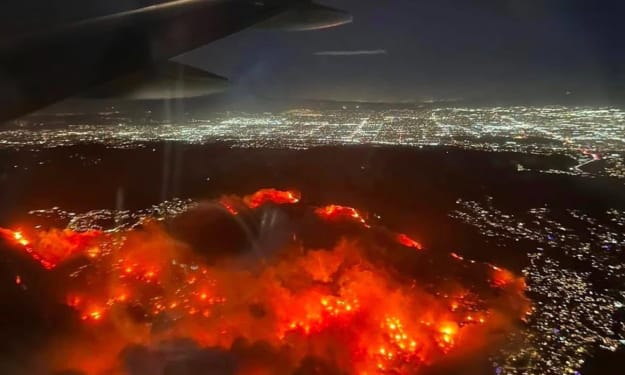
Los Angeles was choking. Smoke billowed into the sky, blotting out the sun as roaring flames consumed the city’s edges. The infamous Santa Ana winds carried embers like messengers of destruction, leaping across neighborhoods, forests, and freeways. The wildfire seemed almost alive, a beast with an insatiable hunger, turning everything it touched into ash.
By Mirhadi Tahsin2 years ago in Earth
5 countries currently experiencing the most devastating fire disasters
The air hung heavy, thick with the scent of pine needles and something else, something primal and metallic. Smoke snaked through the canyons, a serpent of grey ash, choking the life out of the vibrant green. A lone hawk circled overhead, its cries echoing the desperate whispers of the wind.
By Moharif Yulianto2 years ago in Earth
Ashes of History: Los Angeles Wildfires Claim Priceless Architectural Heritage
Los Angeles, a city renowned for its rich history and architectural splendor, now bears the scars of a fiery devastation that has reshaped its cultural landscape. As the Eaton and Palisades wildfires continue to rage, their wrath has extended far beyond homes and businesses, consuming the very fabric of the city’s heritage. At least 35 historically significant structures, many of which embodied decades or centuries of history, have been reduced to ash.
By mureed hussain2 years ago in Earth
The Blue City of Morocco: A Vibrant, Colorful Wonder You Can’t Miss
In the heart of Morocco’s Rif Mountains lies a city like no other, where every surface glimmers in shades of blue—from delicate pastels to striking cobalt. This isn’t just a place; it’s a masterpiece. Nestled in the Rif Mountains, Chefchaouen is a breathtaking blend of culture, history, and, you guessed it, every shade of blue you can imagine.
By Marveline Merab2 years ago in Earth
Why Rebuilding Will Be Challenging Amid Opportunists
When disaster strikes, it brings out the best and the worst in us. In moments of immense loss, we see incredible acts of kindness—strangers coming together, communities uniting, and people giving more than they thought they could. But alongside this compassion, there’s a darker side: opportunists who exploit these tragedies for personal gain. As California faces devastating wildfires that have uprooted lives and destroyed entire neighborhoods, the road to rebuilding will be long and fraught with obstacles. Among the most concerning challenges is the presence of companies and individuals who appear out of nowhere, promising quick fixes and easy solutions, only to profit from the desperation of those in need. The Allure of a Quick Solution In the aftermath of a disaster, emotions run high. For those who’ve lost everything, the thought of rebuilding feels overwhelming. They’re looking for hope, for guidance, for someone to tell them that it’s possible to start over. Opportunistic businesses know this and prey on that vulnerability. These companies often appear credible at first glance—offering discounted services, speedy repairs, or immediate access to essential supplies. But behind the façade of goodwill lies a profit-driven motive. They cut corners, inflate prices, or deliver subpar work, leaving victims to deal with further heartbreak down the line. Why It’s So Hard to Spot Them When we’re in crisis mode, our ability to evaluate risk and think critically can diminish. People are focused on immediate survival and recovery, not on scrutinizing contracts or vetting companies. Add to this the sheer urgency of rebuilding, and you have a perfect storm where bad actors can operate unchecked. It doesn’t help that these opportunists often present themselves as saviors. They know how to blend in, using the language of compassion and urgency to earn trust. They capitalize on the chaotic environment, where oversight and accountability may take a backseat to immediate needs. The Long-Term Impact of Exploitation The damage caused by these opportunists extends beyond the financial. For communities already grappling with loss, being taken advantage of deepens the sense of betrayal and helplessness. It can erode trust—not just in businesses but in the very systems meant to protect and support them. When unscrupulous companies flood the market, they also crowd out legitimate businesses that genuinely want to help. These trustworthy entities often struggle to compete against the aggressive marketing tactics and low prices offered by opportunists. This can delay the rebuilding process further, creating a ripple effect that impacts entire communities. How We Can Build Smarter, Not Faster Rebuilding after a disaster doesn’t just mean restoring what was lost—it’s about creating something stronger and more resilient. That requires thoughtful planning and collaboration. Ask the hard questions. Before committing to any company or contractor, take the time to research their credentials. Ask for references, review their track record, and ensure they are licensed and insured. Lean on your community. Reach out to local organizations, neighbors, and advocacy groups. Shared knowledge can be one of the most powerful tools in identifying bad actors and finding reliable resources. Support local businesses. Whenever possible, prioritize companies that are rooted in the affected community. These businesses often have a vested interest in rebuilding with care and integrity. Demand accountability. Governments and organizations must put safeguards in place to prevent exploitation. This means stricter regulations, transparent bidding processes, and accessible resources for victims. Educate yourself. Knowledge is power, and knowing the warning signs of predatory practices can protect you and those around you. Be wary of anyone who demands payment upfront, refuses to provide contracts, or offers deals that seem too good to be true. The Role of Resilience in Recovery Recovering from a disaster is not just about physical rebuilding; it’s also about emotional and psychological healing. Resilience plays a critical role here. It’s the ability to adapt, to persevere, and to find hope even in the darkest moments. Resilience is built on trust—trust in yourself, in your community, and in the process. It requires us to hold onto the belief that while challenges will come, so will solutions. And it reminds us that rebuilding isn’t a race; it’s a journey. Choosing Integrity Over Convenience The road ahead for California’s wildfire victims will not be easy, but it can be meaningful. As individuals, as communities, and as a society, we have a choice: to prioritize integrity over convenience, to focus on the long-term over the immediate. When we rebuild with care, when we hold each other accountable, and when we refuse to let opportunists define our recovery, we create a foundation that is stronger than any storm or fire. It’s a reminder that even in the face of devastation, we have the power to rise—not just for ourselves, but for each other.
By Seymour Soza2 years ago in Earth
Love in the Face of Disaster. Content Warning.
It started as a faint rumble in the sky, a low growl that sent uneasy whispers through the coastal village of Clearwater. By noon, the government issued a warning: Hurricane Lila was expected to make landfall within 24 hours. The villagers, accustomed to bracing for storms, began hurried preparations. Among them was Maya, a single mother of two, who packed essentials into a backpack with shaking hands. Her eight-year-old son, Leo, tugged at her sleeve. “Will the storm take our house, Mama?” Maya crouched to meet his eyes, forcing a reassuring smile. “It’s just a storm, baby. We’ve been through storms before.” But Maya knew this wasn’t just a storm. The news reports described Lila as “unprecedented,” with winds that could uproot lives as easily as trees. Her husband had left years ago, leaving Maya to face the world alone. This time, however, the stakes felt insurmountable. By evening, the evacuation order came. Maya loaded her children into her aging car, gripping the wheel so tightly her knuckles turned white. The evacuation route was chaotic—cars honking, families shouting, and a sense of urgency hanging in the air. At one junction, a traffic jam brought everything to a standstill. The wind had picked up, shaking the trees violently, and rain lashed against the windshield. It was then Maya noticed the figure in the rearview mirror—a man struggling to push a motorcycle through the rain. He looked like he hadn’t slept in days, his drenched clothes clinging to him. Without thinking, Maya rolled down the window. “Do you need help?” The man hesitated before nodding. “My bike’s out of gas. I just need to get to the shelter.” “Hop in,” she said, surprising even herself. The man hesitated again, glancing at her kids in the backseat, but eventually climbed in. “I’m Sam,” he said, wringing water out of his sleeves. “Maya,” she replied, keeping her eyes on the road. “And these are my kids, Leo and Sophie.” Leo, ever curious, leaned forward. “Are you a firefighter?” he asked, pointing to the badge stitched on Sam’s jacket. Sam smiled faintly. “I used to be. Now I just help where I can.” By the time they reached the shelter—a high school gym converted into a refuge—it was nearly midnight. Families huddled on cots, their faces pale with exhaustion and fear. Maya found a corner for her family and tried to settle her restless children. The night was long and sleepless. The storm howled outside, its fury rattling the building. At some point, the power went out, plunging the gym into darkness. Maya held her children close, whispering lullabies she didn’t believe in herself. Through it all, Sam stayed nearby. He helped elderly evacuees find blankets, comforted crying children, and even repaired a broken generator with tools someone had scavenged. Maya watched him in quiet awe. Despite the chaos, he moved with purpose, as though he belonged to the storm, not against it. When dawn finally broke, the storm had passed, leaving devastation in its wake. Maya ventured outside with her children, her heart sinking at the sight of flattened homes and flooded streets. Clearwater was unrecognizable. Sam approached her, his face somber. “Your house?” She shook her head, tears stinging her eyes. “I don’t even know if it’s standing.” “Let’s check,” he said. They piled into Sam’s borrowed truck and drove through the wreckage. The town was eerily quiet, save for the occasional cry of someone finding—or losing—something precious. When they reached Maya’s street, her worst fears were confirmed. Her home was gone, reduced to a pile of wood and memories. Maya stood frozen, her knees threatening to give way. “It’s just stuff,” she whispered, more to herself than anyone else. “We’re alive. That’s what matters.” But the weight of those words crushed her. She had no home, no savings, no plan for what came next. Sam placed a hand on her shoulder, his grip firm but gentle. “You’ll get through this,” he said. “You’re stronger than you think.” Over the next days and weeks, Sam became a constant in Maya’s life. He helped her navigate FEMA forms, salvaged what little they could from the wreckage, and even built a makeshift shelter in her backyard using tarps and debris. Their bond grew in the quiet moments—sharing meals at the shelter, exchanging stories about their pasts, and laughing over Leo’s endless stream of questions. Sam revealed he had lost his wife in a car accident years ago, a tragedy that had pushed him to leave firefighting and wander aimlessly, helping wherever he was needed. “I guess I needed to find a purpose again,” he admitted one evening, as they sat by a fire. “You’ve found one,” Maya said softly, her eyes meeting his. It wasn’t just the shared trauma that drew them together. It was the way Sam listened when Maya spoke about her fears, the way he treated her children with kindness, and the way he never hesitated to show up, even when it wasn’t convenient.
By Umeakunne chinemerem 2 years ago in Earth
Earth's Hidden Secrets: Unexplained Mysteries of Our Ecosystems
Earth's Hidden Secrets: Unexplained Mysteries of Our Ecosystems Earth, our home, is a fascinating and complex planet teeming with life and mystery. While science has uncovered much about our ecosystems, many secrets remain buried, leaving scientists and researchers astounded. From puzzling natural phenomena to lifeforms thriving in extreme conditions, Earth's ecosystems are a treasure trove of the unexplained. In this article, we delve into some of the most intriguing mysteries of our planet's ecosystems, offering unique insights and information that will leave you in awe. 1. The Great Silence of the Deep Sea Why Is the Deep Ocean So Quiet? The deep sea, which covers over 60% of Earth's surface, remains one of the least explored regions. Despite being a hotspot for marine life, certain areas of the ocean exhibit an eerie silence. Scientists speculate that this quietness is due to unique environmental conditions, such as low oxygen levels or minimal food availability. However, the full reasons behind this phenomenon remain elusive. Key Fact: Over 80% of the ocean is unmapped, unobserved, and unexplored, making it a prime area for uncovering Earth's hidden secrets. 2. The Bioluminescent Phenomenon How and Why Do Creatures Glow? Bioluminescence is a natural phenomenon where living organisms emit light. From fireflies in forests to deep-sea fish, this glowing ability serves various purposes, such as attracting prey, deterring predators, or communicating. However, the exact mechanisms and evolution of bioluminescence in some species remain a scientific enigma.
By Kalpesh Vasava2 years ago in Earth
Renewable Energy Supply Chains: Current Challenges and Innovations
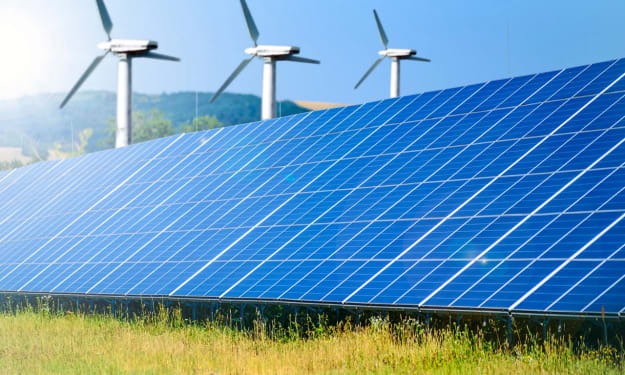
Renewable Energy Supply Chains: Current Challenges and Innovations Find the difficulties confronting environmentally friendly power supply chains and the inventive arrangements changing the business. Figure out how innovation, supportability, and productivity shape a greener future.
By Kalpesh Vasava2 years ago in Earth