Humanity
Was Earth a "Green Marble"?
When we envision Earth from space, we frequently picture the famous "Blue Marble"—a world covered primarily by the deep blue of its oceans, swirling with clouds, and lush with verdant areas. However, Earth might have had a quite different appearance long before it developed into the water-rich planet it is today. According to some scientists, Earth was originally a "Green Marble," a planet without the deep blue glimmer we associate with modern Earth, with green oceans and a thick, hazy atmosphere. A fascinating chapter of Earth's history is presented by this prehistoric incarnation of our planet, one that provides insights into early life, the environment, and even the evolution of other potentially livable worlds.
By Md Mamun Ferdousabout a year ago in Earth
SpaceX Starlink Launch 2025: 21 New Satellites Deployed to Boost Global Internet Coverage
SpaceX Starlink Launch 2025: 21 New Satellites Deployed to Boost Global Internet Coverage In a significant stride toward global internet coverage SpaceX successfully launched 21 Starlink satellites into low Earth orbit (LEO) on March 12 2025. The mission conducted from Cape Canaveral Space Force Station in Florida marked yet another milestone in the company’s ambitious plan to build a vast satellite internet network. The launch designated Starlink Group 12-21 took place at 10:35 p.m. EDT aboard a Falcon 9 rocket. As has become routine for SpaceX the first stage of the Falcon 9 was successfully recovered landing on the droneship A Shortfall of Gravitas stationed in the Atlantic Ocean. This was the 22nd flight for this particular booster showcasing SpaceX’s commitment to reusability and cost-effective space travel. The 21 satellites included 13 equipped with direct to cell capabilities a groundbreaking technology that allows the satellites to communicate directly with standard mobile devices. This advancement could eliminate the need for traditional cell towers in remote areas bringing reliable mobile coverage to places previously considered unreachable. Starlink is SpaceX’s satellite internet constellation project designed to provide high speed low latency broadband internet to underserved and remote regions around the world. Since its initial launches in 2019 the program has seen rapid growth. With this latest deployment SpaceX has now launched more than 8,100 Starlink satellites of which over 7,000 are currently operational. A theses satellites orbit the Earth at altitudes ranging from 340 km to 1,200 km significantly lower than traditional communication satellites. This lower altitude reduces latency and allows for faster data transmission key benefits for internet users particularly those in rural areas with limited infrastructure.
By Adnan Rasheedabout a year ago in Earth
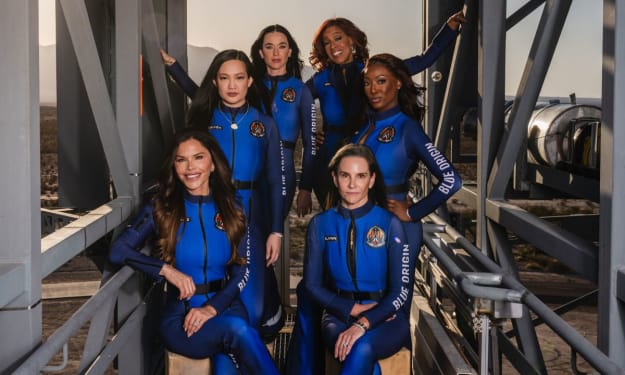
Katy Perry, Gayle King and 4 other women are headed for the ‘edge of space.’ Here’s what that means
A group of well-known women, including pop star Katy Perry and media icon Gayle King, are getting ready for an extraordinary journey to the "edge of space." This mission, organized by Virgin Galactic, is part of an initiative to promote diversity in space travel and inspire future generations of female explorers. However, what exactly is involved in traveling to the "edge of space"? Here’s a breakdown of what these women will experience—and why this mission is so groundbreaking. 1. What Is the ‘Edge of Space’? Virgin Galactic flights, in contrast to SpaceX and NASA's traditional orbital spaceflights, reach the "edge of space," or about 50-55 miles (80-88 kilometers) above Earth. Not quite orbit: This is below the Kármán line (62 miles/100 km), the internationally recognized boundary of space, but high enough to experience weightlessness and see the curvature of the Earth. Suborbital flight: The Virgin Galactic VSS Unity spacecraft ascends to its highest point and glides back down, providing a brief state of weightlessness. 2. Who Will Go? The mission, called "Galactic 07," will feature an all-women crew, including: Superstar and singer Katy Perry Gayle King, co-host of CBS Mornings Two astronauts (likely Virgin Galactic crew members) Two undisclosed passengers (possibly scientists or philanthropists) This flight highlights the growing role of private space tourism and efforts to make space more accessible to women. 3. What Will They Experience? A smooth ascent: The spacecraft is carried by a mothership (VMS Eve) before rocket ignition propels it upward. Stunning views: Passengers will see the blackness of space and Earth’s thin blue atmosphere. Weightlessness: For about 3-4 minutes, they’ll float freely inside the cabin. G-forces on re-entry: A brief but intense sensation as the craft descends. 4. What is the significance of this mission? Diversity in space: Despite this mission's efforts to change the narrative, women are still underrepresented in space flight. Influence from celebrities: Well-known people like Perry and King can get more people interested in space exploration. The future of space tourism: As costs fall, more civilians may be able to see space. Last Thoughts While this isn’t a deep-space mission, flying to the edge of space is still a once-in-a-lifetime experience—one that could pave the way for more inclusive and accessible space travel. If you had the chance, would you travel to the edge of space?
By Easin Munnaabout a year ago in Earth
The Little Guardians
A majestic banyan tree stood in a quiet village between emerald-green hills and a clear river. It was so old that it had grown and died over generations and was so wide that it could shade a house. Its tangled roots spread far across the ground like a web of ancient secrets, and its leaves whispered softly to the wind, sharing stories of the past with those willing to listen.
By Abu Rayhan Rupokabout a year ago in Earth
NASA next big Project
The Earth System Observatory of NASA Keeps an Eye on Our Changing Planet As climate change accelerates and natural disasters grow more frequent, the need for accurate, real-time data about our planet has never been more critical. In response to this growing demand, NASA has launched the Earth System Observatory, a bold and comprehensive initiative that aims to revolutionize the way we observe and understand Earth’s interconnected systems.
By Supriya Patra about a year ago in Earth
The Future of Technology
As we stand on the brink of a new era, the rapid advancement of technology promises to transform nearly every aspect of our lives. From artificial intelligence and quantum computing to biotechnology and renewable energy, the innovations on the horizon are set to revolutionize industries, reshape economies, and redefine human existence. Here’s a glimpse into some of the most promising future technologies that could change the world.
By Gus Woltmannabout a year ago in Earth