Climate
Urban Gardening – A Path to Sustainable Food Systems in Cities
Delivered by [Asim] Good morning, Distinguished guests, colleagues, and fellow citizens, Thank you for the opportunity to speak with you today about an issue that is both deeply practical and profoundly transformative: urban gardening—a grassroots solution with the potential to reshape our cities, strengthen our communities, and build more sustainable food systems for future generations.
By Asim Mehmoodabout a year ago in Earth
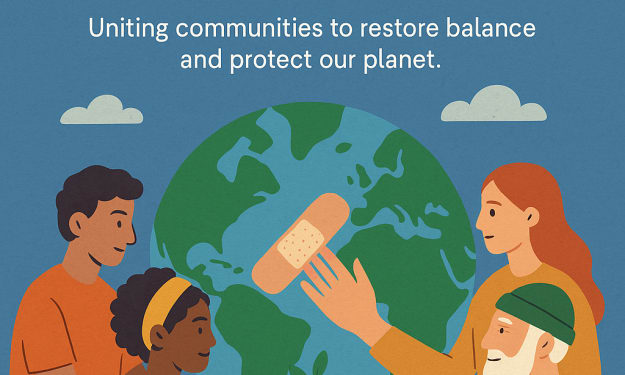
"Together We Heal the Earth"
In an era marked by environmental crises and climate uncertainty, one truth becomes increasingly clear: healing the Earth is not a task for a few, but a mission for all. The Earth is our shared home, and its well-being directly affects our survival and the quality of life for future generations. To bring about real change, communities around the globe must come together with a unified purpose — to protect, restore, and sustain the natural world.
By Mukhtiar Ahmadabout a year ago in Earth
Inferno in the West: Uncovering the True Cause of the California Fires
The sun had barely risen over the Sierra Nevada mountains when the first plume of smoke curled into the golden sky. At first, it was mistaken for morning mist by hikers in the Tahoe National Forest, but by midday, the entire western horizon was choked in a thick, menacing gray. California was burning again. This fire, later dubbed the Shadow Ridge Inferno, would go on to consume over 400,000 acres of forest, farmland, and neighborhoods. The damage was unprecedented, but what shocked investigators and the world even more was what lay behind the blaze—an intricate mix of nature's fury, human negligence, and the undeniable fingerprints of climate change. In the small mountain town of Evergreen Pines, where the fire had started, residents had long ignored the state’s warnings about clearing brush and dry undergrowth. “It was just too much work,” admitted Ray Delgado, a 72-year-old resident who had lived there since the 1960s. “We always thought, ‘It’s never going to come this far.’” But that year had been different. California had experienced its driest winter in recorded history. Rainfall was nearly nonexistent, and snowpack in the Sierra Nevada was less than 20% of normal. By mid-summer, the forests were tinderboxes. Trees stood dead from bark beetle infestations—pests that had flourished as winters became too warm to kill them off. Dry lightning storms, once a rare occurrence, were now a seasonal norm. All it took was one spark. And the spark came. A small electrical transformer, poorly maintained and decades outdated, failed near a ravine just outside Evergreen Pines. The utility company, Western Electric Grid Inc., had deferred maintenance for years. Despite multiple warnings from safety inspectors, no upgrades had been made to their aging equipment. When the transformer exploded, the dry grass below it ignited instantly, and winds gusting at 40 miles per hour did the rest. Within hours, flames leaped from tree to tree, devouring the forest in a roar that resembled a freight train. Firefighters were deployed, but their efforts were hampered by the terrain, lack of resources, and the sheer speed of the fire’s advance. “We had minutes to evacuate,” said Maya Hernandez, who lost her home that night. “The fire was moving like it had a mind of its own.” But it wasn’t just a local disaster—it was a wake-up call. Satellite imagery showed a frightening pattern: wildfires had increased threefold across the Western United States in the last two decades. Research by climatologist Dr. Ellen Park revealed that the fire season was now two months longer than it had been in the 1970s. “This isn’t just bad luck or one dry year,” she said during a press conference. “This is what climate change looks like. Hotter temperatures. Drier air. Unpredictable wind patterns. More lightning. More fire.” While nature had provided the perfect storm, the role of human neglect was equally damning. In the months following the fire, a grand jury investigation revealed that Western Electric Grid Inc. had not inspected their rural infrastructure in over five years. The company’s CEO resigned amid mounting lawsuits and public outrage. Worse yet, forest management policies had long been inadequate. Controlled burns, which could have reduced the fuel load in the forest, had been delayed or canceled due to budget cuts and local opposition. “We thought we were protecting nature by not interfering,” said one local council member. “But in the end, we made it worse.” The aftermath of the Shadow Ridge Inferno left communities shattered. Over 2,500 structures were lost, 37 people died, and thousands were displaced. Wildlife habitats were decimated. The sky stayed orange for weeks, and the air was thick with ash across cities like Sacramento and San Francisco. But amid the tragedy, something changed. The fire became a catalyst for reform. California passed the Wildfire Accountability and Prevention Act, mandating infrastructure updates, expanding funding for forest thinning and controlled burns, and implementing stronger regulations on power companies. Communities were given grants to create “defensible spaces” around homes, and climate education became part of public school curricula. And perhaps most importantly, people began to see the connections. Climate change was no longer an abstract idea. It was burning in their backyards. Back in Evergreen Pines, the forest slowly began to recover. Saplings sprouted in the blackened soil. Wildlife returned. And Maya Hernandez, now a volunteer firefighter, led weekly fire-preparedness workshops for her community. “We can’t undo what happened,” she said, “but we can make sure we’re never this unprepared again.” The inferno in the west was a tragedy born of heat, hubris, and hesitation—but it became a turning point. The true cause of the fires had been uncovered. Now, it was up to everyone to ensure it didn’t happen again.
By Mati Henry about a year ago in Earth
Cooling the Earth: The Fight to Stop Global Warming
The Earth once thrived in perfect harmony—its forests thick with green, oceans rich with life, and skies painted in hues of peace. For thousands of years, the planet balanced itself, shifting slowly through ice ages and warm spells. But in the blink of a century, everything began to change. It started with smoke. Factories rose during the Industrial Revolution, burning coal, oil, and gas to power a booming world. Black smoke curled into the sky. Cities grew. Cars filled roads. Planes filled skies. And with every breath of progress, the Earth’s atmosphere filled with carbon dioxide—a silent gas with dangerous power. Scientists were the first to notice. In the 1950s, Charles Keeling recorded rising CO₂ levels from a Hawaiian volcano. His graph, later called the Keeling Curve, showed a steady climb—and it hasn’t stopped since. By the year 2025, Earth was in crisis. Glaciers melted. Oceans rose. Coral reefs turned ghostly white. Wildfires raged in places that had never burned before. Storms grew stronger. Droughts deeper. The climate was changing faster than anyone had predicted. Amid the chaos, a young girl in Nairobi named Aisha Mburu stood under a dying baobab tree. Once strong and proud, it now bore brown, brittle leaves. Her village had not seen rain in months. Crops failed. Water wells dried. People spoke of moving north—of becoming climate refugees. Aisha, only 14, refused to accept this fate. “Why can’t we stop this?” she asked her father, a schoolteacher. “We can,” he said softly. “But the world must act together.” That night, under starlight, Aisha began her journey. She wrote letters. She recorded videos. She told the story of her drying land, of her friends who walked miles for water, of the baobab trees that once gave shelter to elephants and birds. Her message spread across Africa, then Europe, then the world. Meanwhile, in New York City, Dr. Theo Morales, a climate scientist, was working on something revolutionary. He had spent decades studying carbon capture—machines that could suck CO₂ from the air and lock it safely underground. His lab had created a prototype, but governments were slow to invest. “Too expensive,” they said. “Too complicated.” That changed when Aisha’s video reached his desk. He watched her speak, saw her dry village, and felt the fire return to his heart. He reached out, and together, Aisha and Dr. Morales launched Project Earthrise—a global campaign to unite scientists, activists, and everyday citizens. The world responded. From Tokyo to Toronto, people marched. Students planted trees. Engineers developed solar panels that worked even in rain. Cities banned diesel cars. Massive wind farms appeared off coastlines. In Iceland, carbon capture plants scaled up, pulling thousands of tons of CO₂ from the sky. In the Amazon, indigenous leaders reclaimed forests from illegal loggers. Nations formed climate alliances, pledging to reach net zero emissions by 2050. It wasn’t easy. Oil companies resisted. Fake news spread. Some world leaders denied the problem altogether. But the voices of youth, science, and truth grew louder. Aisha was invited to the United Nations Climate Summit in Geneva, where she stood before the world and spoke: "My village cannot wait. Your cities cannot wait. The Earth cannot wait. You do not inherit the planet from your ancestors—you borrow it from your children. Return it better than you found it." Her words echoed through chambers of power. For the first time in decades, climate funding tripled. Renewable energy surpassed fossil fuels. Education campaigns taught millions about recycling, conserving, and rebuilding ecosystems. By 2035, something incredible happened—the Keeling Curve leveled off. Then it dropped. Rain returned to Aisha’s village. The baobab tree bloomed again. Polar ice began to stabilize. Coral reefs showed signs of life. Earth was healing. But no one claimed victory. They knew the fight would never be over. The climate, like a child, needed constant care. It was not about saving the world in a day—but about saving it every day. As the sun rose over the savannas, the cities, the glaciers, and the forests, one truth became clear: When the world united, it could cool the Earth—not just with technology, but with hope, determination, and love for the generations still to come. And that single spark, lit by a girl under a dying tree, had ignited a movement that would never burn out.
By Mati Henry about a year ago in Earth
Echoes Beneath the Waves: The Mystery of the Titanic
The sea was calm on the night of April 14, 1912. The sky, a blanket of stars, watched over the RMS Titanic as it cut through the icy waters of the North Atlantic. Dubbed “The Unsinkable Ship,” she was a floating palace—boasting luxury, innovation, and grandeur the world had never seen before. But beneath her glowing decks and elegant ballrooms lurked a secret, one that would vanish with her into the ocean’s cold embrace. Over a century later, in the year 2025, deep-sea archaeologist Dr. Elara Hayes stood aboard the research vessel Ocean Whisper, staring at a monitor displaying sonar scans of the Titanic’s wreck site. She had spent a decade studying the Titanic, but this mission was different. Recently uncovered naval logs from 1912 hinted at a mystery beyond the well-known iceberg collision—an unauthorized cargo crate loaded at midnight in Belfast, marked only with the symbol of an ancient compass rose. “Ready to descend,” her voice crackled over the headset as the submersible Abyss Explorer prepared to dive. The ocean swallowed the craft as Elara and her small team descended through miles of pressure-crushing darkness. At 12,500 feet below sea level, the wreck appeared—massive and ghostly, covered in rusticles, resting silently on the seabed. But this time, their eyes weren’t on the grand staircase or the broken bow. They searched the lower cargo hold, a part of the ship rarely explored due to its instability. “There,” Elara whispered, pointing at a warped metal door barely hanging on its hinges. They maneuvered through, beams of light piercing through silt-filled water. Inside, half-buried beneath crates and debris, was what they came for: a rusted, sealed container with the same compass rose symbol. Using robotic arms, they carefully cut through the lock and pried it open. Inside were stacks of documents wrapped in oilcloth, a peculiar glass orb, and a small leather-bound journal. Elara’s hands trembled as she retrieved it. Back aboard the Ocean Whisper, the team gathered around the journal. Its pages, remarkably preserved, were written in a mix of English and an older script—Aramaic. The author identified himself as Dr. Thomas R. Cavendish, a British antiquarian who had boarded the Titanic in secret under the name “Mr. Gray.” His journal revealed a chilling truth: the Titanic was not only carrying passengers and mail—but also a relic believed to be linked to an ancient civilization predating even Mesopotamia. According to Cavendish, the orb was discovered in a collapsed temple in northern Egypt—rumored to grant visions of the future. Its power had driven men to madness. Fearing it would fall into the wrong hands, Cavendish arranged its transport aboard the Titanic, believing the ship’s secrecy and speed would protect it. But he also feared the orb's curse—one he claimed had already begun affecting the crew through hallucinations and erratic behavior. The journal ended abruptly, with the final words: "The sea calls it home. May none ever awaken what sleeps within." Elara’s breath caught. The orb was still on board. Scientists on her team conducted scans—inside the orb were crystalized fragments emitting low-frequency vibrations. The patterns were not natural. They resembled coded messages. One researcher, Dr. Singh, cracked a segment and gasped. “It’s a warning… and a map.” The coordinates pointed to an underwater trench, hundreds of miles from the Titanic. Could there be more relics? Was the Titanic just the beginning of a larger cover-up? News of the discovery leaked. The world reeled. Governments demanded access, private collectors offered billions, and conspiracy theorists shouted of curses and lost civilizations. But Elara had made her decision. She returned the orb to the wreck, placing it gently where it had been found. “Some mysteries,” she said, “aren’t meant to be solved—only remembered.” As they ascended, a storm brewed above. Thunder cracked, waves crashed, but the sea below remained still, as if satisfied. The Titanic had given up one of its secrets, but many more still slept beneath the waves. Back on land, Elara published her findings—not all of them, just enough to honor the past without disturbing it further. The world now knew that the Titanic's story was more than a tragedy—it was a warning, a whisper from the deep. Because the ocean remembers. And sometimes, it speaks.
By Mati Henry about a year ago in Earth
"I Quit My Job to Travel the World — Here's What No One Tells You"
For years, I watched YouTubers and Instagram influencers pack up their lives into 40-liter backpacks and chase sunsets across the globe. “Quit your 9-to-5,” they said. “Live your dream.” So one day, after a particularly soul-crushing meeting where my ideas were ignored yet again, I did exactly that. I handed in my resignation, sold most of my belongings, bought a one-way ticket to Thailand, and posted the obligatory “New Chapter” photo with my passport and latte. My DMs flooded with messages: You’re so brave! I wish I could do that! Living the dream! At first, it felt like I was. The Honeymoon Phase My first few weeks were magical. I island-hopped across Thailand, lived in a treehouse in Bali, and met people from every corner of the world. My days were filled with jungle hikes, coconut smoothies, and sunset yoga. I was finally “free.” No deadlines. No commutes. Just me, my backpack, and the world. I remember thinking, Why didn’t I do this sooner? But Then Reality Hit It started small. A delayed flight here. A stolen phone there. Then came the loneliness. Making friends was easy, but keeping them wasn’t. Everyone was on their own journey, constantly moving, constantly leaving. I’d connect with someone over street food one night, and the next morning they’d be gone—on a bus to another city or a flight to another country. Then came the money stress. I had savings, sure. But they went faster than I expected. Travel wasn’t always cheap, especially when you factored in flights, accommodation, insurance, and the occasional medical emergency (hello, Bali belly). I tried to freelance, but working from different time zones with weak Wi-Fi in humid hostels wasn’t exactly the productivity dream I imagined. You Don’t Escape Yourself One of the biggest myths about quitting your job to travel is that you’ll somehow “find yourself.” But what they don’t tell you is that your problems follow you. In fact, they echo louder when the distractions of daily life are stripped away. Alone on a beach in the Philippines, I realized I was still anxious. Still doubting myself. Still chasing external validation, only now in the form of likes on travel photos. There were nights I cried in hostel beds, missing my friends, my family, my old routine—even my old coffee mug. I felt guilty for not feeling grateful all the time. After all, wasn’t this the dream? Not All Days Are Instagram-Worthy Social media doesn’t show the overnight buses, the language barriers, the food poisoning, or the fear of getting scammed in unfamiliar places. It doesn’t show you panicking when your card gets declined in a country where no one speaks English. Or trying to sleep in a 12-person dorm with someone snoring like a chainsaw. And it certainly doesn’t show the identity crisis that comes when you’re no longer “the marketing manager” or “the reliable friend,” but just another backpacker trying to figure it all out. But It Was Worth It Despite all of this—maybe even because of all of this—I don’t regret it. Traveling stripped away the noise. It forced me to confront who I really was, outside of titles and routines. I learned resilience. How to be okay with being uncomfortable. How to ask for help. How to be alone without being lonely. I discovered that joy isn’t just in the big, dramatic moments, but in tiny ones too—watching monks feed stray dogs at sunrise, or learning how to say “thank you” in five different languages just to see someone smile. And eventually, I found balance. I settled into a slower pace, choosing fewer countries and longer stays. I found a rhythm of working online, budgeting better, and building deeper connections. I stopped chasing the next “epic experience” and started appreciating the stillness. What No One Tells You Quitting your job to travel the world won’t solve your problems. It won’t instantly make you happy or confident or whole. What it will do is challenge you, break you, and—if you let it—transform you. It’s not a fairytale. It’s not always beautiful. But it’s real. And in a world full of filters and false perfection, real is rare. So if you’re thinking about taking the leap, know this: It’s okay to feel scared. It’s okay to miss home. It’s okay if the journey doesn’t look like what you expected. Because sometimes, the best chapters in life are the ones that aren’t planned. And sometimes, freedom isn’t found in where you go—but in finally learning who you are when no one else is watching.
By Nizam khanabout a year ago in Earth
Scientists detect signature of life on a distant planet
In a groundbreaking discovery that would redefine humanitys knowledge of the universe, scientists have detected what seems to be the signature of existence on a far off exoplanet. Using current area telescopes and spectrometry techniques, a group of global researchers found atmospheric markers that strongly endorse the presence of organic activity.
By Prottasha Alamabout a year ago in Earth
Top 50 Must-Visit Destinations in Europe: A Journey Through History, Culture, and Natural Beauty
Seven of the top ten most visited countries are European, thanks to the continent's rich cultural heritage, historical landmarks, safety, and efficient infrastructure. Embark on a journey through the top 50 destinations that showcase Europe's diverse allure.
By Sharmin Smrityabout a year ago in Earth
The Sanda Lizard: Ecology, Culture, and Conservation in South Asia
The Sanda Lizard: Ecology, Culture, and Conservation in South Asia The sanda lizard, scientifically known as Saara hardwickii or Hardwicke’s spiny-tailed lizard, is a remarkable herbivorous reptile native to the arid landscapes of South Asia, particularly the Thar Desert, Kutch, and parts of Pakistan’s Sindh region. Locally called "sanda" or "sandho" in Bangladesh, India, and Pakistan, this burrow-dwelling creature has captured attention not only for its unique biology but also for its cultural, culinary, and medicinal significance. In recent years, the sanda has surged into the spotlight in Bangladesh due to viral social media trends, with memes and videos highlighting its consumption, particularly among expatriate workers in the Middle East. However, the species faces significant threats from poaching, illegal trade, and habitat loss, exacerbated by modernization and agricultural expansion. This article delves into the sanda lizard’s ecology, its role in South Asian culture, its consumption and trade dynamics, conservation challenges, and the broader regional context, including the impact of the India-Pakistan ceasefire of May 10, 2025, on trade routes that affect sanda-related markets.
By MD EMRUL KAYESabout a year ago in Earth