Climate
Story of Planet Earth After Dinosaurs. AI-Generated.
Introduction Around 66 million years ago, the Earth experienced one of its most dramatic moments — the mass extinction that wiped out the dinosaurs. However, that was not the end of our planet's narrative. In fact, it was just the beginning of a whole new chapter — a chapter that shaped the world as we know it today. In this article, we’ll dive into the fascinating story of Earth after the dinosaurs, exploring how life bounced back, how continents shifted, and how the planet transformed into a place that eventually supported us humans.
By Rayyan Writesabout a year ago in Earth
The Deepest Hole on Earth: A Journey into the Heart of Our Planet
How Deep Have Humans Drilled Into the Earth? When we look up at the night sky, we often marvel at how far humans have gone—reaching the Moon, sending probes to Mars, and even exploring the outer planets. But have you ever wondered how far we've gone downward, into our own planet? Surprisingly, despite all our technological advancements, our deepest journey into the Earth barely scratches the surface compared to its total depth. The deepest man-made hole on Earth is known as the Kola Superdeep Borehole, located in the Kola Peninsula in northwest Russia, near the border with Norway. This remarkable scientific project began in the early 1970s, and over nearly two decades of intense drilling, researchers managed to reach a depth of 12,262 meters, or about 7.6 miles below the Earth's surface. Not a Hunt for Gold or Oil Unlike many deep drilling operations that aim to extract oil, gas, or precious minerals, the purpose of the Kola Superdeep Borehole was purely scientific. The Soviet Union initiated this ambitious project as part of its efforts during the Cold War era to gain a deeper understanding of Earth's interior layers. They weren’t looking for gold or silver; they were looking for answers to the mysteries hidden beneath our feet. The scientists wanted to explore the Earth's crust, study the transition between different layers of rock, understand tectonic activity, and examine the history of the Earth as preserved in the rocks. What they found was far beyond what they had imagined. Discoveries from the Depths During the course of the drilling, researchers encountered rocks that were over 2.7 billion years old, revealing some of the oldest geological materials ever studied. These rocks told stories of ancient environments and long-extinct ecosystems. Among the most fascinating discoveries were microfossils—the tiny remains of single-celled organisms—trapped in rock formations several kilometers below the surface. These microfossils were estimated to be billions of years old, indicating that life on Earth has existed in microscopic forms far deeper—and longer—than previously thought. Another surprise was the unexpectedly high temperature encountered at the deepest levels. Scientists had anticipated rising temperatures, but what they found exceeded all predictions. At the deepest point, the temperature reached 180 degrees Celsius (356°F), making further drilling technically impossible with the equipment of that time. The rocks became more plastic and less stable, behaving more like soft clay than hard stone, which made continued drilling dangerous and impractical. The Myth of the "Well to Hell" In the 1990s, as news about the Kola Borehole spread, the project became the subject of urban legends and internet myths. One particularly eerie tale claimed that as scientists reached the deepest layers, they heard screams of human-like voices coming from the depths—leading to sensational headlines calling it the “Well to Hell.” A supposed audio recording circulated online, adding to the chilling effect. According to the myth, scientists fled in fear after lowering a microphone into the borehole and hearing tortured screams. The hole was then allegedly sealed. While the story spread widely, especially in tabloids and paranormal communities, it was eventually debunked. The audio was traced back to a fabricated sound effect from a horror movie, and there was no scientific evidence to support any of the claims. This incident reminds us how mystery and fear often accompany our attempts to explore the unknown, especially when dealing with parts of the Earth we rarely access. What the Kola Borehole Teaches Us The Kola Superdeep Borehole is not just a forgotten Soviet science experiment; it is a monument to human curiosity and determination. It reminds us that while we’ve sent astronauts into space and robots to Mars, we still struggle to penetrate even a fraction of the Earth's total depth. To put it in perspective, the Earth's radius is about 6,371 kilometers (nearly 4,000 miles), but the deepest we've ever drilled is just 12.2 kilometers (7.6 miles)—less than 0.2% of the way to the center of the Earth. It's like barely scratching the skin of an apple when trying to reach its core. The borehole also demonstrated the technical and physical limitations of deep-earth exploration. As depth increases, so does pressure and temperature, making it increasingly difficult to design machines that can survive and operate in such extreme conditions. Why It Still Matters Though the Kola Borehole project was officially abandoned in the early 2000s, its legacy lives on. The knowledge gained from the project is still used in geology, seismology, and even in the search for new energy sources. It helped scientists better understand plate tectonics, the formation of continents, and the thermal dynamics of Earth's crust. In the modern era, countries like Germany, Japan, and the United States have initiated their own deep-drilling projects, often targeting ocean floors where the crust is thinner. These efforts aim to eventually drill into the mantle, the layer beneath the crust, something that no one has ever achieved before. Conclusion: We’ve Been to the Moon, But Not to Earth’s Core The Kola Superdeep Borehole stands as a symbol of both human achievement and our limits. It reflects our desire to understand the planet we call home and the challenges we face in doing so. It’s humbling to realize that while we can observe galaxies millions of light-years away, we still know so little about what lies beneath our own feet. One day, perhaps with more advanced technology, we might finally reach deeper into the Earth. Until then, the journey to the center of the Earth remains more a dream of science fiction than of science fact.
By Ikram Ullahabout a year ago in Earth
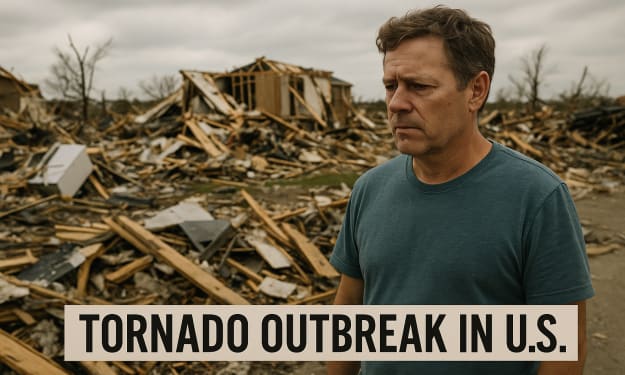
Tornado Outbreak in the U.S.: Nature’s Wrath Unleashed. AI-Generated.
On May 15 and 16, 2025, the American Midwest and Southeast witnessed one of the most violent and widespread tornado outbreaks in recent history. A staggering 55 tornadoes ripped through multiple states, leaving behind a trail of destruction, death, and despair. With 27 confirmed fatalities and damages exceeding $1.2 billion, this two-day catastrophe underscores the growing unpredictability of extreme weather events in the era of climate change.
By Ahmet Kıvanç Demirkıranabout a year ago in Earth
How earth was born form then air
How Earth Was Born and How Air Formed The story of Earth’s birth and the formation of its atmosphere is one of the most fascinating tales in the history of the universe. Over 4.5 billion years ago, in the vast emptiness of space, a spectacular sequence of cosmic events led to the formation of the planet we call home. Let’s explore how Earth was born and how the life-giving air we breathe came to exist. The Birth of Earth Around 4.6 billion years ago, our solar system began as a giant cloud of gas and dust, known as a solar nebula. Triggered by the shock wave from a nearby supernova, the nebula collapsed under its own gravity. As it spun faster, most of the material gathered in the center to form the Sun. The remaining gas and dust flattened into a rotating disk, where particles began to stick together, forming larger and larger bodies. Through a process called accretion, these particles collided and merged to form planetesimals—early building blocks of planets. Over millions of years, some planetesimals grew large enough to become protoplanets, including the early Earth. This early Earth was a hot, molten sphere, constantly bombarded by other space debris, including a Mars-sized body that likely caused the formation of the Moon. As Earth cooled, it began to differentiate into layers. Heavier elements like iron sank to the center to form the core, while lighter materials rose to form the mantle and crust. But Earth was still a harsh, lifeless place—with no air, no oceans, and extreme volcanic activity. The Formation of Earth’s Atmosphere The early atmosphere didn’t come from the outside—it was created from within. This first atmosphere was likely formed by a process called volcanic outgassing. As Earth’s interior remained hot, volcanoes released gases trapped in the planet’s crust. These gases included water vapor (H₂O), carbon dioxide (CO₂), ammonia (NH₃), methane (CH₄), nitrogen (N₂), and small amounts of hydrogen (H₂) and other compounds. This early atmosphere was very different from what we know today. There was no oxygen, so it couldn't support human life. It was a thick, toxic mix of gases. However, this was a crucial step in preparing Earth for the development of life. The Role of Water and Oceans As water vapor in the atmosphere cooled, it condensed and fell as rain—possibly for thousands of years. This created Earth’s first oceans. These vast bodies of water played a key role in shaping the planet’s surface and in the formation of the next vital component: oxygen. Water also helped in dissolving carbon dioxide, which reduced its concentration in the atmosphere and made conditions more stable. The oceans became home to the earliest life forms: simple, microscopic organisms like bacteria and archaea. The Great Oxygenation Event One of the most important changes in Earth's atmosphere happened about 2.5 billion years ago. Cyanobacteria, a type of photosynthetic microbe, began using sunlight to convert carbon dioxide and water into glucose and oxygen through photosynthesis. At first, this oxygen reacted with iron in the oceans, forming iron oxide that settled on the seafloor. But over time, as more oxygen was released, it began to accumulate in the atmosphere. This was known as the Great Oxygenation Event. This dramatic rise in oxygen transformed Earth. It wiped out many of the anaerobic (non-oxygen-using) organisms but made way for new forms of life that could use oxygen for energy. It also led to the formation of the ozone layer, which protected the planet from harmful ultraviolet (UV) rays, allowing life to expand onto land. The Air We Breathe Today Today’s atmosphere is composed of about 78% nitrogen, 21% oxygen, and trace amounts of argon, carbon dioxide, and other gases. This stable mixture supports complex life forms, including humans. The balance of gases is maintained through natural cycles: plants produce oxygen and absorb carbon dioxide, animals do the opposite, and oceans and forests act as carbon sinks. However, human activities such as burning fossil fuels have begun to disturb this balance, leading to climate change and air pollution—an urgent reminder of how precious our atmosphere truly is. Conclusion From fiery beginnings and violent collisions to the gentle rise of oxygen-producing microbes, Earth’s journey to becoming a blue planet with breathable air is a story of transformation, resilience, and balance. Understanding how Earth and its atmosphere formed not only connects us to our cosmic roots but also reminds us of our responsibility to protect the air and environment that sustain us today.
By Shah saab ITabout a year ago in Earth
The Deepest Places on Earth: Exploring the Mariana Trench
The Deepest Places on Earth: Exploring the Mariana Trench Beneath the vast expanse of the Pacific Ocean lies a chasm so deep and enigmatic that it challenges our understanding of Earth's final frontiers. The Mariana Trench, stretching over 2,550 kilometres (1,580 miles) in length and plunging to depths exceeding 10,900 metres (35,800 feet), is the deepest known part of the world's oceans . This crescent-shaped trench, located about 200 kilometres (124 miles) east of the Mariana Islands, represents not just a geographical marvel but a realm of scientific intrigue and discovery .
By Jeno Treshan about a year ago in Earth
How Rocks Can Make Traveling More Risky for Lightning
Few people think about the hidden danger that rocks pose during thunderstorms when they are planning a journey to the mountains, rocky cliffs, or wide plateaus. Most people pack for weather, terrain, and supplies. When the sky darkens and thunder roars in the distance, rocks may appear to be a safe haven, but under some circumstances, they can actually make lightning strikes more dangerous. Making safer decisions when going on outdoor adventures can be facilitated by knowing how and why this occurs.
By mohima mostarinabout a year ago in Earth
"Biodiversity: The Beauty of Life on Earth and Our Shared Responsibility"
Introduction Earth is home to an estimated 8.7 million species, yet human activity drives approximately 150 of them to extinction daily. This staggering loss isn’t just a statistic—it’s an unraveling of the intricate web of life that sustains us all. Biodiversity, the dazzling variety of life on our planet, is both a masterpiece of evolution and a lifeline for humanity. From the depths of coral reefs to the canopies of rainforests, every species plays a role in Earth’s grand symphony. This article explores the irreplaceable beauty of biodiversity, the existential threats it faces, and the collective action needed to safeguard our shared home.
By Shamshair Khan Hasan Zaiabout a year ago in Earth