Climate
Ancient Supercontinents
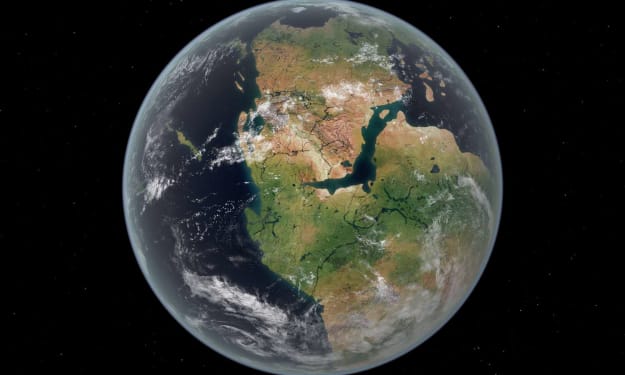
Ancient Supercontinents: The Story of Pangaea and Its Breakup Have you ever looked at a world map and thought that some continents look like they could fit together like puzzle pieces? You’re not alone! Scientists noticed the same thing, and it helped them discover something amazing: the Earth’s continents haven’t always been where they are now. In fact, millions of years ago, all the continents were joined together in one giant landmass called Pangaea. This is the story of Pangaea, how it formed, why it broke apart, and how it changed our planet forever.
By Jeno Treshan about a year ago in Earth
This West Coast earthquake fault's most hazardous section has been named one of the planet's greatest threats.
Imagine two huge pieces of the Earth's outer shell puzzle slowly pushing against each other under the ocean. One piece slides under the other - this is called the subduction zone, and the Cascadia subduction zone is one of the most dangerous regions on the planet.
By Francis Damiabout a year ago in Earth
The World's Largest Sinkhole: A Breathtaking Natural Phenomenon
Located in China's Chongqing Municipality, Xiaozhai Tiankeng is a remarkable example of a natural phenomenon. This massive sinkhole is not only a breathtaking sight but also a significant geological formation that attracts visitors and scientists alike. The Xiaozhai Tiankeng sinkhole is characterized by its enormous size and unique features, making it a fascinating subject for exploration. As a natural wonder, it offers insights into the Earth's geological processes. Key Takeaways Xiaozhai Tiankeng is recognized as the world's largest sinkhole. It is located in China's Chongqing Municipality. This natural phenomenon is a significant geological formation. The sinkhole attracts both tourists and scientists due to its unique features. Xiaozhai Tiankeng offers insights into the Earth's geological processes. The Mysterious World of Sinkholes Sinkholes are a geological wonder that can occur almost anywhere, often with dramatic consequences. These natural depressions or holes in the ground have fascinated humans for centuries, and their formation is a complex process involving various geological factors. What Exactly Is a Sinkhole? A sinkhole is essentially a depression or hole in the ground that forms when a layer of soil or rock is removed or collapses. This can happen for a variety of reasons, including natural processes like erosion or human activities such as mining. Sinkholes can vary greatly in size, from small, barely noticeable depressions to massive craters that can swallow buildings and roads.
By Tech Horizonsabout a year ago in Earth
More carbon is currently being released by some woods than they are storing.
Forests have long stood as symbols of hope in weather. Towering pines, lush rainforests, and dense boreal woodlands are regarded to maintain a solution to our growing emissions. Their leaves breathed in carbon dioxide. Their roots locked carbon within the soil. Their presence presented consolation in a warming world.
By Francis Damiabout a year ago in Earth
The Sun: The Life-Giving Star of Our Solar System
Details About the Sun The Sun is the most essential and powerful star in our solar system. It is the primary source of light, heat, and energy for the Earth and all other planets. Without the Sun, life as we know it could not exist. From providing energy to driving weather patterns and enabling photosynthesis in plants, the Sun plays a crucial role in the stability and continuity of life on Earth. Below are detailed insights into the Sun's characteristics, structure, and influence. --- 1. Size of the Sun The Sun is enormous compared to our planet. It has an approximate diameter of 1.39 million kilometers (1,390,000 km), making it about 109 times wider than Earth. When we consider its volume, it is so vast that over 1.3 million Earths could fit inside it. This immense size is one reason why it can produce and emit such an enormous amount of energy continuously. --- 2. Structure of the Sun The Sun is composed of several distinct layers, each playing a specific role in energy production and transfer: Core: This is the Sun’s innermost part and the powerhouse where nuclear fusion occurs. Here, hydrogen atoms fuse to form helium, releasing an immense amount of energy in the form of light and heat. Radiative Zone: Energy generated in the core travels outward through this zone in the form of electromagnetic radiation. Convective Zone: In this layer, energy moves via convection currents—hot plasma rises, cools down near the surface, and sinks back, creating loops that transfer energy to the outer layers. Photosphere: This is the visible surface of the Sun. It emits the light we see and has a temperature of about 5,500°C. Sunspots, which are cooler, darker patches, can also be observed here. Chromosphere: Located above the photosphere, this layer is harder to observe but becomes visible during solar eclipses as a reddish glow. Corona: The outermost layer of the Sun's atmosphere, extending millions of kilometers into space. Despite being far from the core, it is incredibly hot—up to 1 to 3 million degrees Celsius—and is visible as a white halo during total solar eclipses. --- 3. Temperature of the Sun The Sun’s temperatures vary dramatically across its layers: Core Temperature: About 15 million degrees Celsius (15 million °C). This extreme heat drives the nuclear fusion reactions. Photosphere Temperature: Approximately 5,500 degrees Celsius (5,500 °C). This is the temperature of the Sun’s surface from where light is emitted. Corona Temperature: Between 1 to 3 million degrees Celsius, significantly hotter than the surface due to magnetic activities. --- 4. Mass and Weight of the Sun The Sun’s mass is about 333,000 times that of Earth. It holds 99.86% of all the mass in our solar system, making it the dominant gravitational force that keeps all planets, asteroids, and comets in orbit. Its massive weight and gravitational pull govern the movement and structure of the entire solar system. --- 5. Sunlight and Radiation Sunlight takes around 8 minutes and 20 seconds to reach Earth, traveling at the speed of light. This light contains various types of radiation: Visible Light: The light we see. Infrared Rays: Felt as heat. Ultraviolet (UV) Rays: Invisible rays that can cause sunburn. X-rays and Gamma rays: High-energy rays detected through scientific instruments. Magnetic Waves: Responsible for solar storms and auroras on Earth. These different rays serve various roles, from providing warmth and visibility to driving chemical reactions like photosynthesis and affecting weather and climate. --- 6. Source of Solar Energy The Sun generates its energy through nuclear fusion, a process in which hydrogen nuclei fuse to form helium under extreme temperature and pressure conditions. This reaction releases a vast amount of energy, which travels through space in the form of electromagnetic radiation. A small fraction of this energy reaches Earth and sustains all life. --- 7. Rotation of the Sun The Sun rotates on its axis, but unlike Earth, it doesn’t rotate uniformly: The equatorial region completes a full rotation in about 25 days. The polar regions take about 35 days to complete a rotation. This differential rotation leads to complex magnetic field patterns and solar activities like sunspots, flares, and coronal mass ejections. --- 8. Impact of the Sun on Earth The Sun influences almost every aspect of life on Earth: Climate and Weather: Solar energy drives the water cycle and global wind patterns. Photosynthesis: Plants use sunlight to create food, which supports the food chain. Biological Rhythms: Day and night cycles affect human and animal behavior. Technology: Solar radiation can affect satellite operations and radio communications during solar storms. Without the Sun, Earth would be a frozen, lifeless rock drifting in space. --- 9. Age of the Sun The Sun is approximately 4.6 billion years old, formed from a giant cloud of gas and dust. Scientists estimate that it is currently about halfway through its main sequence life stage. This means it has enough fuel (hydrogen) to continue burning for another 5 billion years or so. --- 10. Future of the Sun As the Sun ages and exhausts its hydrogen fuel: It will swell into a Red Giant, possibly engulfing Mercury, Venus, and even Earth. After this phase, it will shed its outer layers and become a White Dwarf, a small, dense remnant. Over billions of more years, it will gradually cool down and fade away. This long evolutionary journey reflects the life cycle of medium-sized stars like our Sun. --- 11. Importance of the Sun The Sun’s energy and light have a direct impact on agriculture, biology, and the overall climate system. Crops depend on sunlight for growth, animals and humans need it for warmth and survival, and weather systems are directly influenced by it. Without the Sun, Earth would be a cold, dark, and lifeless planet. --- Conclusion The Sun is not just a ball of hot gases in the sky—it is the central life-supporting force of our solar system. Understanding the Sun helps us appreciate the delicate balance of nature and the vast, interconnected systems that allow life to exist. Its incredible energy, structure, and lifecycle are reminders of the complexity and beauty of the universe. The more we learn about the Sun, the better we can understand our place in the cosmos and prepare for future changes it may bring.
By Ikram Ullahabout a year ago in Earth
Because it lacks a shore, it is the only sea on Earth that never touches land.
The Atlantic Ocean holds a secret: a patch of calm water ringed with the aid of using quick currents, sitting approximately 590 miles east of Florida but in no way touching land. Known as the Sargasso Sea, sailors have crossed it for centuries, however, few observe the border once they slip into glassy indigo waters.
By Francis Damiabout a year ago in Earth
The Last Horned Giants. AI-Generated.
In the quiet corners of our world, where the forest meets the mist and the ocean touches forgotten shores, live creatures whose names may one day be spoken only in memory. These are not just animals — they are living echoes of an older, wilder Earth. Among them, the rhinoceros stands as a solemn guardian, but it is not alone in its fading.
By Leesh lalaabout a year ago in Earth