Climate
Japan Races Against Time to Rescue Quake Survivors. Content Warning.
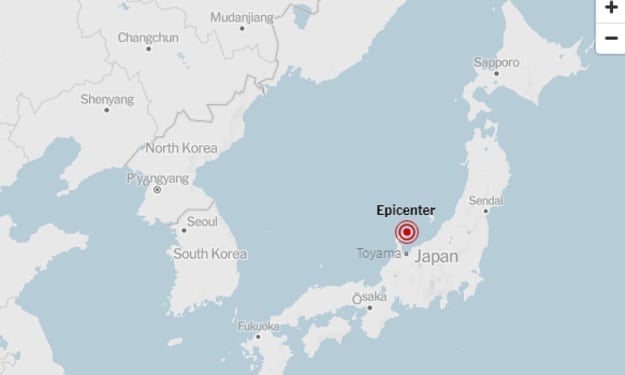
A powerful 7.5 magnitude earthquake rocked Japan's west coast on Monday, leaving a trail of destruction that has claimed multiple lives, according to local authorities. The seismic event caused severe damage to roads and buildings, disrupted transportation and communication services, and raised concerns about widespread power outages affecting tens of thousands of homes.Aftershocks have continued to rattle the affected areas, prompting Japan's weather agency to issue warnings of possible ongoing tremors for the next few days. Despite initial tsunami advisories due to waves reaching up to 1.2 meters (4 feet) along the western coast, all tsunami alerts have now been lifted by the weather agency.In the aftermath, the death toll climbed to at least 30 individuals, as confirmed by authorities in Ishikawa prefecture on Tuesday. Prime Minister Fumio Kishida addressed the challenging situation, highlighting the destruction of crucial roads that hindered access to the affected regions. Rescue teams persistently worked to reach and aid individuals trapped beneath collapsed structures, showcasing the ongoing intensity of the rescue operation.Prime Minister Fumio Kishida, addressing an emergency disaster meeting, emphasized the urgent nature of the rescue operation, citing the challenging conditions faced by responders attempting to reach the northern tip of the Noto peninsula. Helicopter surveys revealed widespread damage to buildings, infrastructure, and numerous fires, adding to the complexity of the situation.The earthquake struck the Noto Peninsula in Ishikawa, resulting in building collapses, fires, and triggering tsunami alerts even in eastern Russia. Although the weather agency withdrew tsunami advisories for parts of Japan's western coast, accessibility to the northern area of the secluded Noto Peninsula remained limited almost a day after the quake hit.Updates from Wajima city officials in Ishikawa prefecture confirmed the death toll had risen to at least 15 individuals. The Ishikawa government continued to collate reports of casualties across the prefecture, intending to provide further updates later in the day.The aftermath of this devastating earthquake has plunged Japan into a state of emergency, with rescue efforts ongoing amid the challenges posed by extensive damage, limited access, and rising casualty counts.A 7.5 magnitude earthquake struck Japan's central Ishikawa prefecture, unleashing devastation that has left numerous households without power and caused widespread casualties and infrastructure damage across multiple prefectures. Here's a comprehensive overview of the seismic event and its aftermath:Power Outages and Casualties:As of Tuesday, approximately 45,700 households remain without power in Ishikawa prefecture following the earthquake. The disaster claimed the lives of at least six individuals in Ishikawa, with dozens reported injured across Toyama, Niigata, and other affected regions, as per reports from Japanese public broadcaster NHK.Rescue Efforts and Military Response:Japan's defense ministry swiftly mobilized 1,000 military personnel to assist in the rescue and recovery operations, intensifying efforts to reach those trapped under collapsed buildings.Tsunami Alerts and Fire Incidents:While all tsunami advisories were lifted after tsunami waves, reaching up to 1.2 meters (4 feet), struck Japan's western coast, reports emerged of over 100 houses and shops engulfed in fires in Wajima, Ishikawa prefecture. The fires continued to burn, exacerbating the post-earthquake challenges.Transport Disruptions and Stranded Passengers:Four bullet trains halted by the earthquake have resumed services after being stranded for over 11 hours between Toyama and Kanazawa. Nearly 1,400 passengers were inside these high-speed trains during the ordeal, with no reports of health issues.The Japan Meteorological Agency highlighted over 90 tremors detected since the initial quake, cautioning about the possibility of additional strong shocks in the coming days. This seismic activity disrupted daily life in Toyama city, with shelves in convenience stores left empty due to disrupted supply chains across the region.Impact and Aftershocks:The quake's impact resulted in collapsed buildings, disrupted communication networks, and severed highways in central Japan. The United States Geological Survey reported at least 31 aftershocks near the earthquake's epicenter, warning of potential ongoing aftershocks in the coming days to months.Response Efforts and International Support:Japan continues to grapple with the immense challenges of damaged infrastructure and rescue operations. Health officials in Suzu city cited road damage impeding medical professionals from reaching woundedInternational support extended as President Joe Biden pledged assistance to Japan, expressing solidarity and readiness to aid in the aftermath of the earthquake.
By Reena Nauriyal 3 years ago in Earth
Climate Challenges and Sustainable Solutions in the UAE: A Leap Towards a Greener Future
In the wake of the conclusion of COP28, a milestone climate summit that engaged oil-producing nations for the first time in a united effort to safeguard the planet, it’s time to celebrate the positive strides made in addressing global climate challenges.
By Andrea Zanon3 years ago in Earth
The ethical considerations surrounding geo engineering.
In the year 2050, the world stood on the precipice of an environmental abyss. Climate change had wreaked havoc, and humanity's survival depended on drastic measures. Among the contentious solutions was geoengineering—an innovative yet controversial approach to manipulate the Earth's climate.
By Ben wordsworth3 years ago in Earth
Everest Base Camp Helicopter Tour Highlights
Overview The Everest Base Camp Helicopter Tour stands out for its ease and convenience, offering a comfortable alternative to traditional treks. With a single-day itinerary(around 3-4 hours), it provides an efficient way to experience the iconic destination without the extended time commitment of a trek.
By bikash bhandari3 years ago in Earth
New York Is Sinking Under It's Own Weight. Content Warning.
A recent study has uncovered a concerning issue in New York City: it's sinking due to the immense weight of its towering skyscrapers. This process, known as subsidence, describes the gradual settling or sinking of the Earth's surface, mainly attributed to the shifting of soft sediments and the city's substantial mass. Despite the seemingly minimal sinking rate of 0.04 to 0.07 inches per year, specific areas within the city experience even faster sinking rates. This poses a significant risk for a city already positioned low and accommodating over 8 million residents. Addressing the growing flood risk and sea level rise, local authorities must devise strategies, although erecting extensive seawalls might not be the most effective solution. Geologists emphasize the adverse impact of constructing more highrises near coastlines, rivers, or lakes, exacerbating future flood risks. Scientific calculations of New York City's building mass—over a million structures—amount to an astounding 1.68 trillion pounds, excluding the weight of roads, sidewalks, and other paved areas. Despite these calculations' limitations, researchers effectively considered the intricate geology beneath the city, identifying soil types prone to subsidence, highlighting the stability of Bedrock that anchors the skyscrapers. Utilizing satellite data and models, researchers generated a sinking map of the city, attributing increased urbanization, groundwater extraction, and drainage practices to worsen the sinking scenario. Similar sinking issues afflict other cities like Jakarta and Venice, each facing unique challenges. Jakarta anticipates partial submersion by 2050, while Venice's foundation on a marshy lagoon, compounded by groundwater extraction, rising sea levels, and tectonic movements, contributes to its slow descent. Venice's sinking rate, matching New York's at 0.04 to 0.07 inches per year, forecasts a significant decline below sea level in the next two decades. Faced with these risks, Venetians are building barriers to thwart encroaching waters, albeit with delays, while the city grapples with building damage due to constant water breaches. Similarly, New Orleans struggles with sinking issues, initially constructed marginally above sea level but now gradually subsiding. Its flat topography and the lower elevation around the French Quarter exacerbate the problem. Efforts to elevate homes and restrict building heights due to unstable soil have been insufficient, compounded by an ill-suited drainage system installed in the 1900s that exacerbated soil destabilization, leading to sinking areas and increased susceptibility to flooding, notably highlighted during Hurricane Katrina. Managing water consumption emerges as a key solution for sinking cities, emphasizing the need for innovative approaches like purifying surface water or converting seawater. An example of successful water management lies in Denmark's NY town, employing rainwater collection to supply toilets and washing machines, showcasing resourcefulness in urban water management. Thus, grappling with these sinking city challenges requires comprehensive strategies, innovative water management, and a concerted effort to sustain these urban centers against the threats of subsidence and rising sea levels.
By Cudjoe Justice3 years ago in Earth