Climate
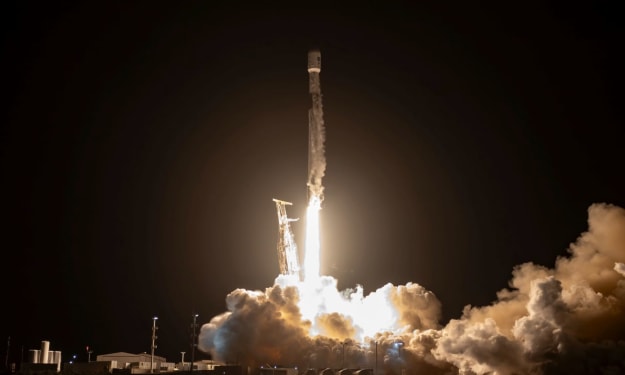
Falcon 9 launches NASA astrophysics and heliophysics missions
Falcon 9 launches NASA astrophysics and heliophysics missions. The SpaceX Falcon 9 rocket successfully launched from Vandenberg Space Force Base in California at 11:10 p.m. Eastern carrying two critical NASA missions into space. The payload included the Spectro-Photometer for the History of the Universe Epoch of Reionization and Ices Explorer (SPHEREx) spacecraft and four satellites for the Polarimeter to Unify the Corona and Heliosphere (PUNCH) mission. This launch marked an important step in NASA’s astrophysics and heliophysics research, using a rideshare approach to maximize efficiency. Following deployment all five spacecraft established communication with their respective controllers and were reported to be functioning as expected.
By Adnan Rasheed2 years ago in Earth
The Almanac of Us
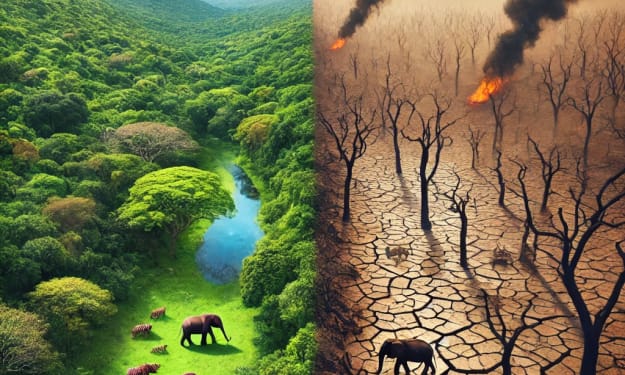
The year the crows stopped migrating was the year we stopped making plans. We’d always joked that the old oak in your backyard was our only reliable witness. Its branches held the initials we carved at sixteen, its roots drank the champagne we spilled at twenty-two, and its leaves, you swore, trembled whenever I kissed you. But the oak died slowly—not from disease, but from a feverish spring that bled into summer, then collapsed into a winter that forgot how to snow. By the time we noticed, its bark had split like a dried riverbed. “It’s just a tree,” you said, but we both knew it wasn’t. We met in the golden age of predictability. Back then, the apricot orchard behind my house bloomed every April, and your father’s almanac—its pages soft as moth wings—could still tell us when to plant tomatoes or expect the first frost. Love, back then, felt like something we could map. You’d leave wildflowers on my windshield; I’d save you the last slice of pie from the diner where I worked. We’d argue about whether the stars were holes in the sky or sparks from some celestial engine. Simple things. But the apricots began ripening in March, then in February, their sweetness turning cloying as the air thickened with unseasonal heat. The diner closed when the river flooded for the third time in a decade. Your father’s almanac became a relic, its wisdom as obsolete as cursive. The first real fight came when the wildfires started. Not the distant ones we’d watch on TV, but the ones that gnawed at the horizon like a hungry dog. Ash fell like gray snow, coating your car, our clothes, and the mugs we drank coffee from. You packed a go-bag—water, documents, the photo of us at the county fair—and said we should move north. “This is home,” I snapped. “We can’t just… *evaporate*.” You looked at me with that familiar expression, the one you have when I get my metaphors all mixed up. “Everything else is,” you said softly. We gave it our best shot to adapt. You set up a system to catch rainwater, and I got to work planting a garden with grains that could handle the dry spells. But the tomatoes didn’t make it, and when the rain finally came, it was acidic, leaving our crops all pockmarked. One evening, you brought up the idea of kids—not as a statement, but more like a question. I imagined a little one squinting up at a yellow sky, wondering why the air smelled like burning plastic. I didn’t say anything, and soon you drifted off to sleep. Sometimes I hike to the old orchard. The trees are skeletons now, but if I squint, I can almost see us at sixteen, lying in the grass, debating stars. The crows follow me, their wings clapping like uncertain applause. I’ve started reading your father’s almanac, not for guidance, but for the marginalia—your doodles, his notes about the first time he kissed your mom (“May 7th, 1983: Rained all morning. Sun broke at 3 p.m. Love does that.”). Yesterday, I found a seedling sprouting near the dead oak. A maple, maybe. Or a weed. I let it grow. You texted me a photo last week—a lake so blue it hurt to look at. I sent back a picture of the crows. We don’t talk about the future anymore. But today, it rained. Not the scouring, angry kind, but soft and slow, the way it used to. I stood in it until my shirt clung to my skin, imagining you somewhere under the same sky, your face tilted up, catching what the clouds dared to give. Maybe that’s all love is now—a thing that persists in the pauses between disasters. A stubborn, thirsty root. A question without an answer. A seed, waiting.
By Khan Muhammed2 years ago in Earth
Saudi Arabia: A Premier Tourist Destination
Saudi Arabia has many historical, cultural and urban attractions. Many tourists love to visit this country. Rich mountains and vast deserts are there for it as one of its better attractions. You can explore its dynamic cities like Riyadh and Jeddah with ease. The kingdom preserves Islamic heritage through lively mosques and historical spots. Visitors will admire Arabic hospitality in opulent resorts and desert camps. Its corniche areas attract all divers and beach lovers. Its futuristic cities demonstrate innovation and architecture. Various All-inclusive Umrah Packages are any pilgrim's invitation to making the journey of a lifetime easier by providing the services the pilgrims would need. The scenery adds beauty and tourism development to the region's world image. Multiple reasons make Saudia a leading tourism destination. In detail, we will discuss below, why Saudia is a leading tourism destination.
By Abdullah Khan2 years ago in Earth
Eco-Friendly Materials That Brands Are Loving Right Now
Hey, have you noticed? Sustainable Packaging Is Everywhere! Seriously, look all around. Your favorite coffee brand? Probably using recyclable cups. That fancy skincare line? Compostable jars. Even Amazon’s swapping out plastic for paper-based alternatives.
By Mahbub Murshed2 years ago in Earth
The Riches of the Amazon Rainforest: A History of Wealth and Mystery. AI-Generated.
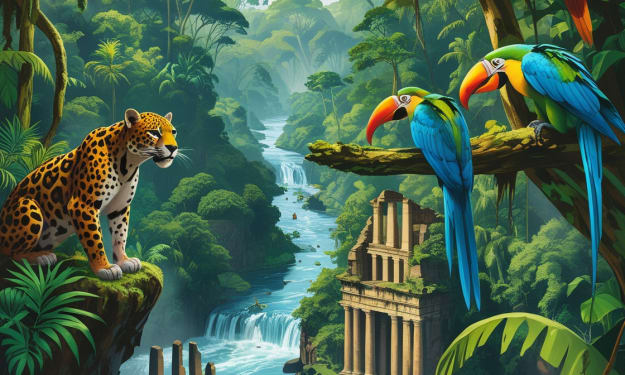
The History and Net Worth of the Amazon Rainforest Introduction The Amazon Rainforest, often referred to as the "lungs of the Earth," is one of the most significant natural ecosystems on the planet. Spanning over nine countries in South America, it covers approximately 5.5 million square kilometers. The Amazon's history dates back millions of years, evolving into a diverse and rich biome that sustains over 10% of the world’s known species. Beyond its ecological importance, the Amazon holds immense economic value, from timber and minerals to pharmaceutical and agricultural resources. Estimating the net worth of the Amazon Rainforest is challenging, but its contributions to global biodiversity, climate stability, and economic potential make it invaluable. Ancient History and Indigenous Inhabitants Long before European explorers arrived, the Amazon was home to advanced indigenous civilizations. Archaeological findings suggest that complex societies thrived in the region over 12,000 years ago, with settlements, roads, and even early forms of agriculture. The indigenous tribes utilized the rainforest’s vast resources sustainably, relying on hunting, fishing, and medicinal plants for survival. Even today, over 400 indigenous groups call the Amazon home, preserving their traditional knowledge and cultural heritage. European Exploration and Colonial Exploitation The first European explorer to traverse the Amazon was Francisco de Orellana in 1542. The Spanish expedition encountered vast landscapes, uncharted rivers, and indigenous warriors. With the colonization of South America, European powers began exploiting the Amazon’s resources. The rubber boom of the late 19th and early 20th centuries brought wealth to industrialists but devastated indigenous communities. Extractive industries, including gold mining and logging, further intensified during colonial rule, leading to large-scale deforestation and ecosystem damage. Economic Value of the Amazon Rainforest The Amazon Rainforest has an immense economic worth, with its resources spanning multiple industries:
By Say the truth 2 years ago in Earth
How Transcription Services Help Researchers Decode Environmental Challenges
Environmental research plays a vital role in helping us understand the changes happening in our ecosystems, the patterns of our climate, and the best strategies for conservation. However, gathering data in this field often involves a lot of qualitative methods like interviews, observations, and discussions with various stakeholders. This is where transcription services can make a significant difference, turning spoken words into written text that's easier to organize, analyze, and share.
By Beth Worthy2 years ago in Earth
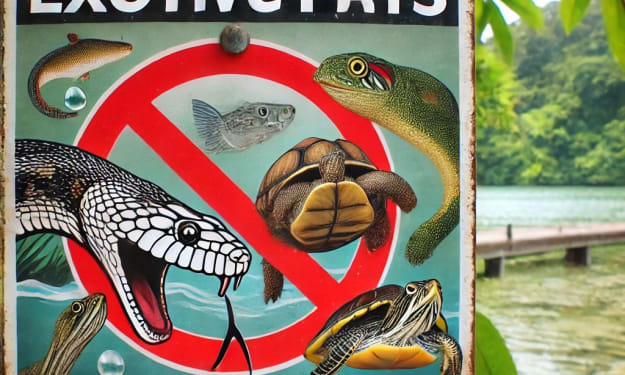
The Silent Invaders: How Invasive Species Threaten Ecosystems and Biodiversity
Introduction Nature thrives on balance, with ecosystems forming over thousands of years through intricate interactions between species. However, when an invasive species enters a new habitat, this delicate balance is disrupted. Invasive species—non-native organisms that spread rapidly and harm native ecosystems—are one of the biggest threats to biodiversity worldwide. Their impact extends beyond ecological damage, affecting economies, agriculture, and even human health.
By InkForChange2 years ago in Earth
How to Advocate for Climate Change When Political Support Is Lacking. AI-Generated.
In today’s political landscape, advocating for climate action can be challenging, especially when policymakers are unresponsive or opposed to environmental initiatives. However, there are effective strategies that individuals and communities can employ to promote meaningful change, even in the absence of robust political backing.
By Futoshi Tachino2 years ago in Earth
10 Easy Ways to Maintain a Sustainable Lifestyle Without Breaking the Bank
Many of us want to contribute to a more sustainable way of life in a world where environmental degradation and climate change dominate the news. However, let's be honest: if you're on a budget, the idea of going green can be overwhelming. The bright side? Sustainable living doesn't have to be hard or expensive. In fact, some of the changes that have the greatest impact are also the simplest. Without jeopardizing your wallet or your sanity, here are ten simple and inexpensive methods for leading a more sustainable lifestyle.
By Rocky Brahma2 years ago in Earth