

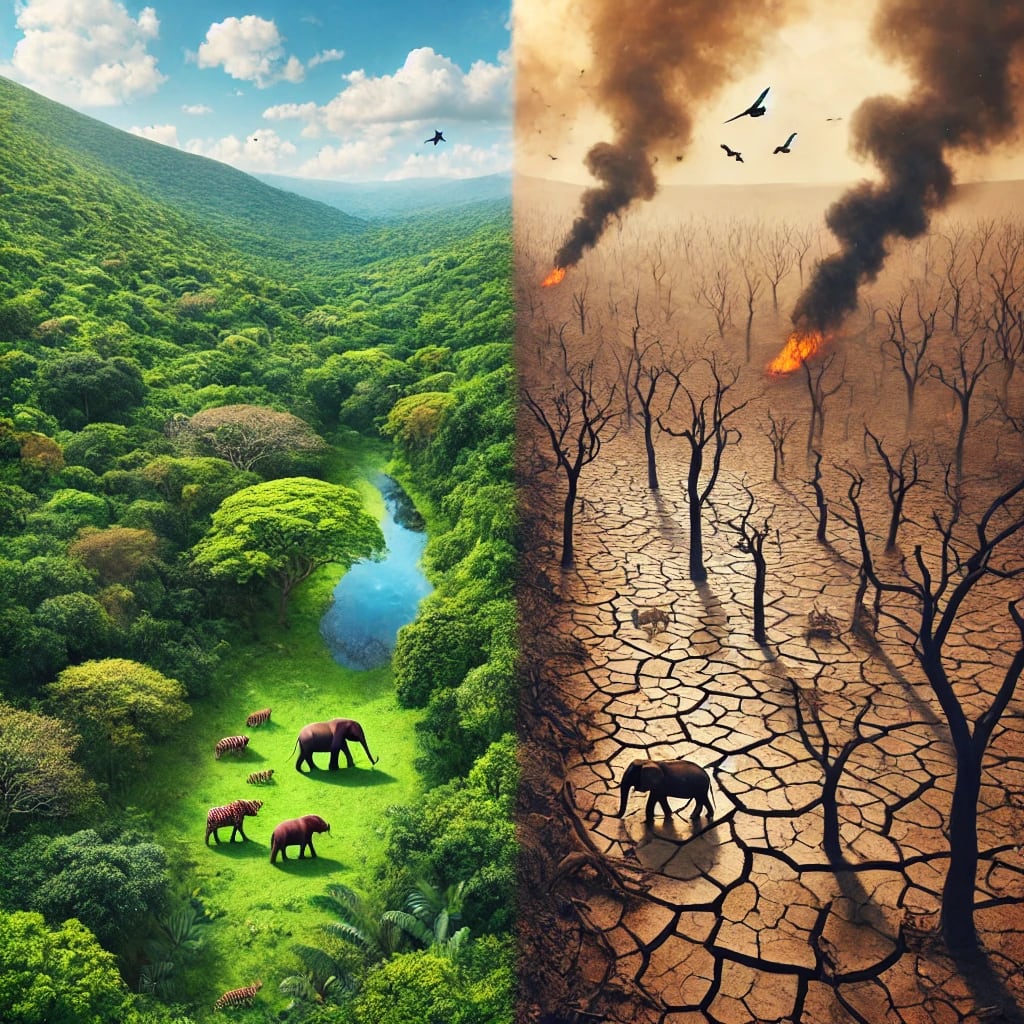
The year the crows stopped migrating was the year we stopped making plans. We’d always joked that the old oak in your backyard was our only reliable witness. Its branches held the initials we carved at sixteen, its roots drank the champagne we spilled at twenty-two, and its leaves, you swore, trembled whenever I kissed you. But the oak died slowly—not from disease, but from a feverish spring that bled into summer, then collapsed into a winter that forgot how to snow. By the time we noticed, its bark had split like a dried riverbed. “It’s just a tree,” you said, but we both knew it wasn’t. We met in the golden age of predictability. Back then, the apricot orchard behind my house bloomed every April, and your father’s almanac—its pages soft as moth wings—could still tell us when to plant tomatoes or expect the first frost. Love, back then, felt like something we could map. You’d leave wildflowers on my windshield; I’d save you the last slice of pie from the diner where I worked. We’d argue about whether the stars were holes in the sky or sparks from some celestial engine. Simple things. But the apricots began ripening in March, then in February, their sweetness turning cloying as the air thickened with unseasonal heat. The diner closed when the river flooded for the third time in a decade. Your father’s almanac became a relic, its wisdom as obsolete as cursive. The first real fight came when the wildfires started. Not the distant ones we’d watch on TV, but the ones that gnawed at the horizon like a hungry dog. Ash fell like gray snow, coating your car, our clothes, and the mugs we drank coffee from. You packed a go-bag—water, documents, the photo of us at the county fair—and said we should move north. “This is home,” I snapped. “We can’t just… *evaporate*.” You looked at me with that familiar expression, the one you have when I get my metaphors all mixed up. “Everything else is,” you said softly. We gave it our best shot to adapt. You set up a system to catch rainwater, and I got to work planting a garden with grains that could handle the dry spells. But the tomatoes didn’t make it, and when the rain finally came, it was acidic, leaving our crops all pockmarked. One evening, you brought up the idea of kids—not as a statement, but more like a question. I imagined a little one squinting up at a yellow sky, wondering why the air smelled like burning plastic. I didn’t say anything, and soon you drifted off to sleep. Sometimes I hike to the old orchard. The trees are skeletons now, but if I squint, I can almost see us at sixteen, lying in the grass, debating stars. The crows follow me, their wings clapping like uncertain applause. I’ve started reading your father’s almanac, not for guidance, but for the marginalia—your doodles, his notes about the first time he kissed your mom (“May 7th, 1983: Rained all morning. Sun broke at 3 p.m. Love does that.”). Yesterday, I found a seedling sprouting near the dead oak. A maple, maybe. Or a weed. I let it grow. You texted me a photo last week—a lake so blue it hurt to look at. I sent back a picture of the crows. We don’t talk about the future anymore. But today, it rained. Not the scouring, angry kind, but soft and slow, the way it used to. I stood in it until my shirt clung to my skin, imagining you somewhere under the same sky, your face tilted up, catching what the clouds dared to give. Maybe that’s all love is now—a thing that persists in the pauses between disasters. A stubborn, thirsty root. A question without an answer. A seed, waiting.
About the Creator
Enjoyed the story? Support the Creator.
Subscribe for free to receive all their stories in your feed.
Comments
There are no comments for this story
Be the first to respond and start the conversation.