Advocacy
Weather's condition
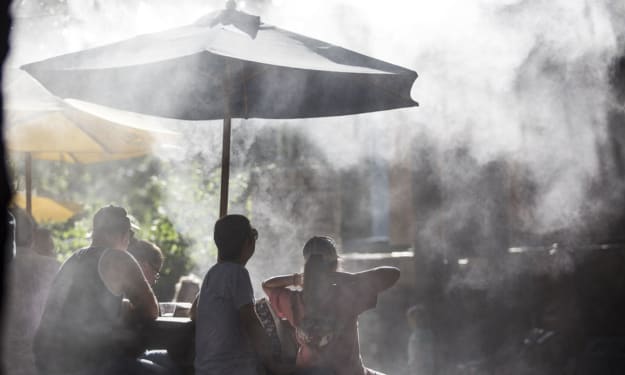
### Enduring the Heat: Houston's Summer Struggle In the heart of Houston, the summer of 2024 arrived with a vengeance. The city was already bracing for the season's notorious heat, but nothing could have prepared its residents for the intensity that came with it this year. The relentless sun seemed to hang perpetually at its zenith, casting an oppressive heat that gripped the city in a relentless embrace. Maria Hernandez felt the weight of the heat every morning as she stepped out of her modest home in the East End. A single mother of two, Maria worked two jobs to make ends meet—one as a cashier at a local grocery store and the other as a cleaner at a downtown office building. Each day began with the same ritual: checking on her children, ensuring they were hydrated and ready for the day ahead, before embarking on her exhausting commute. The air was thick with humidity, making it hard to breathe. Maria could feel the heat rising from the pavement through the soles of her worn-out shoes as she walked to the bus stop. The bus ride was no better; the old vehicle’s air conditioning struggled to combat the searing temperatures, leaving passengers drenched in sweat and silently yearning for relief. At the grocery store, the air conditioning was a saving grace, though it barely kept the stifling heat at bay. Maria's colleagues were all in the same boat—exhausted, drained, and constantly seeking moments of respite in the walk-in freezers. Customers, too, were visibly affected, their tempers flaring over minor inconveniences as the oppressive heat took its toll on everyone's patience. After her shift ended, Maria had a brief window of time to check on her children before heading to her second job. The kids, Jorge and Elena, were resilient but clearly struggling. The family’s small window unit air conditioner was a lifeline, but it couldn't cool their tiny apartment sufficiently. They spent much of the day in the shaded courtyard of their apartment complex, where a makeshift sprinkler provided a bit of relief. The journey downtown was a daily ordeal. Houston’s public transportation system was stretched to its limits, and the heat exacerbated the usual delays and breakdowns. Maria often found herself standing in sweltering bus shelters, the shade offering little comfort against the relentless sun. When she finally arrived at the office building, the air conditioning inside was a stark contrast to the scorching streets outside, and Maria cherished those hours of relative cool. Yet, even in this challenging environment, Maria and her children found moments of joy and community. Their neighbors, also grappling with the heat, came together to share resources and support one another. Community centers opened their doors as cooling shelters, offering water and a respite from the heat. Maria would often take her children there after work, where they met other families and found solace in the shared struggle. Despite the hardship, the summer brought out the best in Houston’s residents. Volunteers distributed bottled water to the homeless and checked on the elderly who were particularly vulnerable to the extreme temperatures. Local businesses set up misting stations and offered free water to passersby. The city’s resilience and sense of community shone through the haze of heat and humidity. One evening, as Maria sat with her children in the cooling center, she reflected on their summer struggle. Jorge and Elena were playing with new friends, their laughter a comforting sound amidst the hum of the air conditioning. Maria knew that while the heat was an overwhelming force, it was their community’s strength and solidarity that would carry them through. She thought about her neighbors—Ms. Johnson, who always had a kind word and a glass of lemonade ready; Mr. Lee, who rigged up a makeshift shade structure in the courtyard for the children to play under; and all the volunteers who tirelessly worked to ensure everyone had what they needed. These small acts of kindness were lifelines in the scorching summer, weaving a tapestry of resilience and hope. As the sun set on another blistering day, Maria felt a sense of gratitude. The heat was unyielding, but so was the spirit of Houston. Together, they would endure, adapt, and find ways to thrive. The struggle against the summer’s oppressive heat was not just about survival—it was a testament to the strength of their community and the bonds that held them together. In the face of such extreme weather, Maria realized that it was the people who made Houston home. Their collective efforts, their unwavering support for one another, and their shared experiences of hardship and joy were what truly defined the city. And as long as they had each other, no amount of heat could break their spirit.
By Drake molb2 years ago in Earth
On The Wild Lawn
Introduction I am not a gardener, not even slightly proficient, so all I say in this piece needs to be taken with a large pinch of salt. I have lived here for close to twenty-five years and in that time, after the initial relaying, the lawn has never been re-laid. You can see what it was like after I mowed it on July 7th 2024 in the main image.
By Mike Singleton 💜 Mikeydred 2 years ago in Earth
The Riskiest Jobs In the World
Workers around the globe put their lives at risk to produce the goods we use every day. In Indonesia, laborers mine sulfur from an active volcano, exposing themselves to toxic gases. The daily wages, the personal protective clothes, other basic supplies, and drinking water have been an issue in these places for decades now. As such small and deep cut injuries have occurred and when it does it's never reported. The government and NGO with other civil organizations in each respective country know about it yet turn a blind eye to processes and events from time to time. The government is pretending not to see, and the mine owners are also pretending the mine is not theirs, and if even it is theirs, the mines aren't working for them. The poor miners work hard as the rich countries and individuals reap the blessings and benefits of their sweat.
By Isaac Ekow Anyidoho2 years ago in Earth
Heat Advisory
TODAY It is roaring roasting, roaring heat. 93 to 95°F in an area of the country that is considered very hot when it’s 85 outside. Our plants and bodies are not used to this. I know it’s hotter elsewhere but this heat is unusual here although it is becoming the norm!
By Andrea Corwin 2 years ago in Earth
Journey Beyond Earth
Explore the Wonders of Space: Journey Beyond Earth Get ready for an amazing adventure that takes you beyond our planet and into the universe. This article will show you the vast and mysterious space. It will reveal the incredible sights and secrets of the cosmos.
By shabana begam2 years ago in Earth
Guardians of Gaia. AI-Generated.
In the heart of a small town nestled between rolling hills and dense forests, lived a young girl named Maya. Maya had always felt a deep connection to nature, often spending her days exploring the woods, listening to the whispers of the trees, and marveling at the beauty of the natural world. She believed that the Earth was a living entity, a guardian that provided for all its inhabitants. One sunny afternoon, while wandering through her favorite grove, Maya stumbled upon an ancient, weathered stone tablet partially buried in the ground. Intrigued, she carefully unearthed it and discovered an inscription that read, "To save Gaia, seek the Heart of the Earth." Confused but determined, Maya took the tablet to the town's wise elder, Mr. Thompson, a retired archaeologist with a wealth of knowledge about ancient legends. Mr. Thompson's eyes widened as he examined the tablet. He explained that Gaia was the ancient name for Earth, often depicted as a nurturing mother. The Heart of the Earth, he said, was a mythical artifact said to hold the power to restore balance and heal the planet. Maya felt a surge of purpose. With Mr. Thompson's guidance, she prepared for a journey to find the Heart of the Earth. She packed essential supplies and set off, guided by the clues on the tablet. Her journey took her through dense forests, over towering mountains, and across vast deserts. Along the way, Maya encountered various challenges that tested her resolve and ingenuity. In a dark, labyrinthine cave, she had to decipher ancient runes to find her way. In the scorching desert, she found solace and direction from a wise old nomad who spoke of the stars' guidance. Each obstacle strengthened her determination and deepened her connection to the Earth. Finally, after many weeks of travel, Maya arrived at the base of a majestic, ancient tree deep within an enchanted forest. The tree radiated a powerful, calming energy, and Maya knew she had found the Heart of the Earth. She approached it with reverence, placing her hand on its trunk. The tree seemed to respond, its leaves shimmering with an ethereal glow. Suddenly, Maya was enveloped in a vision. She saw the Earth in its entirety, from its highest peaks to its deepest oceans, and witnessed the damage caused by pollution, deforestation, and neglect. But she also saw the potential for renewal, the resilience of nature, and the power of collective action. Maya understood that the Heart of the Earth was not a physical object but a symbol of humanity's responsibility to care for the planet. She knew she had to share this vision with others, to inspire a global movement for change. Returning to her village, Maya recounted her journey to the townspeople. Her story resonated deeply, sparking a sense of urgency and hope. The community came together, implementing sustainable practices, restoring natural habitats, and educating others about the importance of protecting the environment. News of Maya's journey spread far and wide, inspiring other communities to take similar actions. The world began to change, one small step at a time. People started to reconnect with nature, understanding their role as stewards of the Earth. Moral of the Story The tale of Maya and the Heart of the Earth teaches us that every individual has the power to make a difference. It reminds us that the Earth is a living entity that needs our care and respect. By working together and embracing sustainable practices, we can heal the planet and ensure a better future for generations to come. The story encourages us to listen to the whispers of nature, to seek wisdom in ancient teachings, and to act with love and responsibility towards our shared home, Gaia.
By John Francis2 years ago in Earth
The Impact of Youth Engagement on Voter Turnout in the 2024 UK General Election
Startriting In the months leading up to the 2024 UK General Election, a quiet revolution was unfolding. It wasn’t the kind of revolution marked by loud protests or dramatic confrontations, but a subtle, persistent wave of change driven by the nation’s youth. This demographic, often perceived as apathetic or disinterested in politics, was about to redefine the landscape of British democracy in a way that few had anticipated.
By NNAEMEKA SAMSON OSITA 2 years ago in Earth
Uncovering the Antarctic Tipping Point: A New Ice Melting Mechanism that Could Reshape Climate Models. AI-Generated.
Conclusion In a groundbreaking discovery, researchers have identified a new Antarctic tipping point that reveals previously undetected ice melting mechanisms. This finding has profound implications for our understanding of climate change and its potential impacts on global sea levels. Hidden Threat Beneath the Ice.For years, scientists have studied the melting patterns of Antarctica's ice sheets, recognizing the role of surface warming and ocean temperatures. However, recent research has uncovered an additional, hidden threat: warm water flowing beneath the ice sheets. This subsurface melting mechanism was not accounted for in existing climate models, making this discovery both alarming and crucial for future predictions.The study, conducted by an international team of glaciologists and climate scientists, utilized advanced satellite imagery and robotic submersibles to explore the underwater environment. They found that warm ocean currents are seeping beneath the ice sheets, causing them to melt from below. This process is accelerating the destabilization of the ice, potentially leading to more rapid ice loss than previously anticipated.
By Amzad Hussain 2 years ago in Earth
Resolving the Amazon Crisis to Mitigate Climate Change
The Amazon rainforest, known as the "lungs of the Earth," plays a crucial role in regulating the global climate by sequestering carbon dioxide and producing oxygen. However, it faces a severe crisis due to deforestation, illegal mining, agricultural expansion, and climate change. Addressing this crisis is essential for both the Amazon and global climate stability. This article outlines a comprehensive approach to resolving the Amazon crisis with a focus on mitigating climate change. Strengthening Environmental Protection Laws Effective environmental laws are the foundation for Amazon conservation. Governments need to enforce existing regulations to prevent illegal activities and introduce stronger legislation to protect more areas of the Amazon. Promoting Sustainable Practices Transitioning to sustainable agricultural and forestry practices can significantly reduce deforestation. Integrating trees into agricultural systems and implementing logging practices that allow forest regeneration can improve biodiversity and carbon sequestration. Implementing Reforestation and Restoration Projects Reforestation and ecosystem restoration are critical to reversing deforestation. Planting native tree species in deforested areas and focusing on restoring the natural functions of degraded forest areas can help restore the Amazon's ecosystem. Securing Government Commitment Governmental support is essential for long-term conservation efforts. National and local governments should prioritize Amazon conservation in their policies, and international cooperation should be strengthened to foster collaborative conservation efforts. Providing Economic Incentives Economic incentives can align financial interests with conservation goals. Developing eco-tourism initiatives and promoting the sustainable harvesting of non-timber forest products can provide economic benefits to local communities while promoting conservation. Supporting Indigenous Rights and Knowledge Indigenous communities are effective stewards of the forest. Recognizing and enforcing their land rights and incorporating their traditional knowledge into conservation strategies are crucial steps in protecting the Amazon. Raising Public Awareness and Education Public support is vital for conservation efforts. Global awareness campaigns and educational initiatives can teach local communities sustainable practices and the importance of forest conservation. Supporting Scientific Research Scientific research provides the data needed to inform and improve conservation strategies. Investing in research and monitoring to track the health of the Amazon and supporting innovative solutions for sustainable forest management are essential. Combating Illegal Activities Illegal activities like logging and mining are major drivers of deforestation. Strengthening law enforcement and increasing transparency in supply chains can help combat these activities effectively. The Amazon rainforest, often called the "lungs of the Earth," plays a pivotal role in supporting global ecological balance and human well-being. Its vast expanse and biodiversity provide numerous benefits that extend far beyond its borders. Climate Regulation The Amazon is a critical carbon sink, absorbing significant amounts of carbon dioxide from the atmosphere and helping mitigate climate change. By storing carbon, the forest reduces greenhouse gases and helps stabilize the global climate. Oxygen Production Through photosynthesis, the Amazon produces a substantial portion of the world’s oxygen. This process is vital for maintaining the atmospheric balance necessary for life on Earth. Biodiversity The Amazon is home to an unparalleled diversity of plant and animal species, many of which are found nowhere else on the planet. This biodiversity supports global ecological stability and has potential for new medicines, foods, and scientific discoveries. Water Cycle The rainforest plays a crucial role in the global water cycle by generating moisture and influencing weather patterns. Its ability to release water vapor into the atmosphere affects rainfall both locally and in distant regions, impacting agriculture and water supplies worldwide. Indigenous Cultures The Amazon is home to numerous indigenous communities whose traditional knowledge and sustainable practices are vital for conservation efforts. Their stewardship helps preserve the forest’s integrity and the services it provides. Economic Value The Amazon’s resources contribute to global economies through products such as rubber, nuts, fruits, and medicinal plants. Sustainable harvesting of these resources supports local livelihoods while maintaining the forest’s health. In Conclusion, The crisis in the Amazon requires a multifaceted approach. By strengthening environmental laws, promoting sustainable practices, implementing reforestation projects, securing government commitment, providing economic incentives, supporting indigenous rights, raising public awareness, supporting scientific research, and combating illegal activities, we can mitigate the crisis and its impact on global climate change. Collaborative efforts at all levels are essential to ensure the long-term health of the Amazon and the global climate.
By Ikpa Denis2 years ago in Earth