Latest Stories
Most recently published stories in Earth.
Israel Declares National Emergency as Wildfires Threaten Jerusalem
In a rapidly intensifying crisis, the Israeli government has declared a national emergency as devastating wildfires spread uncontrollably near Jerusalem, consuming thousands of acres of forest and prompting urgent evacuations across several communities. Prime Minister Benjamin Netanyahu issued a stark warning on Wednesday, describing the fires as a “national danger” and emphasizing the need for “complete national mobilization” to combat the flames and protect civilian lives.
By Chowdhury Nazmes Sama Ahmedabout a year ago in Earth
New Record! 6 Rockets Launch in Less Than 24 Hours. AI-Generated.
In a remarkable achievement that underscores the rapid advancement of global space capabilities, six rockets were successfully launched within a span of less than 24 hours—a new record in the history of space exploration. This extraordinary feat involved a combination of government space agencies and private companies, reflecting both international cooperation and healthy competition in the race to expand humanity’s reach into space. The launches, which took place between April 29 and April 30, 2025, were staggered across different continents and time zones, showcasing the global nature of modern space operations. The missions ranged from deploying satellites for communications and Earth observation to delivering critical supplies to the International Space Station (ISS). A Global Effort The first launch of the sequence was executed by SpaceX from Cape Canaveral, Florida. A Falcon 9 rocket carried a new batch of Starlink satellites, further expanding the company's growing constellation aimed at providing global broadband internet. Just three hours later, China’s Long March 6A took off from the Taiyuan Satellite Launch Center, delivering a set of Earth observation satellites to orbit. Russia followed suit with a Soyuz launch from Baikonur Cosmodrome, sending a Progress cargo ship loaded with supplies for the ISS. Meanwhile, India’s space agency, ISRO, launched its PSLV rocket from Sriharikota, successfully placing a weather monitoring satellite into a precise orbit. Not to be outdone, Europe’s Arianespace completed the fifth launch with a Vega rocket from French Guiana, which carried multiple small satellites for various international clients. The record-breaking streak concluded with a surprise entry: a Rocket Lab Electron launch from New Zealand, deploying a microsatellite designed for scientific research. Pushing the Boundaries This series of launches highlights how the space industry has evolved in recent years. The simultaneous advancement of reusable rocket technology, miniaturization of satellites, and the growth of private space companies have contributed to an unprecedented pace of launches. Experts point out that the surge in space activity is not merely a matter of breaking records. "Each launch contributes to critical infrastructure for communications, science, and security," noted Dr. Elena Martínez, a space policy analyst. "The fact that we can now see six launches in less than a day reflects both technological progress and the rising demand for space-based services." Challenges and Risks While the achievement is impressive, it also raises concerns about space traffic management and orbital debris. With thousands of satellites already in orbit and many more planned, experts warn that the risk of collisions is increasing. International efforts are underway to establish clearer regulations and improved tracking systems to keep space safe for future operations. Additionally, environmental groups have highlighted the growing carbon footprint of frequent rocket launches. Companies like SpaceX and Rocket Lab are already working on ways to make launches more sustainable, including reusability and cleaner fuels. Looking Ahead The success of these six launches marks a turning point for space exploration and utilization. With plans for lunar missions, Mars exploration, and even space tourism accelerating, the pace of activity is expected to grow even faster in the coming years. Governments and private enterprises alike are investing heavily in next-generation rockets and infrastructure. The dream of a multi-planetary species, once the stuff of science fiction, is inching closer to reality thanks to achievements like this. In the words of NASA Administrator Bill Nelson, “This record is not just a number—it’s a testament to human ingenuity, global collaboration, and our relentless curiosity about the universe.” As humanity continues to reach for the stars, milestones like this remind us of how far we’ve come—and how much farther we can still go.
By Dhananjay Sikdarabout a year ago in Earth
World history or global history as a field of historical study examines history from a global perspective. It emerged centuries ago; some leading practitioners are Voltaire, Hegel, Karl Marx, Oswald Spengler, and Arnold J. Toynbee. The field became much more active in the late 20th
The study of human societies from ancient times to the present day is the subject of the vast and intricate field of world history. It encompasses political, economic, social, cultural, and technological developments, exploring interactions between civilizations, empires, nations, and peoples.
By Md.Abdur Roufabout a year ago in Earth
Neon Skies of Arcturon
The city of Arcturon gleamed like a monument to perfection—skybridges coiling between diamond towers, airborne trains whispering past the clouds, and a sky so full of neon that stars had been forgotten. Beneath it all, millions of citizens existed under a perfect algorithm, breathing engineered air and thinking thoughts pre-approved by the city’s Central Intelligence Grid.
By muqaddas shuraabout a year ago in Earth
🐍King Cobra : Toxic Supreme
The King Cobra (Ophiophagus hannah) isn’t just another venomous snake—it's the longest venomous snake in the world and one of the most lethally fascinating creatures on the planet. Found in forests across Asia, this toxic reptile has earned a legendary reputation for its size, deadly venom, and unique behavior. In this post, we’ll explore everything that makes the King Cobra a true monarch of the wild.
By Bishal Chakraborty about a year ago in Earth
7 Signs Your Trees Need Professional Attention: When to Call Local Experts
Trees add beauty, shade, and value to our properties. Many Seattle area homeowners enjoy the lush greenery surrounding their homes but aren't always sure when their leafy friends need professional care. While some tree issues are obvious, others can fly under the radar until they become serious problems. Knowing when to call in skilled tree care professionals can save you money, protect your property, and potentially save your beloved trees.
By Cary Johan about a year ago in Earth
If You See This Thing, Don’t Even Think About Going Near. AI-Generated.
A trip to Hawaii may become your last. This is exactly what happened to David Pototts, who came to Maui to spend some quality time with his girlfriend. We all know that the ocean can pose a whole bunch of dangers. Riptides, sharks, poisonous algae. Even a seemingly safe sand hole can end your life in a matter of seconds. Blow holes can do that, too.
By taylor lindaniabout a year ago in Earth
Mystery of Antarctica Creepy Doorway Finally Cracked. AI-Generated.
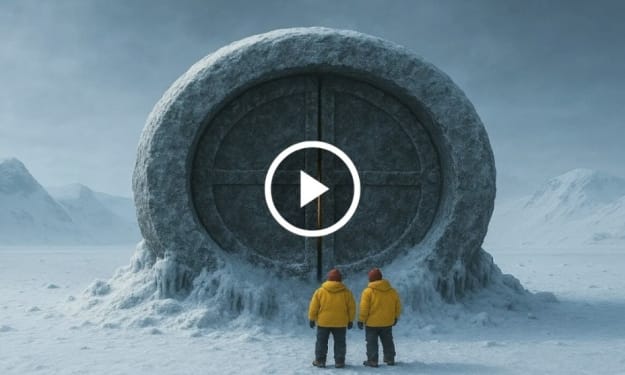
So, there's a mysterious doorway in the middle of Antarctica. Some people think it's Bigfoot's vacation home, or a shuttlecraft from Star Trek, or maybe a door to Agartha, a mythical kingdom some people believe is located in the center of the Earth. Well, the scientists debunked all these poetic theories and explained that what looks like a mysterious doorway is located in an area of fast sea ice. It's offshore of the coast and is full of little islands with shallow water around them. When ice flows around hard rocks hidden underneath, it can create patterns that look odd but are totally normal. In this spot, the ice is thin. So, the rocks underneath have a big effect on how the ice moves. The cold winds in Antarctica also shape the ice and snow and make it look like they're lines and shapes. So, the mysterious doorway is just a rocky ridge poking out because the ice has melted a little. The top of the doorway is the tip of the rock and the sides are snowy trails left by strong winds blowing in the same direction. It's essentially an iceberg that got stranded and is melting in one place. One YouTuber found another out ofplace mysterious object more than 150 m off the shore of Antarctica. a 400 ft long ice ship. The internet went wild with theories like that the ship must have ended up there right from the Bermuda Triangle. But there was no scientific proof that it was a ship and not just a large chunk of ice. And once some other internet users revisited the place, they noticed the ice melted in the summer and the hypothetical ship was gone. Another mysterious Google Maps find in Antarctica was a pyramid. And before you make up an exciting theory about how the ancient Egyptians built a secret base here, I have to tell you it turned out to be just a mountain. It's part of the tallest mountain range in Antarctica that stretches for almost 250 mi. It's not the first pyramid on this continent, as explorers from the British Antarctic Expedition found another unusually shaped mountain and nicknamed it the pyramid. But this one didn't even have a pyramid shape. Here's one Antarctic find that definitely won't disappoint you. A giant ice shelf that reminded scientists of the Grand Canyon. A special submarine robot named Ran covered over 600 miles under the thick ice and brought back some amazing footage of icy mountains, valleys, flat plateaus, and swirly patterns made entirely of ice. One of the strangest things Rand found was giant ball-shaped holes or scoops in the ice. Sadly, scientists lost track of the robot. They think that curious Wendell seals may have accidentally bumped into Ran and caused it to get stuck. To save energy, Ran probably shut itself down, and the scientists couldn't find it again. But the team is hoping to build a new robot and continue exploring this icy canyon to see how the patterns under the ice might change over the years. Another huge Antarctic canyon was found thanks to bad weather. A team of sound experts had to pause their work at the Casey Research Station in a storm.
By taylor lindaniabout a year ago in Earth
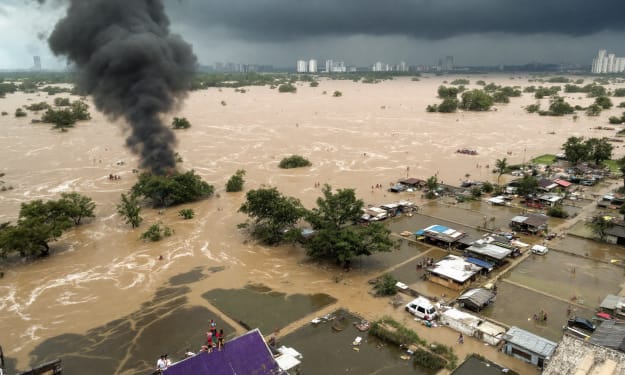
Drowned in Fury: The Wrath of Yangtze River Floods
The 1931 Yangtze River Floods: China's Watery Cataclysm In the sweltering summer of 1931, China found itself at the mercy of one of the most catastrophic natural disasters in human history. The Yangtze River, normally a source of life and sustenance, transformed into a monstrous force of destruction. What unfolded was not just a flood—it was a months-long watery siege that drowned cities, shattered rural life, and left a death toll that climbed into the millions. No modern disaster before or since has matched its scale of devastation.
By James Brockabout a year ago in Earth
Largest Creatures of the Deep
Beluga Sturgeons Beluga sturgeons live in rivers. They grow up to 24 feet in length making them the largest freshwater fish. They are native to the Caspian and Black Sea and migrate to spawn in freshwater rivers. These ancient fish are known for their roe, prized globally as beluga caviar. Beluga sturgeons are bottom dwellers and feed on fish and invertebrates.
By Rasma Raistersabout a year ago in Earth