Latest Stories
Most recently published stories in Earth.
How did a cowboy Saved A Cow. Content Warning. AI-Generated.
The Last Ride to the Spring” The wind was hot and dry as it swept across the wide plains of Willow Creek. The land had turned to dust under the scorching sun, and the cattle were restless, thirsty, and weak. It hadn’t rained in weeks, and the ranch’s water holes were drying up faster than anyone had seen before. Tom Ryder, a seasoned cowboy with sun-worn skin and steady hands, rode out early that morning to check on the herd. His horse, Dusty, trotted at an easy pace, hooves kicking up little clouds behind them. Tom had lived his whole life on this land. He knew every trail, every creek, and every sound the wind carried. As he crested a small ridge, Tom saw something that made his heart sink. One of the younger cows—Millie, a red and white heifer born the previous spring—was lying alone near a dried-up watering hole. She wasn’t moving much, just lifting her head now and then, letting it fall again into the dirt. “Damn,” Tom muttered under his breath. He spurred Dusty forward and dismounted beside her. Kneeling down, he touched Millie’s side—her skin was hot and her breath shallow. She had collapsed from heat exhaustion and dehydration. If she didn’t get water soon, she wouldn’t last the day. Tom looked around. There was no shade for miles, and the nearest spring was over two miles away—uphill and rocky. But he wasn’t about to leave her to die. Not on his watch. “Hang in there, girl,” he whispered. Quickly, Tom pulled his canteen from his saddle. He poured a bit of the warm water into his hat and brought it to Millie’s lips. She drank weakly, her tongue flicking at the water. It wasn’t nearly enough, but it gave her a spark. Tom knew she was too weak to walk that far, so he had to get creative. He took off his lasso and tied a harness gently around her body. Then, with steady hands, he looped the rope over Dusty’s saddle horn. Dusty was strong, and Tom knew he could handle it if they took it slow. “Easy, boy,” Tom said, patting Dusty’s neck. He led them forward, carefully guiding Dusty while watching over Millie, who now dragged slowly across the ground behind. Every few hundred feet, they stopped so Tom could check her breathing and give her a few more sips from the canteen. He talked to her the whole way, encouraging her, keeping her calm. “Just a little further, girl. We’re almost there.” The sun beat down harder with every step, but Tom didn’t stop. Sweat poured down his face, his throat dry, but he didn’t care. He could see the grove of cottonwoods up ahead—the spring still flowed beneath their roots. It was the last fresh water for miles. When they reached the spring, Tom untied the rope, knelt by Millie, and cupped the cool water into her mouth. He splashed her body gently to bring her temperature down. After several minutes, she opened her eyes wider, let out a soft moo, and tried to sit up. “You made it,” Tom said with a tired smile. He stayed with her for hours, watching as she drank and slowly recovered. That night, he built a small fire and kept watch. Coyotes howled in the distance, but none dared come near the cowboy and the cow resting by the water. By morning, Millie was standing. Wobbly, but standing. Tom stood beside her, proud and quiet. Back at the ranch, they called it “Tom’s last ride to the spring,” though it was far from his last. To Tom, it was just part of the job—looking after the land, the animals, and doing what’s right, even when no one’s watching. Because that’s what real cowboys do. Let me know if you'd like a version with dialogue or illustrations!
By ARIFUL ARYANabout a year ago in Earth
Biodiversity: The Key to Earth's Survival
Man, you really gotta hand it to Earth—it’s essentially the ultimate flex when it comes to biodiversity. Seriously! You’ve got the wild rooftop jungles up in the rainforest canopies, the sun-bleached wastelands where cacti still pull off the “eternally hydrated” look, and under the ocean, it’s straight-up finding Nemo meets technicolor fever dream. Life, everywhere, all the freakin’ time.
By Cotheeka Srijonabout a year ago in Earth
Lessons from the Changing Climate
Buried deep in the wildest heart of the woods, there’s this gnarly, towering tree—an honest-to-goodness behemoth called Elder Oak. Locals swear the old thing has seen, well, basically everything. It’s got roots tangled so far into the ground it’s probably eavesdropping on secrets from the center of the Earth or something. This tree isn’t just a tree, you know? It’s the kind that gossips with the wind, soaks up every sunrise, and probably remembers when dinosaurs were a problem.
By Cotheeka Srijonabout a year ago in Earth
The Harmony of the Ecosystem
Alright, let’s drop the flowery, textbook “nature writing” vibe for a second and really dig into what’s happening in a forest when you wake up early—like, deep woods, not your local park with the screaming toddlers and rogue frisbees.
By Cotheeka Srijonabout a year ago in Earth
The Resilience of Mother Earth
Deep in the guts of some wild, half-forgotten forest—honestly, the kind of place most people just wander past without a second thought—Mother Earth stretched herself awake. She didn’t look young anymore, not by a long shot. Ages old, carrying scars from storms and floods and fires that would’ve sent most things packing. Yet, she stuck around, stubborn as ever. This was her domain. Life thrummed in the weirdest places—cracked logs sprouting mushrooms no one had names for, rabbits pouncing around like they owned the joint, the wind talking smack to the leaves. Everything knit together, messy but tough, surviving ’cause that’s what nature does.
By Cotheeka Srijonabout a year ago in Earth
How Basketball Boosts Mental Health and Wellness by Basketball Enthusiasts such as Matthew Skorny
Basketball, like many sports, offers more than just physical benefits. Engaging in this fast-paced, team-oriented game can have profound effects on mental health and overall wellness. Whether played professionally or casually, basketball provides individuals with an avenue to boost self-esteem, reduce stress, and foster social connections. The mental health benefits extend beyond the court, with the game offering a sense of achievement, improved mood, and better coping mechanisms. Understanding how basketball positively impacts mental well-being highlights its role as a powerful tool for mental health.
By Matthew Skornyabout a year ago in Earth
Taste & Travel: The Best Regional Dishes to Try on an Italian Road Trip
Italy doesn’t do uniform. Not in landscape, not in dialect, not in food. That’s what makes it perfect for a road trip. In one day, the food can shift completely. Cheese gets saltier. Pasta gets thinner. Bread gets crunchier or softer or suddenly vanishes from the table altogether.
By Richard Francisabout a year ago in Earth
NASA ready for the Red Planet? US senator's 'Mission to MARS Act' aims to modernize Johnson Space Center
As the global race to explore Mars accelerates, the United States is staking a bold claim to remain at the forefront of deep space exploration. A key step in that ambition comes from Capitol Hill, where U.S. Senator John Cornyn (R-TX) has introduced the “Mission to Modernize Astronautic Resources for Space” (MARS) Act—a sweeping $1 billion proposal aimed at revitalizing NASA’s Johnson Space Center (JSC) in Houston. The legislation reflects growing national interest in ensuring that NASA’s infrastructure is not only mission-ready for lunar operations but fully capable of supporting future missions to Mars. Why Modernize Now? NASA's Artemis program, which aims to return humans to the Moon by the late 2020s, is laying the foundation for future Mars expeditions. However, to achieve those long-duration missions, NASA needs ground facilities that match the technological complexity and operational demands of interplanetary travel. The Johnson Space Center has long served as the hub of America’s human spaceflight efforts, including astronaut training, spacecraft operations, and mission control. But much of its infrastructure dates back decades. Without significant investment, experts warn that the facility could struggle to support the next generation of exploration. “The Johnson Space Center has always been a cornerstone of NASA’s mission,” said Sen. Cornyn. “This bill is a recognition that if we are serious about going to Mars, we must be just as serious about modernizing the critical facilities that will get us there.” A Breakdown of the MARS Act The MARS Act proposes a 10-year, $1 billion infrastructure overhaul at JSC. This includes major renovations and new facilities that will directly support lunar and Martian mission objectives. Among the specific upgrades: Neutral Buoyancy Laboratory (NBL): One of NASA’s most iconic astronaut training sites, the NBL simulates microgravity and underwater environments. The bill proposes modernizing this facility to accommodate new space station modules, lunar equipment training, and enhanced safety standards. Astromaterials Curation Facility: With upcoming missions returning samples from both the Moon and Mars, NASA’s curation center must be updated to store, analyze, and protect these scientifically invaluable materials. Mission Control Center: The very room where Apollo 11 was guided to the Moon is overdue for a technological facelift. Enhancing real-time operations capability will be crucial for managing missions millions of miles from Earth. Ellington Field: Home to NASA’s T-38 astronaut training jets, this airfield’s facilities would be renovated to support pilot training and suborbital flight readiness. Space Food Systems Lab: Long-term missions to Mars will require sustainable, nutrient-rich food options. A new lab will support innovation in food preservation and delivery systems suited for deep space. Critical Infrastructure Upgrades: From asbestos removal and HVAC upgrades to electrical and plumbing overhauls, much of the JSC's backbone systems will be renewed to modern standards. The Mars Mission: A National Strategy Senator Cornyn argues that the investment is about more than just Texas—it’s a strategic imperative for the U.S. space program. “We’re entering a new space race,” he said, pointing to China’s rapidly expanding space ambitions, including lunar bases and robotic Mars landers. “We can’t afford to fall behind.” Experts agree that modernizing NASA’s ground infrastructure is critical. “No matter how advanced your rockets or spacecraft, missions will only succeed if your support systems on Earth are up to the task,” said Dr. Marcia Smith, president of the Space and Technology Policy Group. Funding and Political Path Ahead The legislation has been referred to the Senate Committee on Commerce, Science, and Transportation, where it’s expected to garner bipartisan interest. Fellow Texas Senator Ted Cruz, who chairs the subcommittee on space and science, has expressed support for continued investment in NASA. Still, the MARS Act comes during a time of fiscal scrutiny. President Biden’s FY2026 budget proposed modest increases to human exploration programs, while scaling back some science missions. If passed, the MARS Act would need to secure appropriations that align with broader budgetary priorities. A Launchpad for the Future For Houston—and the nation—the MARS Act represents a vital commitment to maintaining leadership in space exploration. Beyond the symbolic weight of Mars, the legislation promises thousands of jobs, partnerships with private aerospace companies, and long-term scientific and economic returns. Whether the first human to step on Mars will train at a newly revitalized Johnson Space Center remains to be seen. But if the MARS Act succeeds, it could be the launchpad that ensures America's next giant leap. --- Let me know if you'd like this in a specific format (PDF, blog post style, etc.) or tailored to a particular audience.
By Md Abdullaabout a year ago in Earth
The Amazon Jungle
The Amazon Jungle, also known as the Amazon Rainforest, is one of the most magnificent natural wonders on Earth. It spans across nine countries in South America, covering an area of more than five and a half million square kilometers. Most of it lies within Brazil, but parts also stretch into Peru, Colombia, Venezuela, Ecuador, Bolivia, Guyana, Suriname, and French Guiana.
By Naeem Khanabout a year ago in Earth
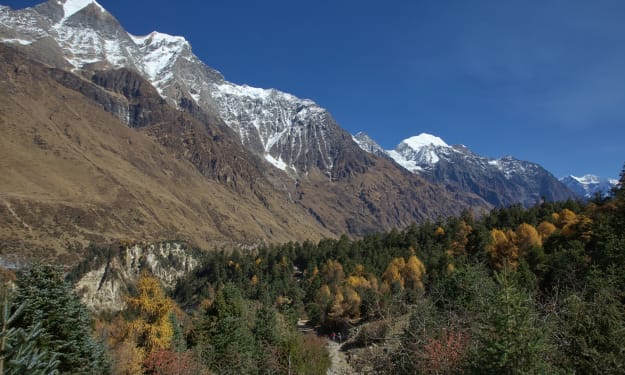
Manaslu Circuit Trek on a Budget: How to Explore More by Spending Less
The Manaslu Circuit Trek is one of Nepal’s most beautiful trekking experiences, but it is also one of the less commercial ones. That’s part of what makes it special fewer crowds, more peace, and deeper cultural moments. But for many travelers, cost plays a big role when planning a trek, and knowing what to expect in terms of pricing can make the difference between dreaming and doing.
By Anima Tamangabout a year ago in Earth