Latest Stories
Most recently published stories in Earth.
Unraveling the Cosmic Metronome: Strange Radio & X‑Ray Pulses Every 44 Minutes
In a finding that seems almost like something out of science fiction, astronomers have identified a cosmic entity that emits precisely timed signals—both radio and X-ray—every 44 minutes, a pattern that has never been seen before. This entity, now referred to as ASKAP J1832–0911, was initially detected by the Australian Square Kilometre Array Pathfinder (ASKAP) and subsequently verified with data from NASA’s Chandra X-ray Observatory.
By MILTON CHANDRA ADIKARYabout a year ago in Earth
“Extinction Witness: The Grief of Losing a Species”
In a quiet corner of Madagascar’s rainforest, Dr. Marie Fontaine stood beneath a towering baobab tree and wept. She held in her hand the last recorded audio of the silky sifaka—a haunting chorus of calls, now ghostly, echoing through her headphones. The primate’s call was once common in this forest. Now, it was only memory.
By Solomon Ebenezerabout a year ago in Earth
Rage at politicians, corporations, and powerful entities who prioritize profit over planetary health.
Lena stood at the edge of the forest she had grown up exploring, the crisp mountain air replaced by thick smoke. Her little brother, Sam, clutched her hand, his face half-hidden behind a reusable cloth mask-decorated with cartoon trees that were now burning. “They said it’s under control,” he whispered. She didn’t answer. She couldn’t. How do you explain to a child that “they” have been saying that for decades? That “under control” is just a political phrase now, a bandage slapped on the gaping wound of a dying world. Lena was 19 and angry. Not the social media kind of angry, not performative hashtags or filtered eco-aesthetic angry. Her anger simmered, real, raw, and relentless. It pulsed in her veins when she saw images of oil spills and deforested land. It surged in her chest when billionaires launched rockets for fun while the oceans choked on plastic and people in her town drank bottled water because the tap wasn’t safe anymore. But the thing that tore at her most-what clawed at her gut every single night-was how nobody seemed to care enough to change. Not really. Not her father, who chuckled every time she tried to bring up carbon emissions. “We’ve always had hot summers, Lena,” he’d say, popping a beer, “you’re just too sensitive.” Not her aunt, who mocked her bamboo toothbrush and called her a “hippie freak” at family dinners. And certainly not the politicians on TV, who spoke of climate like it was a distant, polite topic, not an emergency. They smiled while forests burned, ice melted, and futures collapsed. Lena tried. God, she tried. She organized local cleanups. She switched to a plant-based diet. She cycled everywhere, avoided fast fashion, reused, recycled, reduced. But still-her hometown was on fire. Again. Sam’s school was closed for the third time this year due to “smoke risk.” He was only seven, and already knew how to pack a “go-bag.” Last night, she had cried quietly into her pillow while he slept beside her. The guilt was suffocating. I should’ve done more. I should’ve screamed louder. Why didn’t I chain myself to something? March more? But the real fear, the one that kept her up, was this: What if it doesn’t matter? That morning, she had opened her phone and found a new video trending. Some politician was laughing about climate activists. Again. Calling them “emotional kids” who “don’t understand the economy.” Her hands trembled. The economy? What use is an economy if there’s no air to breathe? Later, they went to her grandfather’s house, a safer area upwind from the fires. As they sat around the dinner table, the conversation turned, as it often did, to “back in my day.” Her grandfather, a retired farmer with sun-wrinkled skin, gestured with a spoon. “Lena, I’m proud of you for caring. But the world isn’t going to change because of your composting. We’ve got bigger fish to fry.” Lena bit her lip. “Maybe,” she said quietly, “we’re out of fish because everyone just kept saying that.” The room went quiet. Her father cleared his throat. “Don’t talk to your grandfather like that.” She stood up. “I’m not being disrespectful. I’m just tired of pretending this isn’t a crisis. That it’s not your generation that burned through all the resources. That we’re the ones being ‘dramatic’ when we’re just trying to survive what you left us.” Her voice cracked. Sam looked up at her, wide-eyed. Her mom sighed. “This again?” “Yes,” Lena said. “This again. Because I can’t go a single day without thinking about the end of the world. I have nightmares about rising seas and burning skies. I panic when I see a single-use plastic bottle. I cry when I read climate reports. And you all just... act like it’s not happening.” Her fists were clenched. Her chest heaved. She didn’t mean to explode. But it was too much. It had always been too much. “You get to be nostalgic,” she said through tears, “because your childhood wasn’t on fire.” Later that night, her grandfather knocked gently on her door. He entered slowly, holding something in his hand: an old photo album. Pictures of his farm, from decades ago. Green fields. Bees. Wildflowers. Clean rivers. “I didn’t know,” he said quietly. “Not really. We weren’t taught. We thought progress meant machines, fuel, bigger harvests, more comfort.” He sat down beside her, flipping a page. “I thought I was building something for you. A better world. I didn’t see what we were breaking.” Lena cried again. This time, not out of anger. But grief. And something softer, quieter-shared sorrow.
By Sisipho Machithiabout a year ago in Earth
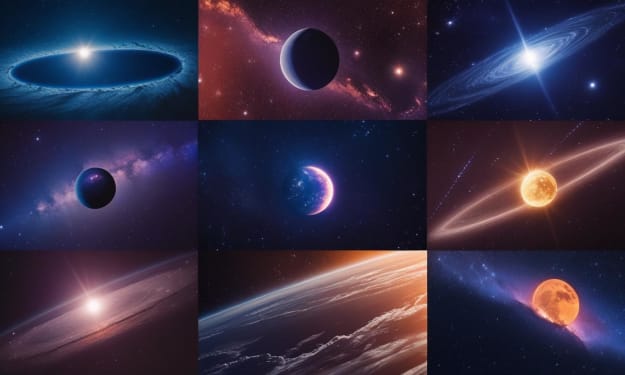
June 2025 Sky Spectacle: 9 Astronomical Events That Will Leave You Starstruck
June 2025 is poised to be an exceptionally exciting month for astronomy enthusiasts in recent times. With at least nine significant celestial occurrences scheduled, the night sky will be bustling with activity—from meteor showers and planetary alignments to full moons that hold cultural importance. Regardless of whether you have a telescope or simply a keen pair of eyes, these events can be observed with little equipment from various locations around the globe. Here’s what to anticipate this month and the reasons behind its significance.
By MILTON CHANDRA ADIKARYabout a year ago in Earth
Rethinking Fisheries Management
Sustainable fisheries are not only a conservation challenge, they are the lifeblood of coastal and indigenous fishing communities, a source of livelihood, food security, and cultural identity. Too often, fisheries management relies on top-down approach overlooking the opinions, voices, knowledge of the people who are intimately engaged with the fisheries. Excluding communities from policy and decision-making will ultimately result in non-compliance, mismatch between policy goals and community needs, distrust in governing bodies, and increased conflicts over resource-use. As a result, most of the management initiatives often fail to be effective and bring long-term changes.
By KEYA CHAKMAabout a year ago in Earth
The Haber Process: A Scientific Revolution in Agriculture. AI-Generated.
The Haber Process, also known as the Haber-Bosch process, is one of the most significant scientific and industrial achievements in human history. It enabled the mass production of artificial fertilizer by synthesizing ammonia from atmospheric nitrogen, laying the foundation for modern agriculture and feeding billions of people. Without this process, the rapid population growth and food production of the 20th and 21st centuries would have been impossible.
By Zain Ul Abidin Khanabout a year ago in Earth
The Tree That Waited for Her
Mira was seven when she first met the tree. It stood alone on a hill just behind her grandmother’s house, tall and sprawling, with thick arms that twisted into the sky and roots that clung to the earth like the fingers of an old friend refusing to let go. It was neither the tallest nor the most beautiful tree in the village, but to Mira, it was magic. Her grandmother called it The Listening Tree. “They say it hears the voice of anyone who speaks to it,” she had said one lazy afternoon, sitting beneath the shade of its wide branches. “And not just hears—but remembers.” Mira’s eyes had widened. “Even secrets?” “Especially secrets,” her grandmother replied with a smile. That summer, the Listening Tree became her confidant. Mira whispered her worries to it, her dreams, her little victories, and embarrassments. She told it about the boy in school who pulled her braids and the book she was secretly writing about talking cats and flying tigers. She asked it questions no one else took time to answer: Where does the wind come from? Do trees feel lonely? And the tree always listened. --- Years passed, and Mira returned to the village each summer, as the city devoured her childhood with its tall buildings and exam schedules. But the moment she arrived at her grandmother’s house, she would drop her bags, run up the hill, and collapse into the embrace of the tree's shadow like it was an old friend waiting at the station. Each year, the tree stood just as she remembered—unchanged, steady, and silent. When Mira’s parents divorced, the tree heard her tears. When her first story got published in the school magazine, she hugged its trunk in glee. When her grandmother grew weaker and thinner, the tree offered the only kind of comfort that words couldn’t. Then, after her grandmother passed away, the visits stopped. --- Life swallowed Mira whole. University led to internships, which led to a job in a city so loud it made silence seem mythical. There were people, deadlines, expectations, rent. Trees were background blur in Uber rides, decorative fixtures in corporate lobbies, or pixelated in Zoom backgrounds. The Listening Tree became a memory stored somewhere between a childhood photo album and a forgotten bedtime story. Ten years passed. Then, one gray morning in November, Mira lost everything. The company she worked for collapsed overnight. Her relationship ended with the kind of silence that echoes louder than shouting. And for the first time in a long time, there was nothing left to chase. A single email from her aunt brought it all crashing in: We’re selling Nani’s house. If you want anything from there, come soon. Without thinking, Mira packed a small bag and boarded a train headed back to the village she hadn’t seen in over a decade. --- The village had changed. The dirt roads were now paved, and colorful plastic banners hung between buildings advertising mobile plans and online coaching centers. Her grandmother’s house stood the same—old, quiet, untouched. A ghost of comfort in a town that had moved on. Mira stepped inside and let the stillness wrap around her. And then she walked up the hill. With every step, her heart thudded louder. Would the tree still be there? Would it remember her? Would she recognize it? But as she crested the hill, her breath caught. The Listening Tree still stood. Older now, yes. A large branch had broken off, and its trunk bore a jagged scar—lightning, perhaps. Its canopy wasn’t as lush, and the grass around it was sparse. But it stood strong, as if it had been waiting. Mira walked slowly, her fingers trembling as she touched the bark. It was rougher than she remembered, colder. But when she sat beneath it, something inside her settled. “Hi,” she whispered. “It’s been a while.” A breeze rustled through the branches above her. She laughed quietly, eyes misty. “I don’t even know where to start.” And then she began to talk. She told the tree about the years she had been gone, the people she’d loved and lost, the job that had consumed her and then vanished. She told it about the fear she felt waking up each morning not knowing who she was anymore. And the tree listened. There was no reply, no magical wind, no glowing light. Just the sound of her voice softening, her shoulders loosening, her breath slowing. She stayed there for hours, until the sun began to dip behind the hills. Before she left, she pressed her palm against the bark. “Thank you for waiting,” she said. --- The next morning, Mira took a walk through the village. As she passed the school where her grandmother once taught, a man called out to her. “You’re Zubeda’s granddaughter, aren’t you?” he asked, smiling. “I am,” she replied. “You look just like her. She used to sit under that old tree all the time.” Mira blinked. “She did?” He nodded. “Said it was the only place where she could think clearly.” That evening, Mira returned to the Listening Tree with a notebook and a pen. She began to write. Not about deadlines or sales pitches or product copy. But about the tree. The village. Her grandmother. Herself. Each day, she returned, and each day, the pages filled. A month later, Mira published a short story called The Listening Tree on a small online platform. It went viral. Messages poured in from readers across the world: "This reminded me of my childhood tree." "I cried. Thank you for writing this." "I haven’t spoken to nature in years. Today I did." Publishers reached out. Offers came. A book deal followed. Mira stayed in the village for months, restoring her grandmother’s home, turning one room into a small writing studio. The Listening Tree stood just outside the window, always in view. --- Moral of the Story: In a world that forgets us, nature remembers. When life becomes too loud, the quiet arms of the earth are always there, waiting—not to speak, but to listen. We often run far chasing meaning, only to find it waiting in the places we left behind.
By Muhammad Taimoorabout a year ago in Earth
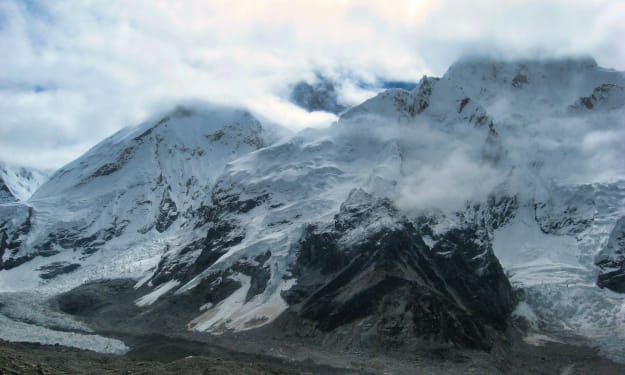
Guided or Lost — What Everest Base Camp Taught Me the Hard Way
I met a guy in Kathmandu who said he had done the Everest Base Camp trek alone. He looked proud, but also tired. His face had that hardened look of someone who had seen too much. I asked him how it went, and after a long pause, he said three words that stayed with me: Not worth it.
By Anima Tamangabout a year ago in Earth
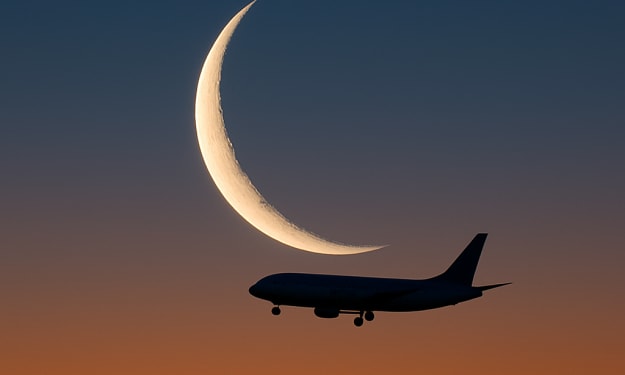
Chasing Dusk A Crescent Farewell
Imagine a scene that captures the quiet power of motion, the elegance of light, and the poetry of timing—all within a single, hyper-realistic frame. The image prompt presents a deeply evocative concept: a crescent moon gently holding the tail of an aircraft, flying away into a post-sunset sky with a perfect gradient of colors. This composition is not just visually striking; it’s emotionally rich and metaphorically layered.
By Anees Kaleemabout a year ago in Earth
A Quiet Home in the Heart of the Forest
There are places in the world where time slows down—not because clocks tick differently, but because the soul finally exhales. Deep within an ancient forest, tucked far from the hum of highways and the glow of cities, lies one such place. A quiet home, built not of marble or modern ambition, but of wood, stone, and stillness.
By Anees Kaleemabout a year ago in Earth
Surviving Scorching Heat in 2025. Content Warning.
As the summer of 2025 unfolds, many regions around the globe are experiencing unprecedented heat waves. Scorching temperatures can pose serious health risks, making it essential to take proactive measures to stay safe and comfortable. Here are some practical tips and strategies to help you navigate the extreme heat this year. Stay Hydrated One of the most critical aspects of surviving extreme heat is staying well hydrated. Your body loses a lot of water through sweat, and it’s essential to replenish it regularly. Here’s how you can ensure you stay hydrated:- Drink Plenty of Water. Aim to drink at least 8-10 glasses of water a day. Carry a water bottle with you to remind yourself to hydrate frequently. Avoid Dehydrating Drinks. Limit your intake of caffeine and alcohol, as they can lead to dehydration. Incorporate Hydrating Foods. Eat fruits and vegetables with high water content, such as cucumbers, watermelon, oranges, and strawberries. Dress Appropriately Your choice of clothing can significantly impact your comfort level during extreme heat. Opt for clothing that helps keep your body cool through:- Lightweight and Loose-fitting Clothes. Wear light-colored, loose-fitting clothing made from natural fabrics like cotton, which allow your skin to breathe and sweat to evaporate. Wide-brimmed Hats and Sunglasses. Protect your face and eyes from the sun’s harsh rays by wearing a wide-brimmed hat and UV-protective sunglasses. Stay Indoors During Peak Heat The sun is usually at its strongest between 10 a.m. and 4 p.m. During these hours, try to stay indoors or in shaded areas as much as possible to avoid direct sun exposure. Create a Cool Environment. Keep your home cool by closing blinds or curtains to block out the sun. Use fans or air conditioning to maintain a comfortable indoor temperature. If you don’t have air conditioning, consider spending time in public places like shopping malls, libraries, or community centers that are air conditioned. Limit Strenuous Activities. Avoid intense physical activities during the hottest parts of the day. If you must exercise, do so early in the morning or later in the evening when temperatures are cooler. Use Cooling Techniques There are several techniques you can use to cool down your body and stay comfortable during a heat wave:- Take Cool Showers or Baths: Cool water can help lower your body temperature. Taking a cool shower or bath is an effective way to refresh yourself. Use Wet Cloths: Apply damp cloths or towels to pulse points like your wrists, neck, and forehead. This can help cool your blood and reduce overall body temperature. Stay in the Shade: If you need to be outside, seek shaded areas and avoid direct sunlight. Use umbrellas or portable canopies to create shade if necessary. Protect Your Skin Sunburn can exacerbate the effects of heat and increase your risk of skin cancer. Protect your skin by:- Applying Sunscreen Use a broad spectrum sunscreen with an SPF of at least 30. Reapply every two hours and after swimming or sweating. Wearing Protective Clothing: Long sleeved shirts and long pants made from lightweight fabrics can provide an extra layer of protection against the sun’s harmful rays. Be Mindful of Heat Related Illnesses Extreme heat can lead to serious health issues like heat exhaustion and heat stroke. Be aware of the symptoms and take immediate action if you or someone else shows signs of heat-related illness: Heat Exhaustion Symptoms Heavy sweating, weakness, cold, pale, and clammy skin, fast or weak pulse, nausea, and fainting. Move to a cooler place, drink water, and apply cool cloths to the body. Heat Stroke Symptoms: High body temperature (above 103°F), hot, red, dry, or damp skin, rapid and strong pulse, confusion, and unconsciousness. Heat stroke is a medical emergency—call 911 immediately and try to cool the person down until help arrives. Stay Informed Keep yourself updated with weather forecasts and heat advisories. Local news channels, weather apps, and government websites often provide important information about extreme weather conditions. Check on Vulnerable Individuals Ensure that children, elderly people, and those with chronic illnesses are staying cool and hydrated. They are more susceptible to heat-related illnesses and may need extra care during heat waves. Conclusion As we face increasingly extreme weather patterns, being prepared for scorching heat is more important than ever. By staying hydrated, dressing appropriately, avoiding peak heat, using cooling techniques, protecting your skin, being mindful of heat-related illnesses, staying informed, and checking on vulnerable individuals, you can effectively manage and mitigate the risks associated with high temperatures. Remember, taking proactive steps can make a significant difference in your comfort and safety during the heat of 2025. For more such articles and information visit https//:informativechannel113.blogspot.com
By Naveed Younisabout a year ago in Earth