
Yesu Kristo anazungumza na Sanamu ya Uhuru (Swahili)
Translation: Christ talks to Liberty

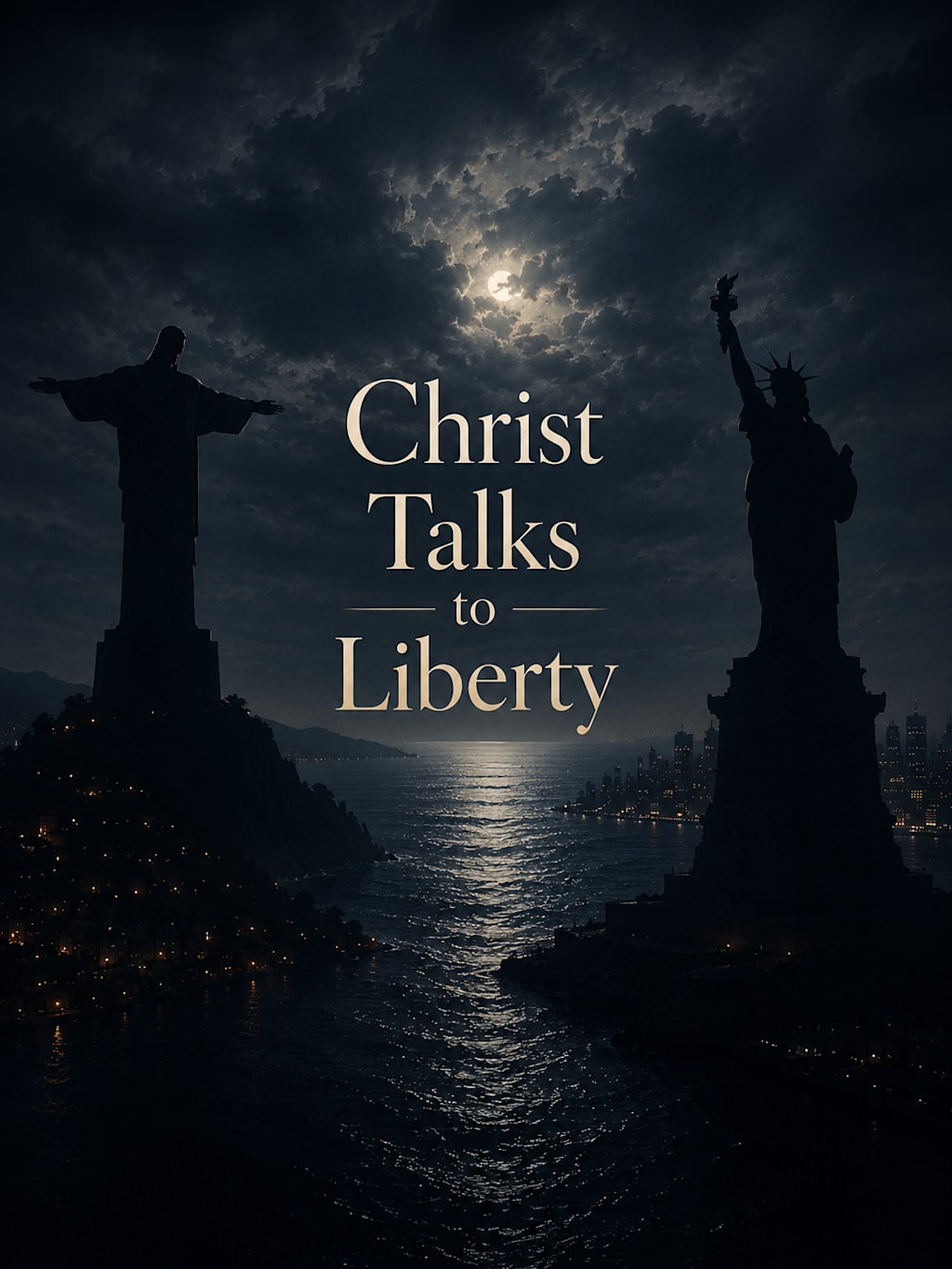
I started writing a story about Christ the Redeemer talking to Statue of Liberty. Basically, a conversation between Jesus Christ and Lady Liberty.
The idea came from thinking about what monuments would say if they could speak after witnessing generations of human behavior. Christ the Redeemer watches over a city shaped by beauty, poverty, celebration, and violence. The Statue of Liberty stands in a harbor that once represented hope, immigration, ambition, and reinvention. I imagined them speaking across oceans at night like old guardians comparing notes on humanity.
At first, the concept felt expansive and poetic. I wanted the story to move between politics, faith, immigration, race, tourism, loneliness, and the burden of symbolism. I pictured Liberty as exhausted and cynical from watching people chase dreams that America no longer consistently delivers. I imagined Christ the Redeemer as compassionate but conflicted, carrying the weight of human suffering below him while remaining physically frozen in eternal openness.
The problem is that the story never fully came together because the metaphor became larger than the narrative itself.
Every time I tried to write dialogue between them, the conversation drifted into abstract philosophy instead of becoming an actual story with momentum. The monuments had perspectives, but they did not have stakes. They could observe humanity, but they could not truly intervene in it. Because of that, the draft began to feel more like a collection of speeches than a living piece of fiction.
Another issue is tone. I could not decide whether the story wanted to be satirical, spiritual, political, or magical realist. Some passages sounded like a sermon. Others sounded like social commentary. A few sections leaned almost comedic because the idea of monuments gossiping about humanity has an inherent absurdity to it. Those tones kept colliding instead of blending.
The scope also became unmanageable. Once the monuments started discussing immigration, inequality, religion, and nationalism, every topic opened ten more doors. The story stopped feeling intimate. It became an argument with the entire modern world. I kept expanding the symbolism instead of grounding the narrative in a single emotional thread.
What holds it back most, though, is that I still do not fully understand what the monuments want from each other.
Are they comforting one another? Mourning humanity together? Warning each other? Falling into ideological disagreement? Watching civilization decay? I know the imagery. I know the atmosphere. I know the themes. But I still do not know the emotional destination.
So the draft remains suspended between concept and story.
What survives is the feeling: two enormous silent figures, built to inspire hope, speaking honestly for the first time after decades of watching humanity fail to live up to its promises.
About the Creator
Violet Hamilton
Harlem born. Author of Shark Weak. Wrote multiple Award-Winning Cast and Crew screenplay "What If" and "Trickster." Educated. World traveler. I now reside in Long Island, New York. I adore writing. It's the only time I get to play God.
Enjoyed the story? Support the Creator.
Subscribe for free to receive all their stories in your feed.
Comments
There are no comments for this story
Be the first to respond and start the conversation.