
The Shawshank Redemption Is Not the Masterpiece We Keep Saying It Is
A very good film trapped inside an extraordinary reputation

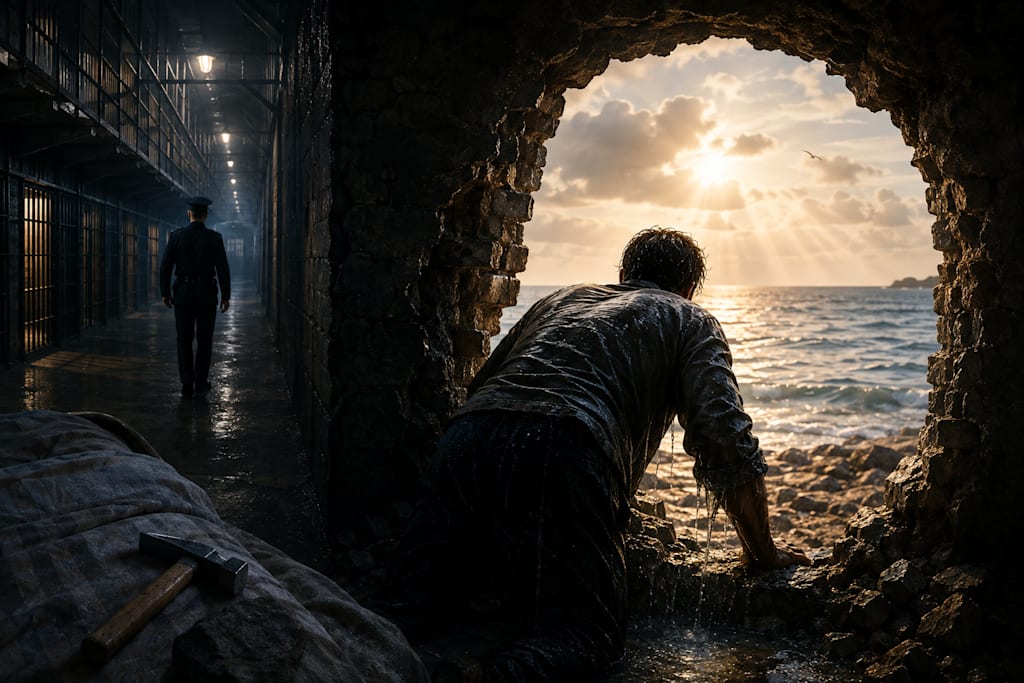
There are films people recommend.
Then there are films people defend.
The Shawshank Redemption belongs firmly to the second category.
Say that you dislike it and people assume you were distracted. Say that you merely think it is "good" and they look at you as though you have confessed an inability to experience hope. For years, it has occupied the upper reaches of audience rankings and has become one of those movies whose greatness is treated less as an opinion than as established fact.
So let me begin carefully.
The Shawshank Redemption is a good film.
It may even be a very good film.
But one of the greatest films ever made?
No.
And perhaps its extraordinary reputation tells us as much about what audiences want from movies as it does about the movie itself.
The film has almost everything required to be loved.
An innocent man.
A brutal institution.
A loyal friendship.
Corrupt authority.
Patient resistance.
A spectacular escape.
And, finally, redemption beneath a blue sky.
It is beautifully constructed.
Perhaps too beautifully.
That is my problem.
The movie presents itself as a story about the cruelty, randomness, and dehumanization of imprisonment, but beneath that surface it behaves like an exceptionally elegant machine designed to deliver emotional satisfaction.
Almost everything matters later.
Almost every humiliation contributes to eventual triumph.
Almost every detail receives its reward.
Even a poster on a prison wall becomes part of an ingenious mechanism.
Real despair is rarely so considerate.
Consider Andy Dufresne.
Tim Robbins plays him with admirable restraint, but Andy is less a psychologically messy human being than an ideal instrument for the story.
He is intelligent when intelligence is required.
Patient when patience is required.
Emotionally controlled when control is required.
Financially gifted when accounting becomes useful.
Geologically knowledgeable when rocks become useful.
And capable of maintaining an almost superhuman long-term plan without revealing enough of himself to jeopardize the film's final surprise.
He does not simply survive Shawshank.
He seems, retrospectively, to have been designed specifically to defeat it.
This makes for excellent storytelling.
It also makes the storytelling visible.
The famous escape is a perfect example.
We are meant to experience it as an astonishing revelation: Andy has spent years tunneling through his cell wall, concealing the hole behind posters, disposing of debris unnoticed, preparing false identities, gathering evidence, and eventually crawling through a sewage pipe to freedom.
It is exhilarating.
It is also the point at which the movie's emotional logic becomes almost mythological.
Andy does not merely escape prison.
He passes through filth and emerges into rain with his arms raised toward the heavens.
The symbolism could hardly be more explicit if Morgan Freeman paused the narration to announce:
"Andy was now being reborn."
And that narration is another problem.
Morgan Freeman could narrate the instructions for assembling a wardrobe and make them sound like wisdom discovered beside a dying fire.
His voice is magnificent.
But the film relies on it constantly.
Red tells us what events mean.
He tells us what Andy means.
He tells us what hope means.
He tells us what institutionalization means.
Again and again, the movie approaches an emotion and then gently explains it to us.
The technique works.
That does not make it subtle.
Brooks's story demonstrates this perfectly.
His release after decades in prison is genuinely moving. The outside world has become incomprehensible to him. His identity belonged to the institution that confined him, and freedom becomes another form of exile.
It is probably the film's strongest section.
Yet even here, the movie cannot resist arranging every emotional object precisely where it belongs.
The room.
The job.
The letter.
The carved message.
The tragedy.
Everything lands exactly where it should.
We are devastated on schedule.
And perhaps this explains why the film has become so universally loved.
It gives us suffering without leaving us trapped inside it.
Shawshank is cruel, but its cruelty is narratively useful.
The villains are sufficiently villainous that we can enjoy their punishment.
The innocent man is sufficiently innocent that our sympathy never becomes complicated.
The friendship is sufficiently pure that betrayal never seriously threatens it.
The ending is sufficiently complete that almost nothing remains emotionally unresolved.
Even the Pacific Ocean cooperates.
Compare that with genuinely unsettling prison films, or with films that refuse to transform suffering into moral architecture.
Those movies often leave us uncomfortable.
The Shawshank Redemption ultimately leaves us satisfied.
That is not a flaw by itself.
But satisfaction and greatness are not synonyms.
There is also the problem of reputation.
Watching The Shawshank Redemption today is almost impossible without hearing decades of applause before the opening credits.
You are not simply watching a film.
You are watching A Masterpiece.
The capitalization arrives in advance.
And when any artwork accumulates that much reverence, criticism begins to feel almost impolite.
Yet great works should survive impoliteness.
So what remains if we remove the cultural halo?
An exceptionally well-made Hollywood drama.
Strong performances.
Memorable characters.
Excellent pacing.
Emotional intelligence.
A superb score.
A satisfying narrative.
And one of cinema's most effective endings.
That is already a considerable achievement.
Why must it also be one of the greatest films ever made?
Perhaps because it offers something audiences desperately want: the belief that patience has meaning.
That injustice can be outlasted.
That friendship survives.
That corrupt men eventually receive punishment.
That suffering contains the architecture of its own escape.
That somewhere beyond the walls there is an ocean waiting for us.
I understand why people love that.
I understand why they return to it.
I understand why its final scenes make people feel better about being alive.
But those qualities make The Shawshank Redemption comforting more than profound.
Its darkness exists partly to make the light brighter.
Its despair exists partly to make hope triumphant.
Its prison ultimately becomes the setting for liberation.
Life is rarely that obliging.
Perhaps that is exactly why we love the film.
And perhaps that is also why we praise it too much.
The Shawshank Redemption is not overrated because it is bad.
It is overrated because "very good" somehow stopped being enough.
We turned an expertly made, deeply satisfying film into a sacred object.
Andy Dufresne escaped from Shawshank.
The film itself has never quite escaped from our need to call it a masterpiece.
About the Creator
Alain SUPPINI
I’m Alain — a French critical care anesthesiologist who writes to keep memory alive. Between past and present, medicine and words, I search for what endures.
Enjoyed the story? Support the Creator.
Subscribe for free to receive all their stories in your feed. You could also become a paid subscriber, letting them know you appreciate their work.
Comments
There are no comments for this story
Be the first to respond and start the conversation.