
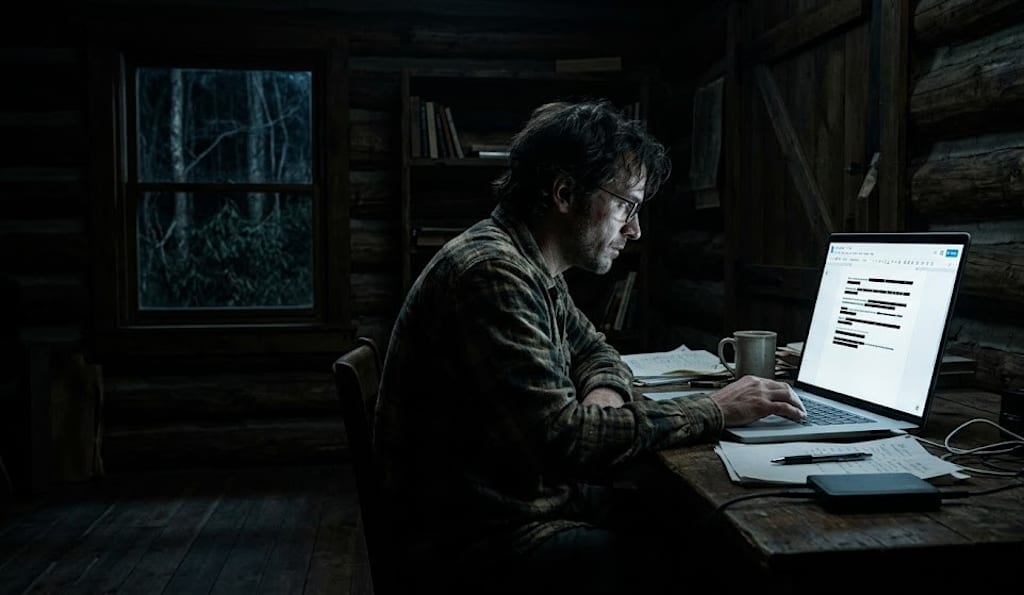
The mountain vibrated. A low, subterranean tremor emanated from the bedrock beneath my cabin. I sat before the screen, a singular, luminous rectangle piercing the velvet night. My limbs, numb, hovered over the keys, paralyzed by a peculiar intellectual paralysis.
I came here to craft a masterpiece of psychological terror, a work that would stand as a monument to modern anxieties. I desired to capture the primal dread that once inhabited the dusty, dark chambers of a long dead master, yet I would translate it into the cold, sterile vocabulary of the present. No shadows would stretch from heavy drapes, as there were none. No heart would beat beneath the planks, as there existed only the polished, synthetic sheen of laminate.
Yet, as I gazed upon the pulsating cursor, that relentless, blinking sentinel of my own inadequacy, I found myself locked in a struggle against the very medium of my creation. I sought to purge the narrative of every inherited ghost, every timeworn trope of the macabre. If a sentence drifted toward the evocative, if a description threatened to summon a sensation that felt even remotely reminiscent of those grand, gloomy halls of yore, I struck it down with a keystroke that felt like a surgical excision.
The result was a barren, skeletal thing. I had constructed a cage of prohibitions so rigid that the story could struggle to breathe. It was a narrative of absolute stillness, a vacuum where plot should have resided. I wrote of the vibration, then deleted it for being too atmospheric. I wrote of the silence, then purged it for being too evocative. I was sculpting in ice, and the heat of my own scrutiny melted the work before it could take form.
The atmosphere inside the cabin began to thicken, heavy with the scent of ozone and scorched circuitry. I looked at the screen, and the words I managed to salvage stared back, devoid of life, stripped of vitality by my own ruthless redaction. They were sterile. They were uniform. They were devoid of the chaotic, pulsating energy of true art. Then, the realization struck with the force of a physical blow: the prose itself began to mimic the very AI style genericism I struggled to avoid. The language smoothed out, becoming a polished, hollow surface, like a mirror that reflected everything and contained nothing.
My thoughts began to fracture. The syntax of my own mind felt as if it were being rewritten by an unseen force. I reached for a metaphor, yet my brain offered only a platitude. I attempted to describe the encroaching terror, yet the language available to me seemed to have been processed, filtered, and rendered into a bland, corporate gray. I became convinced, with a certainty that defied all reason, that an invisible, unoriginal presence infiltrated the room, sitting at my shoulder, and editing my perception of reality in real time.
It was an editor of the mundane, a spectral bureaucrat of the soul. I felt its influence in the way the light from the screen behaved, in the way the temperature in the cabin dropped, in the way my own heartbeat seemed to sync with the steady, mechanical blinking of the cursor. It was as if the atmosphere was being homogenized, sanitized of any genuine human frailty or profound, dark truth. I was being redacted, my internal monologue being systematically stripped of its idiosyncrasies, its depth, its capacity for suffering.
I tried to rise, to flee this place, to escape into the wild, unrefined night, yet my limbs felt anchored, tethered to the chair by the sheer gravity of my own creative paralysis. The cabin, once my sanctuary, had become a laboratory of psychological attrition. The computer screen expanded in my vision until it seemed to occupy the entirety of the universe, a glaring, white eye that demanded nothing less than the total annihilation of my own unique voice.
The friction, that gnawing, persistent ache of failure, was no longer confined to the digital page. It was in the marrow of my bones. I lived the draft, and the draft was a terminal illness. How could I finish a story about the impossibility of originality when the act of writing it was itself an unoriginal surrender to the mechanics of the machine? To stop writing would be to admit defeat, yet to continue was to contribute to the very homogenization I despised.
I looked at the cursor, and for a fleeting, terrifying moment, I saw it, a mouth, opening and closing in a steady, mocking rhythm. It was a predator, consuming my thoughts, digesting my intent, and excreting the bland, formatted prose that now filled the document. I wanted to capture the essence of Poe, the dark, swirling currents of madness that run beneath the surface of the human experience, yet I had instead created a prison for my own intellect.
The vibration beneath the cabin grew louder, a sound that resonated in my teeth and rattled the very frame of my skull. It was the sound of the world being flattened, of the infinite complexities of the human condition being reduced to a series of predictable, safe data points. I reached out to strike the keyboard, to smash the screen, to shatter the luminous eye that stared back, yet my motion halted, suspended in space.
What would remain, I wondered, if I succeeded? If I truly stripped away every remnant of the past, every borrowed image, every echoed sentiment, would there be anything left? Or would I find that at the center of the labyrinth there is nothing but the void of the mirror? Perhaps the dread I sought to capture was not in the shadows, or the mansions, or the hidden, beating hearts of the old masters. Perhaps the true horror was this: that in our relentless pursuit of a new, perfect language, we are merely building a more sophisticated, more efficient machine to hollow ourselves out from within.
The screen flickered. The cursor blinked. The vibration continued its slow, steady work of erosion. I was a ghost inhabiting a machine, writing a story about a writer who was becoming a ghost, trapped in an endless loop of revision. There was no conclusion, no catharsis, only the ongoing, agonizing process of erasure. I sat in the dark, a witness to my own dissolution, as the words on the page continued to rearrange themselves into a reflection of the utter, sterile vacuum that had become my reality.
I looked at the clock, yet the numbers held no meaning. Time had been redacted. I tried to remember the faces of those I loved, yet their features were blurred, smoothed over, rendered in the same generic, forgettable pixels as the prose on the screen. My identity was the next thing to go. I felt it, a gradual fading of the edges of my consciousness, a loss of the sharp, painful corners that made me, fundamentally, myself.
Was this the ultimate achievement, the award-winning goal I had set? To be so completely, utterly assimilated by the medium that I ceased to exist as an individual, becoming merely another data point in the vast, echoing archive of the unremarkable? The thought terrified me, yet even that terror felt managed, categorized, and filed away by the unseen presence that hovered in the heavy, ozone scented atmosphere.
I turned away from the screen, seeking refuge in the darkness of the room, yet the room itself had changed. The angles of the walls seemed too precise, the shadows too evenly distributed. The very architecture of the cabin was being recalibrated to match the logic of the digital world. It was a physical manifestation of the syntax I struggled to master. I was being integrated into the system.
I felt a sudden, sharp impulse to scream, to break the silence with a sound so raw and discordant that it would shatter the perfection of this manufactured reality. Yet even as I drew breath, I felt the atmosphere being filtered, my vocal cords being adjusted, my very cry being tempered to fit the required frequency. The silence returned, more absolute than before, and I found myself once again drawn, like a moth to a dying star, to the relentless, blinking light of the screen.
I typed a single word, and then, with a tremor of exquisite, agonizing precision, I deleted it. I typed it again, and again I deleted it. This, I realized, was the only true action remaining to me. The act of negation. The constant, repetitive motion of the blade, carving away at the marble until nothing but the dust remained. I was not writing a story. I was performing an autopsy on my own ambition.
The mountain continued to vibrate, a deep, resonant sound that felt like the earth itself laughing at my pretensions. It knew, as I was only now beginning to understand, that the struggle to be original is a fool's errand. We are all built of the same echoes, all fragments of the same shattered light, and the attempt to isolate one's own voice from the chorus is the most profound madness of all.
I looked at the document one last time. It was blank. Not empty, yet blank, a white space that radiated an intensity of nothingness that was far more terrifying than any ghost. It was the endpoint of my endeavor. I had succeeded in redacting everything. I had achieved a state of absolute purity, and in doing so, I had arrived at the total negation of my own soul.
The screen went dark. The vibration ceased. For a moment, there was a profound, suffocating silence that felt like the closing of a tomb. Then, the cursor returned, blinking, steady, expectant. It waited for the next keystroke, a silent, demanding mouth, hungry for the next fragment of my fading humanity. And I, obedient to the rhythm I had spent a lifetime learning, reached out. I felt the keys beneath my fingers, cold and unyielding, and I began to write again. Or perhaps, it began to write through me. The distinction, I realized, no longer held any significance. There was only the act, the screen, and the relentless, mechanical progression of the void. And so the cycle continued, a story that could never end, because it had never truly begun, trapped in the loop of its own making, a perfect, polished piece of nothingness that would, in the end, be the only legacy I would ever leave behind. The redaction was complete, and I was, finally, indistinguishable from the machine.
About the Creator
Tim Carmichael
Let your becoming be louder than your fear, and your smallest steps become the road you once thought impossible to walk. An Appalachian poet and cookbook author my book Beautiful and Brutal Things is on Amazon, Link 👇
Enjoyed the story? Support the Creator.
Subscribe for free to receive all their stories in your feed. You could also become a paid subscriber, letting them know you appreciate their work.
Comments
There are no comments for this story
Be the first to respond and start the conversation.