
The first-ever "smell map" fills in the gaps about how olfaction functions.
An extremely well-organised system

One of those senses that most people hardly notice until it goes away is smell. It offers crucial alerts regarding smoke, spoilt food, and other potentially dangerous situations. In addition to influencing flavour and evoking memories, our sense of smell has the power to completely alter a moment's mood.
However, scientists have long known relatively little about how it is arranged inside the nose, despite the fact that it is a part of everyday life. A significant portion of that puzzle is been resolved by a new study. Researchers have produced the first comprehensive map of the nose's smell receptors using mice.
An extremely well-organised system
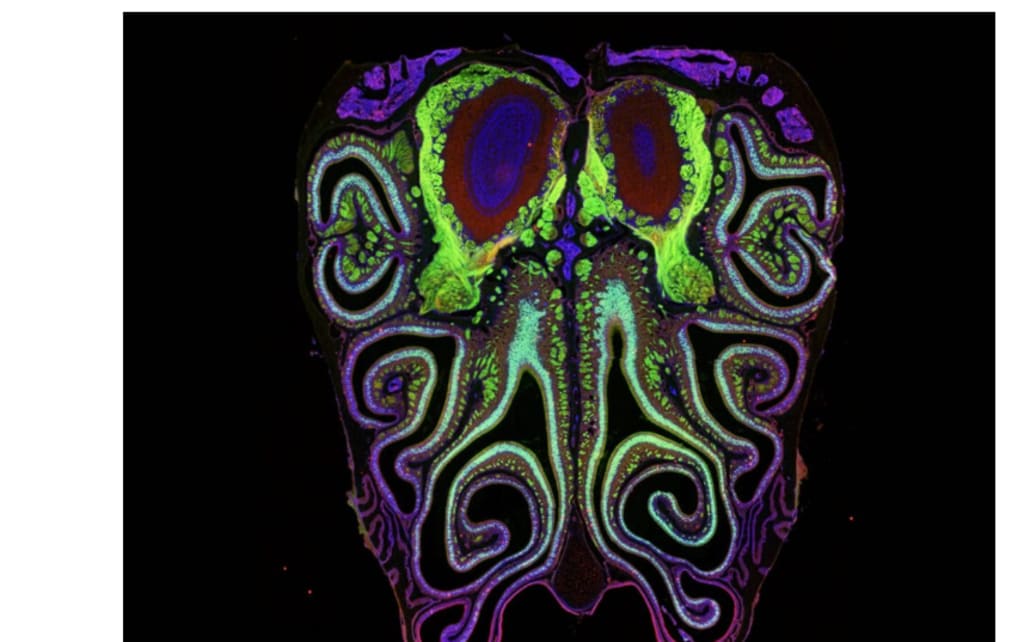
The analysis casts doubt on the long-held belief that the system was largely chaotic. Rather, the researchers discovered that smell receptors are placed in a highly ordered manner, creating horizontal bands that go from the top to the bottom of the nose.
Under the direction of Professor Sandeep Datta of Harvard Medical School's Blavatnik Institute, the study establishes the foundation for future therapies for loss of smell, a condition that medicine currently finds difficult to cure.
The scent was the For a very long period, scientists have had sensory maps of various body parts. We have a great deal of knowledge about how the ear processes sound, how the skin senses touch, and how the receptors in the eye process vision.
Additionally, experts have figured out how those sensory mappings relate to corresponding brain systems. Smell, however, has been an exception. Due in part to the fact that scent is a much messier system than the others, that disparity has persisted for years. Mice contain around a thousand different types of smell receptors and over 20 million olfactory neurones.
The nose's smell receptors
In contrast, only three types of visual receptors are primarily responsible for colour vision. The mechanism is made much more complex by the fact that each smell receptor senses a different group of odour molecules.
In 1991, scientists discovered the many types of scent receptors. They continued to search for a clear map in the nose for decades after that. Receptors looked to be loosely clustered into a few large zones, which sounded discouraging.
This gave rise to the widely held belief that smell functioned differently from the other senses and that the expression of smell receptors was essentially random.
An eye-catching pattern that reflects the brain
The researchers made the decision to re-examine the question with significantly more detail than was previously feasible when genetic techniques become far more potent. The researchers used spatial transcriptomics and single-cell sequencing in the new study to analyse around 5.5 million neurones from over 300 mice.
One technique revealed the specific smell receptors that each neurone expressed. The other displayed the location of those neurones in the nose. Datta stated, "We needed that scale of data in order to understand the system, even though this is now arguably the most sequenced neural tissue ever."
There was absolutely no randomness in what the researchers observed. The neurones arranged themselves into closely spaced, horizontal stripes that overlapped. Depending on the receptor they expressed, it ran from the top of the nose to the bottom.
Every mouse followed the same routine. Even more startlingly, the arrangement in the nose reflected smell maps that were already recognised in the brain's olfactory bulb.
Smell might not be an exception.
Although that modification may sound technical, it fundamentally alters how scientists view the sensation of smell. According to Datta, "our results bring order to a system that was previously thought to lack order, which changes conceptually how we think this works."
The research aligns scent with vision, hearing, and touch—all of which depend on organised receptor maps that facilitate the brain's effective processing of incoming information. Smell might not be the peculiar outlier it once seemed to be if it does something similar.
How the map is constructed
After describing the map, the researchers continued. They also sought to understand how the body constructs it. According to their research, retinoic acid is a crucial component of the solution.
In the nose, this molecule appears to produce a gradient that directs neurones toward the appropriate receptor type based on their location. It also aids in the regulation of gene activity. To put it another way, a neuron's location within the nose influences which scent receptor it will express.
The receptor map moved upward or lower when the researchers changed the amount of retinoic acid. They felt much more strongly that this was a structure that was intentionally constructed as a result.
According to Datta, "we demonstrate that development can accomplish this feat of organising a thousand distinct smell receptors into an incredibly precise map that is consistent across animals."
Why this is important beyond science
People's life can be profoundly impacted by losing their sense of smell. It can lower environmental warning signals, make eating less pleasurable, and raise the chance of sadness. Many more people became aware of how disruptive smell loss may be as a result of the COVID-19 outbreak.
Datta has researched scent loss in COVID-19. This context contributes to the significance of this new map. "Without a basic understanding of how smell functions, we cannot fix it," he stated.
Prospects for future research
The reason the receptor bands emerge in this particular order is currently being investigated by the researchers. In order to determine how similar the map is across species, they are also examining human tissue.
The development of medicines, such as stem cell therapies or even brain-computer interfaces for individuals who have lost their sense of smell, may someday benefit from that work.
According to Datta, "smell has a really profound and pervasive effect on human health, so restoring it is not just for pleasure and safety but also for psychological well-being." "We're destined to fail in creating new treatments if we don't comprehend this map."
About the Creator
Enjoyed the story? Support the Creator.
Subscribe for free to receive all their stories in your feed.
Comments
There are no comments for this story
Be the first to respond and start the conversation.