
The Dark Knight Is the Most Overrated Movie of the 21st Century
Eighteen years on, The Dark Knight still shows up on best-films-ever lists next to The Godfather and Citizen Kane. That placement has never made sense to me, and the longer the film sits in that company, the more the gap shows.

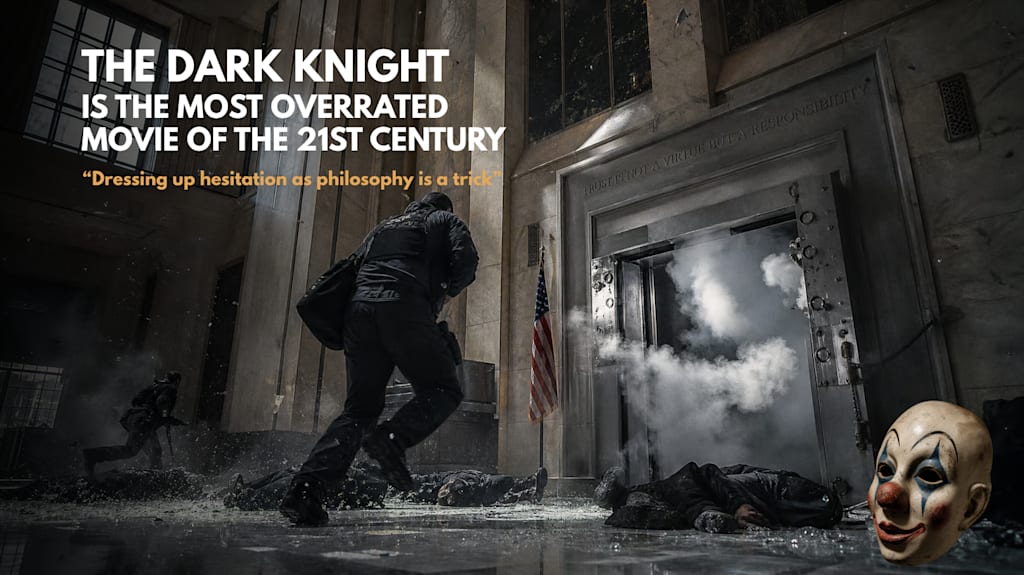
Let's be clear about what I'm not arguing. The Dark Knight is a good comic book movie. Christopher Nolan's ambition is real. Heath Ledger's performance is genuinely excellent. None of that is in dispute. What I'm disputing is the leap from "excellent superhero film" to "one of the greatest movies ever made," because that leap requires you to ignore plot holes, an abandoned character arc, and a moral centerpiece that falls apart the moment you look at it straight.
The Performance That Became Untouchable
Ledger's Joker is theatrical, unsettling, and one of the most quoted villain performances of the last two decades. It's also, I think, one-note in a way the film's reputation doesn't allow anyone to say out loud.
He's chaos incarnate from his first scene to his last, and that's a real strength for a horror-adjacent villain in a single film. Range is a separate question. Compare him to Anthony Hopkins' Hannibal Lecter, who reveals new layers every time he's on screen, or to Javier Bardem's Anton Chigurh, whose stillness does more work than any of Ledger's mannerisms. Even Joaquin Phoenix's Joker, whatever you think of that film, gives you an actual transformation across two hours. Ledger gives you the same fully-formed menace at minute five and minute one-fifty, which is a hell of a thing to sustain for two and a half hours, and also, I suspect, close to the ceiling of what the performance is actually doing.
I don't think that's a coincidence of timing, either. Ledger died months before the film's release, and a strong Oscar-contender performance turned into a posthumous legend almost overnight. Strip the context away and judge the physical work on its own terms, the same register held for the whole runtime, and what you get is excellent work in one key rather than the multi-layered performance its reputation claims. Eighteen years feels like enough distance to make that comparison on the film alone, though I'll admit this is the argument in this piece I'm least sure of. Performances get reassessed constantly, in both directions, and mine might not hold up any better than the consensus it's arguing against.
A Plan That Only Works If Everyone Follows the Script
Take the bank heist that opens the film. The Joker's crew has to kill each other off in sequence, on cue, with nobody deviating and nobody surviving a beat too early or too late. Watch it twice and the whole thing depends less on the Joker's genius than on a screenwriter making sure nobody in the scene does anything unexpected. It's convenience wearing a clever plan's coat.
There's also the question everyone raises, the one the film thinks it's answered but hasn't: why doesn't the Joker just kill Batman? He gets multiple chances. The film's answer is that the Joker needs Batman alive to prove a point about human nature, and in the interrogation scene he says as much directly, telling Batman "you complete me." The two of them, the logic goes, are opposite halves of the same idea, and neither means anything without the other.
It's a good line. It doesn't hold up. Watch what the Joker actually does for the rest of the film: he drives an eighteen-wheeler straight at Batman, rigs a truck convoy specifically to kill him, and spends the back half of the movie trying to get him shot by cops or torn apart by criminals. A villain who genuinely needs his opposite alive to complete him doesn't behave like that. "You complete me" plays beautifully in the scene it's spoken in, but it contradicts the Joker's behavior everywhere else in the runtime, and the plot hole doesn't go away just because the line covering it is this good.
The hospital explosion has the same problem in miniature, and I'll admit I have a soft spot for it, it might be my favorite shot in the whole trilogy. The Joker strolls out of a building mid-collapse with a scratch, timed so the explosion chases him out the door like a stunt coordinator's dream. It looks fantastic. It also doesn't survive a second of actual thought, and a film this reliant on "don't think about it" spectacle is coasting harder than its reputation gives it credit for.
The Cost Two-Face Pays for Someone Else's Ending
The common complaint about Harvey Dent is that his fall feels rushed. It does, and I don't think it's an accident. The film needs Dent's turn fast and total, because the ending only works if it is.
Aaron Eckhart is given a real arc on paper: an idealistic district attorney, Gotham's "white knight," a man who believes the city can be saved through the rules rather than a cape. Then Rachel dies, and instead of watching that belief erode in real time, we cut straight to a scarred man with a coin and a grudge. Two-Face gets something like fifteen minutes of screen time in a film that runs past two and a half hours, and almost the entire transformation happens off screen, reported rather than felt.
The film's ending hinges on Batman taking the blame for Dent's crimes so Gotham can keep believing in its white knight. That trade only works emotionally if Dent's fall reads as clean villainy, something a city needs protecting from. Give his breakdown real screen time, let the audience actually sit with a grieving, disintegrating man instead of a costume change between scenes, and he stops being a threat to cover up and starts looking like a tragedy the film would have to reckon with rather than paper over. Whether that trade was worth making is its own argument, and a harder one than "the pacing suffered." It's just not the one people usually have about this part of the film.
The Ferry Scene Doesn't Prove What Everyone Says It Proves
This is the one I have the most trouble letting go of, because it's treated as the film's moral payoff, the scene that supposedly earns The Dark Knight its philosophical reputation.
The setup: two ferries, one full of civilians and one full of prisoners, each holding the detonator for the other boat. Blow up the other boat and you live. Do nothing and the Joker kills everyone on both at midnight. It's framed as a test of whether ordinary people are fundamentally decent.
Here's what actually happens on screen. On the civilian boat, a vote is held, and the room leans toward pressing the button. Nobody can quite bring themselves to actually pull the trigger, and that hesitation is presented as proof of humanity's goodness. But a room voting to kill strangers and then flinching at the last second isn't much of an endorsement of human decency. It's people who can talk themselves into murder in the abstract and can't quite stomach doing it in front of each other. Take away the audience, and I'm not convinced the outcome holds.
On the other boat, the one clean, unambiguous act of decency in the whole scene happens, where a convicted man throws the detonator out a window before anyone else can use it. The film's own framing treats the prisoners as the morally suspect half of this experiment, and yet they're the ones who actually refuse to kill, while the "innocent" boat spends its screen time inching toward doing exactly that.
The Joker's thesis is that people are only good when it costs them nothing. The ferry scene barely argues against it. The civilians very nearly voted for mass murder. They just couldn't physically finish the act while everyone was watching. Batman narrates a lesson about faith in Gotham over the ending, but the scene itself supports a much messier and less comforting reading than the film wants credit for. Dressing up hesitation as philosophy is a trick, and it's one The Dark Knight gets a pass on that a lesser-regarded film wouldn't.
The "It's Not a Comic Book Movie" Defense
The most common way people protect The Dark Knight from criticism is to insist it isn't really a comic book movie at all, that it's actually a crime drama or a philosophical thriller that happens to have a man in a bat costume in it.
It's a comic book movie. A man dresses as a bat to fight a clown-faced terrorist. There's a secret identity, an origin story carried over from the previous film, and a hero with a strict no-killing code that's there because the comics require it more than the story does. It's built on a DC character inside a shared universe. None of that is a criticism on its own, but pretending it's absent lets people wave away the film's actual weaknesses as if they belong to a more serious genre that has nothing to do with them.
The comic book logic is everywhere once you look for it. Batman walks away from injuries that would end most action heroes. The Joker's schemes run on narrative convenience rather than anything resembling planning. Gotham itself reads more like a mood board than an actual city. Every superhero movie carries some version of these problems, and this one manages them about as well as any film of its type. What it doesn't do, whatever the reputation says, is transcend them. Nobody's really tried to argue that case in years, as far as I can tell. It just keeps getting repeated.
What Actually Deserves the Praise
None of this makes The Dark Knight a bad film. It's a genuinely well-made, well-acted, visually ambitious superhero movie, and it earned its place as one of the best of its genre. My argument isn't that it should rank lower than it does among comic book adaptations. It's that "best of its genre" and "one of the greatest films ever made, full stop" are different claims, and the second one only survives if nobody checks the plot logic, follows Harvey Dent's arc to its rushed conclusion, or looks too closely at what actually happens on those two boats.
The Godfather doesn't need anyone to argue it isn't a crime film. Casablanca doesn't need defending against the charge of being a romance. Genuinely great films wear their genre without needing an exception carved out for them. The Dark Knight needed that exception, got it, and has been living off it for eighteen years. It's time the reputation caught up with the film that's actually on screen.
About the Creator
Phil Henderson
I'm Phil Henderson. I ghostwrite for brands and founders by day as well as consult as a SAP Project Manager for major organisations. Here on Vocal I just write, essays, critiques, the odd short story.
Enjoyed the story? Support the Creator.
Subscribe for free to receive all their stories in your feed. You could also become a paid subscriber, letting them know you appreciate their work.
Comments
There are no comments for this story
Be the first to respond and start the conversation.