Proofreading
Mapping vs Listing
Much of what gets labeled as rambling is actually a mismatch between how ideas are structured internally and how they are expected to be presented externally. Many environments reward listing, where ideas are arranged in clean sequences, bullet points, or linear arguments that move from premise to conclusion in a predictable order. This structure works well for certain kinds of reasoning, particularly when problems are discrete and conclusions are already known. It does not work as well for reasoning that depends on relationships, causality, or pattern recognition across multiple domains. When relational thinkers speak, they are often navigating a different internal structure altogether, and that difference is frequently misunderstood.
By Peter Thwing - Host of the FST Podcast7 months ago in Critique
Falling Between Every System
Modern social systems are often described as safety nets. Employment law protects workers. Healthcare programs provide treatment. Disability benefits replace lost income. Unemployment insurance bridges job loss. Each system is presented as a safeguard designed to catch people when life disrupts their ability to function normally. Yet for many people living with disability, chronic illness, or injury, the lived experience is the opposite. Rather than forming a net, these systems stack vertically, each with its own eligibility rules, thresholds, and assumptions. Instead of catching the fall, they create gaps. People do not slip through because they failed to try. They fall because the systems were never designed to align.
By Peter Thwing - Host of the FST Podcast7 months ago in Critique
Why Saying Less Makes Words Feel More Valuable
There is a widely held belief that words gain value through scarcity. When someone speaks rarely, their statements are treated as weightier, more deliberate, and more worth attending to. When someone speaks often, their words are assumed to be interchangeable, disposable, or less carefully considered. This intuition is not entirely wrong, but it is frequently misapplied. Scarcity does affect perception, but perception is not the same as truth, and rarity is not the same as meaning.
By Peter Thwing - Host of the FST Podcast8 months ago in Critique
Speaking to Time Instead of the Room
Much of modern communication is oriented toward immediacy. Writing is framed as something meant to be consumed quickly, reacted to instantly, and replaced just as fast by whatever comes next. Under this model, the value of a piece is measured almost entirely by its initial reception. If it does not land immediately, it is treated as a failure. This assumption narrows the purpose of writing and misunderstands how meaning actually travels through time.
By Peter Thwing - Host of the FST Podcast8 months ago in Critique
Practice vs Performance
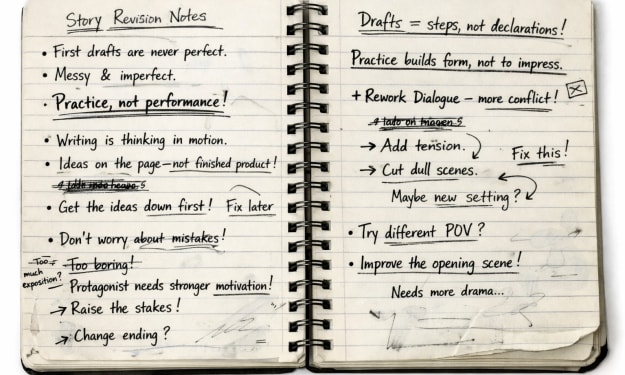
One of the quiet pressures shaping modern communication is the assumption that anything written should be immediately shareable. Drafts blur into declarations, and exploration is mistaken for conclusion. Under this pressure, writing becomes performative by default. The moment words are placed on a page, they are treated as finished statements rather than steps in a process. This expectation distorts both how writing is produced and how it is received, collapsing practice into performance and leaving little room for genuine development.
By Peter Thwing - Host of the FST Podcast8 months ago in Critique
AI as a Reflective Surface
Much of the confusion surrounding artificial intelligence comes from treating it as an agent rather than a surface. When people speak about AI “doing the thinking,” “creating the ideas,” or “speaking for someone,” they are often projecting agency onto a system that does not possess intention, belief, or understanding. This projection obscures what is actually happening in many real-world uses. In those cases, AI is not acting as a source of meaning, but as a surface that reflects, redirects, and reshapes what is already present.
By Peter Thwing - Host of the FST Podcast9 months ago in Critique
When Is a Move Final?
The Commitment Problem in Modern Chess Modern chess operates under a fractured commitment model that no longer aligns with how players think, how turns function in most games, or how chess itself is actually played across physical and digital formats. At the heart of the problem is that chess treats physical contact with a piece as binding commitment while simultaneously relying on a separate explicit action to end a player’s turn. This creates a logical contradiction: a move becomes final before the turn is over. In most turn-based games, interaction with game components is provisional until the player explicitly signals the end of their turn. Chess is an anomaly in this respect, and the inconsistency becomes increasingly visible in modern play.
By Peter Thwing - Host of the FST Podcast9 months ago in Critique
The Lost City of Z
The Lost City of Z by David Grann Growing up I thought I wanted to be an archaeologist. Now that I’m a ripe 32, I realize what I really wanted to be was an adventurer–someone who dug deep into the dark and emerged with treasures unseen for millennia.
By Matthew J. Fromm10 months ago in Critique
Report on the Rumor of a Fire at the Grand Egyptian Museum
Report on the Rumor of a Fire at the Grand Egyptian Museum In recent days, news spread rapidly claiming that a major fire had broken out at the Grand Egyptian Museum, located near the Giza Pyramids. These reports caused widespread concern across media platforms and social networks. However, official authorities later confirmed that these stories were false and that the museum remains fully operational, with no incidents reported. This report explores what actually happened, how the authorities handled the rumors, and why verifying news before sharing it is essential. When the rumor first began to circulate, social media platforms were flooded with photos and videos allegedly showing flames and smoke rising from the museum’s roof. Some posts claimed that valuable artifacts had been damaged, while others suggested that the supposed fire had delayed the museum’s official opening. These images caused panic among Egyptians and archaeology enthusiasts worldwide, as the museum is considered one of the most significant cultural projects of the 21st century. Within hours, the responsible authorities released official statements denying the claims and clarifying that the circulating images were either fabricated or taken from unrelated, older incidents. Officials emphasized that the museum’s safety and security systems operate around the clock and that its advanced fire protection technology functions efficiently. They also confirmed that all archaeological artifacts are completely safe and that no part of the building suffered any harm. Despite the official denial, the rumor continued to circulate on some pages for a while, prompting many people to question why such false news spreads so easily. Media experts suggest that the rapid spread of misinformation today is often driven by artificial intelligence tools capable of generating highly realistic fake images and videos. They note that people are naturally drawn to shocking or emotional stories and may share them impulsively without verifying their authenticity. Meanwhile, staff members at the Grand Egyptian Museum explained that the facility is equipped with one of the most advanced fire detection and suppression systems in the region, as well as a detailed emergency response plan. The entire site is under constant surveillance through modern camera systems, making it virtually impossible for any fire to occur without being immediately detected and contained. It is worth noting that this is not the first time such rumors have appeared. Back in 2018, a small incident occurred during the museum’s construction phase when some flammable materials caught fire in an external work area. The minor blaze was quickly extinguished without any injuries or damage to the structure or artifacts. Experts believe that images from that old event were later reused and falsely presented online as recent evidence of a new fire. The Grand Egyptian Museum is one of the largest museums in the world dedicated to ancient Egyptian civilization. It houses more than one hundred thousand artifacts, including the complete collection of the young pharaoh Tutankhamun. The museum also symbolizes international collaboration between Egypt and various global partners in the fields of culture and archaeology. Consequently, any rumor concerning this monumental institution attracts significant local and international attention. This incident highlights the critical importance of media literacy and public awareness. False news can harm a nation’s reputation, disrupt public confidence, and even affect tourism—a key sector that relies heavily on trust and stability. When fake stories about major cultural institutions spread, they can mislead the public and undermine the credibility of official communication channels. For this reason, both citizens and media organizations must work together to combat misinformation by sharing only verified and credible information. Fact-checking should always be the first step before reposting or commenting on any trending story, especially those related to national heritage or public safety. Only through collective responsibility can societies protect the truth and preserve their cultural image before the world. In conclusion, the reports claiming that a fire occurred at the Grand Egyptian Museum were entirely false. The museum has not experienced any fire or damage in recent times and continues its preparations to become one of the most important museums globally, showcasing Egypt’s ancient history through cutting-edge technology. This incident serves as a powerful reminder of the dangers of misinformation and the need for vigilance and verification in the digital age.
By America today 11 months ago in Critique
Truth Demands Proof
I saw a post on Facebook where a man shared a letter he had sent to his elected officials calling for the impeachment of the sitting president. He claimed that the offenses were “so obvious” and “so well documented” that he did not even need to include them. That single assumption captured everything wrong with modern political thinking. When someone says “the reasons are obvious,” what they often mean is that they cannot defend them. Emotional conviction replaces evidence. The appearance of certainty replaces truth itself.
By Peter Thwing - Host of the FST Podcastabout a year ago in Critique
Returning to Vocal and Writing
Wow. It's been a wild ride the past five years. From telemarketing in 2021, to a failed craft business in 2022, to Vanlifing in 2023, to wasting tons of money in 2024, to hiding in my four walls in 2025. Bizarre, absolutely bizarre. I have horror stories and comical stories. I have romantic stories and tragic stories. But most of all, I have my own emotional journey story and that begins with coming back to the world wide web to continue my writing career. And that begins with the two websites that have prompted me to call myself a professional writer: Vocal.media and allpoetry.com.
By Shanon Angermeyer Normanabout a year ago in Critique