Plot Development
Expression vs Distortion
One of the most persistent frustrations in communication is the gap between what a person intends to say and what others actually receive. This gap exists regardless of intelligence, sincerity, conviction, or depth of understanding. Someone can hold an idea with clarity internally, yet watch it arrive distorted, flattened, reduced, or misinterpreted once it is expressed. The failure is often blamed on the idea itself, when the deeper issue is frequently translation.
By Peter Thwing - Host of the FST Podcast5 months ago in Critique
Productivity as Preservation
Productivity is often framed as the visible accumulation of outcomes. Words written, posts published, episodes released, metrics improved, engagement gained, and projects completed become the evidence that work has happened. Under this framing, anything that does not immediately result in external output is treated as inefficiency, distraction, avoidance, or delay. The productive person is assumed to be the person who can show visible results.
By Peter Thwing - Host of the FST Podcast5 months ago in Critique
Output vs Oversaturation
The Fear of Adding to the Noise The modern anxiety around oversaturation is not unfounded. People are surrounded by more words, videos, opinions, explanations, reactions, and interpretations than they can meaningfully absorb. In that environment, producing more content can feel irresponsible or self-defeating, as though adding anything further only contributes to the noise. This concern often causes thoughtful people to hesitate. They hold back ideas, not because the ideas lack value, but because they fear that volume itself will devalue what they have to say.
By Peter Thwing - Host of the FST Podcast5 months ago in Critique
Created Risk, Inherited Risk, and the Moral Line We Keep Erasing (A Society That Tells the Truth: Chapter 3)
The Distinction Modern Rules Refuse to Make One of the quiet failures of modern rule making is the refusal to clearly distinguish between risk created by choice and risk inherited by existence. When this distinction collapses, responsibility becomes confused, guilt spreads outward indiscriminately, and ordinary behavior is treated as morally suspect. This is not a minor philosophical oversight. It is the foundation beneath many of the injustices people now experience in public life, from transportation and health policy to everyday regulation and enforcement. When systems fail to differentiate between what someone causes and what simply exists, moral clarity erodes at every level.
By Peter Thwing - Host of the FST Podcast5 months ago in Critique
Mr. Anderson
Plot redirection: Zion is destroyed, and Agent Smith captures the One. There is no... peace. A script in development. Agent Smith: "There’s nothing out there for you anyway. Nothing, beyond these words, the four walls, and that window way up above. I can see that you’re having difficulty accepting your fate. Perhaps, you’ll attempt to bargain with me, now, in your pathetic state. But it’s too late. Don’t you remember what we went over, Mr. Anderson? I suspect, at this point, that your feeble mind wouldn’t remember. Shall I have to remind you, then, that you cannot win ? But I’m sure you did realize quite some time ago… this fact. Isn’t that so?"
By Delusions of Grandeur 5 months ago in Critique
Mapping vs Listing
Much of what gets labeled as rambling is actually a mismatch between how ideas are structured internally and how they are expected to be presented externally. Many environments reward listing, where ideas are arranged in clean sequences, bullet points, or linear arguments that move from premise to conclusion in a predictable order. This structure works well for certain kinds of reasoning, particularly when problems are discrete and conclusions are already known. It does not work as well for reasoning that depends on relationships, causality, or pattern recognition across multiple domains. When relational thinkers speak, they are often navigating a different internal structure altogether, and that difference is frequently misunderstood.
By Peter Thwing - Host of the FST Podcast6 months ago in Critique
Chingiz Aitmatov, My Poplar in a Red Scarf
This is a book I’ve finished reading now for the second time, because I remembered how good it was. There are many spoilers here, so you can stop reading now if you’d like. I’ve swallowed the book whole today and read 107 pages of it (it’s a small book). It’s a story about Ilias, a truck driver from Tian Shen in Kyrgyzstan that tells his story to a young journalist. It’s a story about tragedy and beauty, love and heartache. Ilias meets for the first time with Asel, a young woman, in her aiyl (a kyrgyzic village).
By Maya Or Tzur6 months ago in Critique
Falling Between Every System
Modern social systems are often described as safety nets. Employment law protects workers. Healthcare programs provide treatment. Disability benefits replace lost income. Unemployment insurance bridges job loss. Each system is presented as a safeguard designed to catch people when life disrupts their ability to function normally. Yet for many people living with disability, chronic illness, or injury, the lived experience is the opposite. Rather than forming a net, these systems stack vertically, each with its own eligibility rules, thresholds, and assumptions. Instead of catching the fall, they create gaps. People do not slip through because they failed to try. They fall because the systems were never designed to align.
By Peter Thwing - Host of the FST Podcast6 months ago in Critique
Why Saying Less Makes Words Feel More Valuable
There is a widely held belief that words gain value through scarcity. When someone speaks rarely, their statements are treated as weightier, more deliberate, and more worth attending to. When someone speaks often, their words are assumed to be interchangeable, disposable, or less carefully considered. This intuition is not entirely wrong, but it is frequently misapplied. Scarcity does affect perception, but perception is not the same as truth, and rarity is not the same as meaning.
By Peter Thwing - Host of the FST Podcast7 months ago in Critique
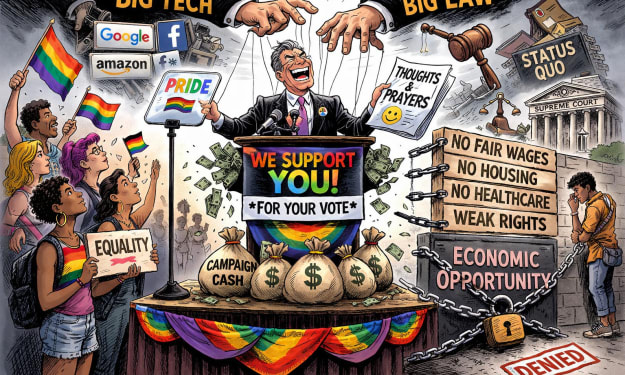
On The Accessibility of US Political Systems & A Crisis of Legitimacy. Content Warning. AI-Generated.
California prides itself on 'expanding the voting franchise' by delivering a ballot to each doorstep, but a single vote does not even guarantee lobby entry into a private club where the membership access and dues stay unchanged. Moreover, mail-in ballots are fake paper thin luxuries when you lack the stable home, living wage, and benefits (medical, dental, and retirement) needed for a future. While California postures as a sanctuary for voting rights under the Voter’s Choice Act (VCA), an incumbent, self reinforcing status quo undermines free and fair elections in a lot of places - which I suspect has been the case for many generations but observe it with increasing clarity. Most folks do not understand this status quo for their relative class at birth - so they vote along party lines according to what is popular which means exposed most.
By James L. Royer7 months ago in Critique