Fiction
Scrooge has entered the building!. Top Story - November 2025.
From the swirling depths of inner turmoil, I grace you with a moment of much-needed sarcasm... I was gifted/tempted with the task of sharing unbiased opinions for a torrent of uplifting pieces of written art that have found their way to my unapproving eyes.
By Lamar Wiggins11 months ago in Critique
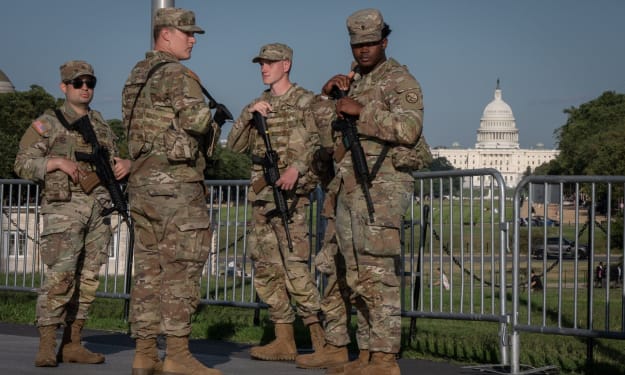
Judge Temporarily Blocks Deployment of National Guard in Washington
A federal judge in Washington temporarily blocked the Trump administration on Thursday from maintaining more than 2,000 members of the National Guard deployed to the city’s streets, finding the city was likely to succeed in arguing the deployment was illegal. Judge Jia M. Cobb of Federal District Court, a Biden appointee, wrote in a 61-page opinion that the deployment, which began in August, appeared to be illegal for a variety of reasons, including limits on the president’s authority to assert total control over the local D.C. National Guard, as well as concerns over the city’s rights to self-governance. Those concerns were compounded, she wrote, by the fact that more than 1,000 members of the force deployed to Washington are from other states, and that the Trump administration had taken steps to establish a semi-permanent command structure, with an eye to keeping troops in the city well into next year. She paused her ruling for three weeks, to allow time for the administration to remove the troops, as well as to appeal her decision. “At its core, Congress has given the District rights to govern itself,” Judge Cobb wrote. “Those rights are infringed upon when defendants approve, in excess of their statutory authority, the deployment of National Guard troops to the District.” President Trump announced the deployment in Washington as part of an aggressive drive to ratchet up law enforcement in the city, directing heavily armed National Guardsmen to deploy to the city while integrating federal agents with local police officers to conduct sometimes routine police work. The troops have also played a role as armed backup for sharply stepped-up immigration and deportation operations around the city in what experts have described as a trial run in joint immigration operations. Since the summer, small groups of armed National Guardsmen have been ubiquitous around the city, patrolling subway stops, tourist areas and nightlife districts. They have also been subject to mockery online after being observed guarding national monuments and relatively vacant areas or doing “beautification” work such as removing trash or sweeping plant debris. Judge Cobb’s ruling followed several others around the country in which federal judges found that Mr. Trump’s deployment of troops to Chicago, Memphis and Portland, Ore., also most likely violated the law. The Supreme Court is currently considering whether the president can deploy hundreds of National Guard troops to the Chicago area over the objections of state and local leaders. Whatever the justices decide in the Illinois case will most likely set the ground rules for Mr. Trump’s efforts to use state-based troops in other American cities as part of his aggressive immigration crackdown. But it’s not clear if the court’s decision will have a similar impact in Washington, because of the unusual status of the District of Columbia, where federal authorities including the president have expanded powers. Mr. Trump has used that authority to bring in a force of National Guard troops contributed by at least 9 Republican states to serve as a semipermanent patrol in the city, and has announced plans to keep the force in place until at least the end of February. “There is also the risk that this incursion may become permanent, or at least enduring, given the creation of a D.C.N.G. unit specifically established to conduct law enforcement in the District,” Judge Cobb wrote, referring to the D.C. National Guard. She noted that under the Home Rule Act, the federal law granting the city limited self-government, Congress delegated considerable control over the city’s law enforcement to its local leaders. She described the president’s actions as “major intrusions into local governance.” She wrote that the Trump administration “exceeded the bounds of their authority” with the deployment, and “acted contrary to law” by sending in the Guard to carry out “nonmilitary, crime-deterrence missions in the absence of a request from the city’s civil authorities.” A White House spokeswoman said in an email that Mr. Trump enjoyed broad power to assume control over and command the members of the D.C. National Guard. “This lawsuit is nothing more than another attempt — at the detriment of D.C. residents — to undermine the president’s highly successful operations to stop violent crime in D.C.,” said the spokeswoman, Abigail Jackson. While Muriel E. Bowser, the city’s mayor, initially opposed the Trump administration’s efforts to wrest law enforcement control from her office, she has since softened her rhetoric, expressing openness to collaborating with the federal government to decrease crime in the city. The lawsuit was brought by Brian Schwalb, Washington’s attorney general, who was elected separately from the mayor. He celebrated the ruling as a major breakthrough for the city after months of daily patrols by armed troops spread out across much of the city. “From the beginning, we made clear that the U.S. military should not be policing American citizens on American soil,” he said in a statement. “Normalizing the use of military troops for domestic law enforcement sets a dangerous precedent, where the president can disregard states’ independence and deploy troops wherever and whenever he wants — with no check on his military power.” The decision was a second win for Mr. Schwalb’s office. A previous case kept control of the local police department with city leaders after Mr. Trump had tried to use emergency powers to seize command.
By DigitalAddi11 months ago in Critique
Report on the Rumor of a Fire at the Grand Egyptian Museum
Report on the Rumor of a Fire at the Grand Egyptian Museum In recent days, news spread rapidly claiming that a major fire had broken out at the Grand Egyptian Museum, located near the Giza Pyramids. These reports caused widespread concern across media platforms and social networks. However, official authorities later confirmed that these stories were false and that the museum remains fully operational, with no incidents reported. This report explores what actually happened, how the authorities handled the rumors, and why verifying news before sharing it is essential. When the rumor first began to circulate, social media platforms were flooded with photos and videos allegedly showing flames and smoke rising from the museum’s roof. Some posts claimed that valuable artifacts had been damaged, while others suggested that the supposed fire had delayed the museum’s official opening. These images caused panic among Egyptians and archaeology enthusiasts worldwide, as the museum is considered one of the most significant cultural projects of the 21st century. Within hours, the responsible authorities released official statements denying the claims and clarifying that the circulating images were either fabricated or taken from unrelated, older incidents. Officials emphasized that the museum’s safety and security systems operate around the clock and that its advanced fire protection technology functions efficiently. They also confirmed that all archaeological artifacts are completely safe and that no part of the building suffered any harm. Despite the official denial, the rumor continued to circulate on some pages for a while, prompting many people to question why such false news spreads so easily. Media experts suggest that the rapid spread of misinformation today is often driven by artificial intelligence tools capable of generating highly realistic fake images and videos. They note that people are naturally drawn to shocking or emotional stories and may share them impulsively without verifying their authenticity. Meanwhile, staff members at the Grand Egyptian Museum explained that the facility is equipped with one of the most advanced fire detection and suppression systems in the region, as well as a detailed emergency response plan. The entire site is under constant surveillance through modern camera systems, making it virtually impossible for any fire to occur without being immediately detected and contained. It is worth noting that this is not the first time such rumors have appeared. Back in 2018, a small incident occurred during the museum’s construction phase when some flammable materials caught fire in an external work area. The minor blaze was quickly extinguished without any injuries or damage to the structure or artifacts. Experts believe that images from that old event were later reused and falsely presented online as recent evidence of a new fire. The Grand Egyptian Museum is one of the largest museums in the world dedicated to ancient Egyptian civilization. It houses more than one hundred thousand artifacts, including the complete collection of the young pharaoh Tutankhamun. The museum also symbolizes international collaboration between Egypt and various global partners in the fields of culture and archaeology. Consequently, any rumor concerning this monumental institution attracts significant local and international attention. This incident highlights the critical importance of media literacy and public awareness. False news can harm a nation’s reputation, disrupt public confidence, and even affect tourism—a key sector that relies heavily on trust and stability. When fake stories about major cultural institutions spread, they can mislead the public and undermine the credibility of official communication channels. For this reason, both citizens and media organizations must work together to combat misinformation by sharing only verified and credible information. Fact-checking should always be the first step before reposting or commenting on any trending story, especially those related to national heritage or public safety. Only through collective responsibility can societies protect the truth and preserve their cultural image before the world. In conclusion, the reports claiming that a fire occurred at the Grand Egyptian Museum were entirely false. The museum has not experienced any fire or damage in recent times and continues its preparations to become one of the most important museums globally, showcasing Egypt’s ancient history through cutting-edge technology. This incident serves as a powerful reminder of the dangers of misinformation and the need for vigilance and verification in the digital age.
By America today 12 months ago in Critique
Shadow at the Gate
On my way home from middle school, I spot what might be a possible shortcut to my home. Checking both ways, I cross to the other side of the street and kick the gravel where a sidewalk should be. A canal runs through a field and under the train tracks. Maybe I can go under the train tracks through the canal. That can save me a mile of walking five days a week, technically 180 days a year. That potential shortcut is worth exploring for one day.
By Eileen Davis12 months ago in Critique
The Dream We Can't Wake Up From
I remember leaving the theater after seeing Inception feeling like my mind had been put through a workout, but in the best way possible. On the surface, it's this incredibly smart and thrilling heist movie that just happens to take place inside the most fascinating dreams. The visuals are stunning cities folding over on themselves, zero-gravity fights in a spinning hallway—it’s the kind of spectacle that makes you remember why you love going to the movies.
By Zara Schwartz12 months ago in Critique
I rewatched Twilight: Breaking Dawn Part 2
The Twilight Saga: Breaking Dawn Part 2 (2012) serves as the conclusion to the massively popular franchise based on Stephenie Meyer's novels. Directed by Bill Condon, the film attempts to provide closure to the supernatural romance while delivering the spectacle audiences expected from a franchise finale. However, its execution reveals both the strengths and significant weaknesses that defined the series.
By Parsley Rose about a year ago in Critique
The Last Bet
It was a gray evening in Paris when Julien entered the small café on Rue des Martyrs. The rain tapped against the window, soft and relentless, like time reminding him he was running out of it. He had one last envelope of cash — ten thousand euros — all that remained of his father’s inheritance.
By GoldenSpeechabout a year ago in Critique
I went back and watched Twilight: New Moon (2009)
The Sophomore Slump New Moon, the second installment in the Twilight saga, attempts something genuinely daring for a blockbuster franchise: it removes its male lead for the majority of the film's runtime. This bold narrative choice serves the story's emotional arc but simultaneously exposes the franchise's structural weaknesses. In an era where young adult adaptations were rushing to capitalize on the success of the first film, New Moon takes the unexpected route of dwelling in darkness, depression, and absence—a risky gambit that doesn't entirely pay off.
By Parsley Rose about a year ago in Critique