
One Brick Knew the Truth: The Real Reason the Tower of Babel Never Stood a Chance
Ancient ambition met arithmetic — and the bottom brick cracked first.
The Limit of a Single Brick
Babylon, 6th century BC.
If a man stood on the banks of the Euphrates and looked up at the stepped temple called Etemenanki, he would have thought it touched the sky. 91 meters. Three hundred feet. On the flat plain, it was the tallest thing human hands had ever raised.
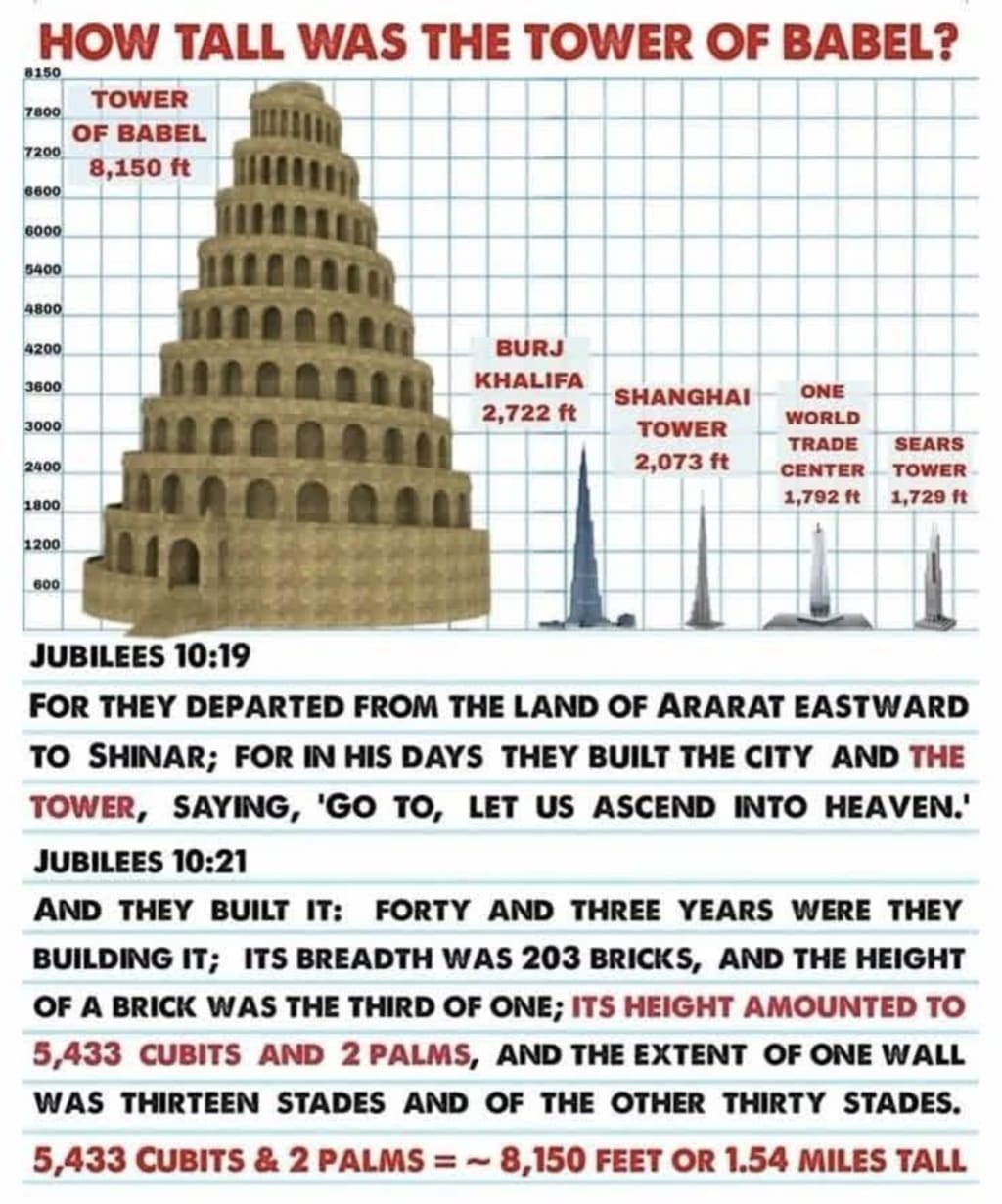
About a thousand years later, someone researched a manuscript and decided 91 meters wasn't bold enough. He picked up his pen and rewrote the tower's height as one mile. The base became 4.6 kilometers long and 2 kilometers wide. The wall thickness became 203 bricks.
He probably thought the change was reasonable—after all, both numbers meant "absurdly high." A thousand meters and a hundred meters look the same on paper.
But bricks don't.
I. The Brick at the Bottom
Clay bricks, fired at low temperature, mixed with chopped reeds, held together with bitumen.
Modern labs have tested this kind of material: compressive strength between 10 and 15 megapascals. Be generous—take 15.
One mile is 1,600 meters. The density of brick is about 2,000 kilograms per cubic meter.
Gravity is 9.8.
Pressure at the bottom = 2000 × 9.8 × 1600 = 31.36 megapascals.
31 is greater than 15.
What does that mean? It means that when the tower reached about 750 meters, the lowest brick was already bear pressure beyond its internal structural limit. It wouldn't shatter with a dramatic crack—nothing so cinematic. It would creep. Microstructure sliding, grains shifting, the brick slowly expanding, cracking, powdering.
You couldn't see it from the ground. But that brick knew it couldn't hold.
After 750 meters, every new brick placed on top was the final straw.
At half the intended height, the material at the bottom was already dead.
II. The Ground Below
Even if the bricks didn't crumble, the earth couldn't hold.
Mesopotamia is an alluvial plain. The silt carried by the Euphrates and Tigris deposited layer upon layer—soft, high water content, bearing capacity roughly 200 to 300 kilopascals.
If the base really was 4.6 by 2 kilometers, the area was large enough. The problem wasn't area—it was pressure per unit area.
The estimated weight of that tower was hundreds of millions of tons, possibly billions. The base pressure far exceeded the soil's yield strength. The ground wouldn't sink slowly—that would be too gentle. It would undergo shear failure.
Plainly: the massive load would squeeze the deeper soil sideways. The ground would heave, the foundation would tilt, and the entire tower would lean to one side, like an anvil set on wet mud.
No earthquake needed. Just its own weight would push the earth outward.
Ancient builders could move bricks. They could not move the soil displacement caused by their own weight.
III. The Wind from the Side
Brick's fatal weakness is tensile strength—it has almost none.
Mortar joints—bitumen and reeds—can barely hold under vertical compression. But when wind hits from the side, one face of the tower is in tension, joints pull apart. The other face is in compression, bricks are crushed beyond their limit.
At one mile up, wind speeds at the top regularly exceed 45 meters per second. The lateral force generates an overturning moment at the base that far exceeds the tensile capacity of those joints.
Structural engineers call this global buckling.
In plainer terms: a tall, thin clay column. Wind blows. The leeward side opens first. Cracks start at the top and run downward. Halfway down, the tower bends—and then it folds.
Mesopotamia also sits in an earthquake zone. A magnitude 5 quake sends shear waves through the structure, and there's nothing in those brick joints to absorb the energy.
The tower wasn't toppled by God. Wind or earthquake—whichever arrived first.
IV. Numbers and Numbers
Compare.
The Great Pyramid of Giza: 146 meters tall, built over 20 years, used 2.3 million stone blocks, total volume 2.6 million cubic meters.
A one-mile Tower of Babel, even if hollow, would have a volume at least two thousand times that of the Pyramid. That means over 5 billion kiln-fired bricks.
Firing one brick requires fuel. Five billion bricks demand enough firewood to clear every forest along the upper Tigris. Forty years wouldn't even cover a tenth of the firing alone.
Transport? No cranes, no steel cables, only ramps, rollers, and human muscle. Moving hundreds of millions of tons of clay, water, and fuel to the site would require a permanent workforce in the millions. The total global population in 2500 BC was roughly 50 million.
The entire population of the era couldn't even move the raw materials, let alone lay a single brick.
V. The Scribe's Hand
Where did the account come from?
Babylon did have a high tower: Etemenanki. A stepped temple dedicated to Marduk. Modern archaeology and cuneiform tablets confirm its existence—and its height: 91 meters.
For farmers on the plain, 91 meters was already the visual limit. In oral tradition and successive copying, the number grew. By the time the Book of Jubilees was written, 91 had become 1,600.
Not malice. The scribe simply didn't know one rule: volume grows as the cube, while the base area grows as the square.
He thought that widening the base would allow infinite height. He didn't know that width can never catch up with height.
The Last Brick
So the tower wasn't dismantled by God. It never had the chance to be dismantled.
At about a quarter of its intended height, the bottom bricks were already creeping.
At half height, they crumbled.
If they hadn't, the foundation would have slid.
If the foundation hadn't, a gust of wind would have pulled the cracks open on the leeward side.
The tower's end wasn't collapse—it was material failure before collapse.
We build taller today because we use steel and concrete—tensile strength dozens of times higher, foundations driven to bedrock, wind tunnels tested a thousand times.
But that doesn't mean we "conquered" anything. We just learned arithmetic.
Go back to that bottom brick.
It was placed at the lowest point, bearing a weight it was never made to carry. It cracked. Then the bricks above pressed down and ground it to dust.
It wasn't punished by God. It simply—exceeded its limit.
End of story.
About the Creator
Jin
Writer of reamstories
https://reamstories.com/jin
Enjoyed the story? Support the Creator.
Subscribe for free to receive all their stories in your feed. You could also become a paid subscriber, letting them know you appreciate their work.
Comments
There are no comments for this story
Be the first to respond and start the conversation.