
No, Peter Frampton
I won’t show you the way

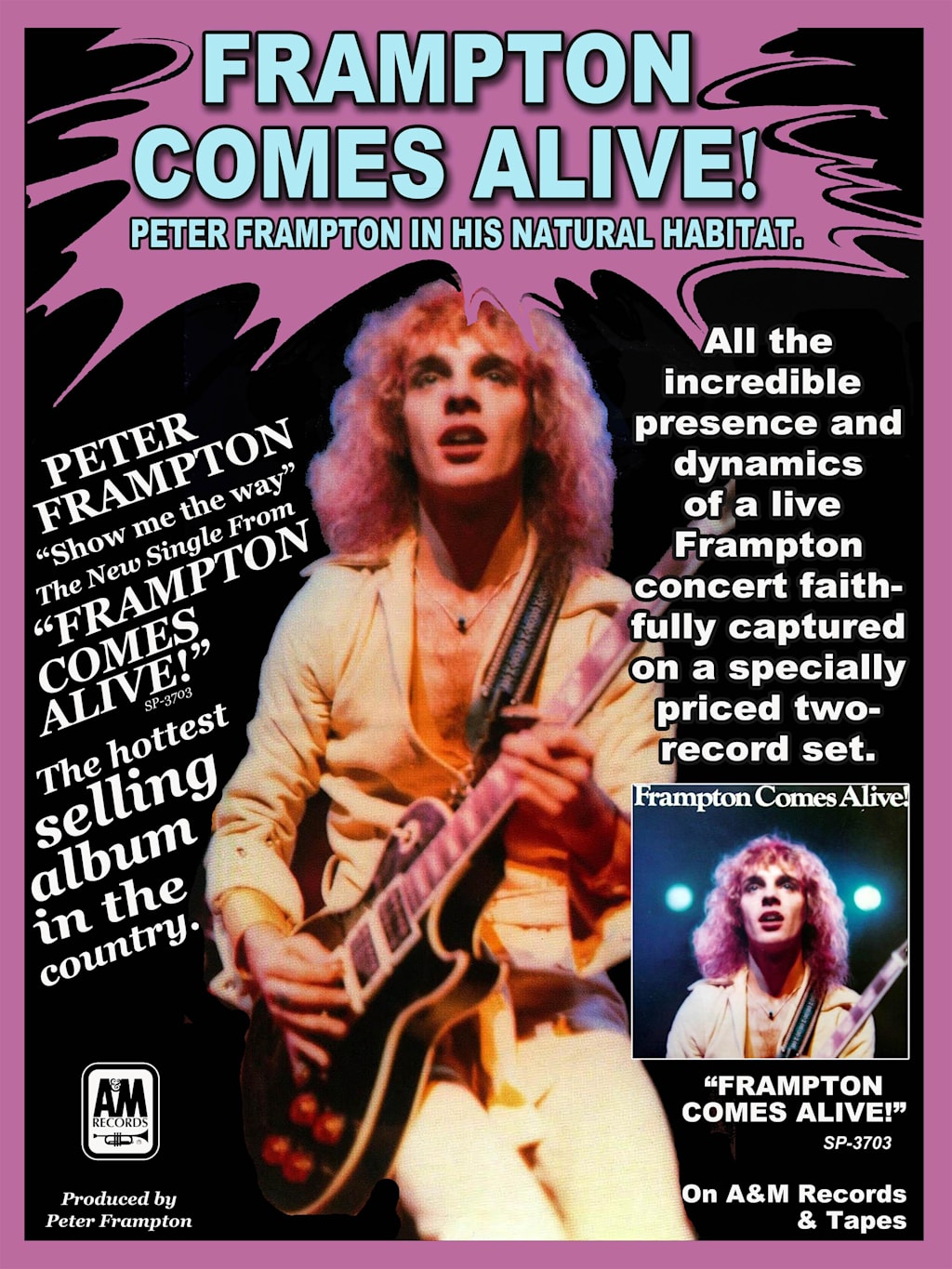
Frampton Comes Alive! had stratospheric sales. 8 million certified US sales, and it was the number one album of 1976, and enjoyed 97 weeks on the Billboard chart. It’s one of the top five live rock albums of all time. The hit singles from it continue to get airtime, even though the seventies DJs are long gone from our space age radio waves. Specifically, “Baby, I Love Your Way,” “Show Me the Way,” and “Do You Feel Like We Do” have popularity that defies human and machine sensibility.
I understand that disco had risen from the underground by our bicentennial year, but I was four years old and thought disco was fantastic. I could really twirl in a dress to disco. My parents liked country music, Elvis, and funk, so I was blissfully unaware of Peter Frampton’s music until I was a teenager and discovered that rock ‘n roll and disco, both of whom allegedly hated the other, had been in the sack together and produced this bastard: Peter Frampton’s “talking” guitar.
There’s a treble-heaviness to every Frampton song I’ve heard. If that’s not true of all of them, I’ll take your word for it rather than torture myself on a snipe hunt for bass. It’s disconcerting, putting me on edge. Treble should be light by definition, but in Frampton’s music, the dominance of treble in music that craves bass creates a feeling of butterflies trying to lift weights; it simply doesn’t work, and it was a bad idea out of the gate. Ear-bleeding? Not quite, just as the vocals aren’t falsettos but somehow feel like they are. Strange tenor, indeed.
On paper (until you look at the lyrics, but we’ll get to those later), Frampton Comes Alive! looks fantastic, a chart-topping live rock album with a talking guitar and hit singles. But it’s just wrong. It’s as wrong as Jethro Tull is mind-bogglingly right. A flute in a rock band? Okay, whatever. But it works; it’s unexpectedly brilliant. Yet Bursting Out doesn’t touch Frampton Comes Alive! in terms of sales. Makes no sense whatsoever.
Speaking of making no sense whatsoever, I said we’d circle back to Frampton’s lyrics, and here we are. Oh, dear, no. According to the almighty internet, Frampton spent twenty minutes, start to finish, on the lyrics to “Show Me The Way,” was hungover when he wrote “Do You Feel Like We Do,” and literally watching a sunset during the composition of the third overplayed atrocity. I can’t say that this surprises me; that’s exactly how they read and play—like a hungover rough draft under a palm tree.
There’s a dull prosaic quality to the one whose title seems to be centered around rhyming with “day.” Also, that tenor stretches up toward falsetto on this one that forces romantic love and a sunset together like squabbling siblings in the backseat of a car, making everyone miserable.
“Show Me The Way” seems to express the opinion that a disjointed line here and there is poetry distilled with no regard whatsoever for meaning or sound, aside from what appears to be an obsession with long, open vowels trying to enforce an easiness that can’t exist in the treble-heavy world created by this music.
I’m grateful for music subscriptions that allow me to keep songs and artists I don’t want to hear out of my space. Previously, I would change the station on the radio, occasionally encountering the hellscape of “Baby, I Love Your Way” simultaneously playing on multiple stations.
Framptonstein Comes Alive! would be a more fitting title for this monster fused together out of leftover musical corpses, implanted with disco’s beating heart and hooked up to an amplifier to stalk the airwaves until the end of time.
About the Creator
Harper Lewis
Intrusive rhyme bothers me, except as a weapon.
Intertextuality is my passion.
Formalist/ New Critical are my guiding theories.
My words are mine, not a robot’s.
MA English literature, CofC
Enjoyed the story? Support the Creator.
Subscribe for free to receive all their stories in your feed. You could also become a paid subscriber, letting them know you appreciate their work.
Comments
There are no comments for this story
Be the first to respond and start the conversation.