
"Lab Rats" and the ethics of writing about children
What responsibility does a writer have to their characters?


When I was eleven years old I read The Hunger Games for the first time and followed it up, swiftly, with Catching Fire and Mockingjay. I enjoyed all three books— although I find the first is most deserving of its acclaim— but I told my mother afterwards, "Suzanne Collins must be a sick person."
I found it difficult to fathom that a woman, one who worked on Clifford The Big Red Dog, no less, could make profit off of children going through indescribable circumstances and still be normal, without bodies in the basement. I looked at her angelic, honey-blond face and shuddered. I thought about how horrible it would be to live in that universe and blamed her in some odd way for it, as though by dreaming up the story she had put real people through torment.
Nowadays I've read many other books on more gruesome, unholy topics and moved away from that opinion, but the books had an impact on how I thought about violence in the world, how children could be manipulated to weaponry or to innocence depending on the whim of a, potentially deranged, author. As a child myself I was offended. I thought of my three younger brothers. I was angry at the mere implication their lives could become awful in someone else's universe.
I suspect this thought lingered enough to make the story Lab Rats difficult for me to finish. I've had it sitting in my drafts for two years now, and here's why.
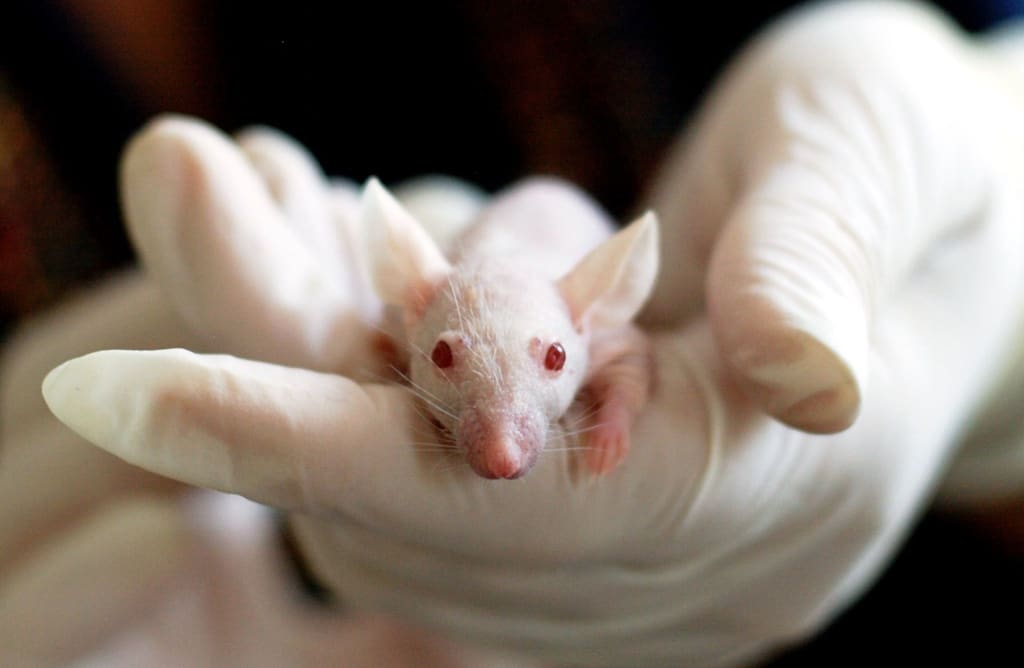
Lab Rats began as a dream I had about myself and other children, each with some sort of body mutilation— artificially white hair, unnatural stretched smile, too-long fingers— being taken to a lab via elevators, and made to conduct experiments on white rats that were then inserted into a huge clear 'box' in the middle to see if the experiments worked. The dream began when we, the characters, were all asking about a person named Skippy and whether he'd be alright— who is Skippy, I wondered when I woke up, but I knew I wanted to find out.
From there, the story spawned into a piece about insanity, and torture, and irony: the children, I decided, would be in the lab to do experiments on small white mice for some unforeseen purpose, but they themselves would be the experiments too, taken away when they displeased their overlords and their features changed, their bodies cut apart and put back together. To keep themselves stable they worshipped the 'box', in which hundreds of white mice corpses lay: a breeding ground for their failures.
The story had legs, I knew. It was so vivid in my mind, pure white around the edges but seemed too large, too complex and wrapped in a strange mixture of adolescence and innocence, my characters' sanity preserved by pleas to the 'box' and jokes about their torment and sex, occasionally.
As it went on I found myself a bit revolted by what I was writing, in a fascinated way. The main character, Birdie, was small, unhinged, and dedicated to the 'box' she thought of as a father figure. Many of the others spent the story trying to pull her from her desperate grasp on normalcy, trying and failing to, as I saw it, make her grow up.
It seemed too ugly, too hopeless, so I tried to give it hope. I aged them, then I de-aged them. I put them there for years, then months, then back to years. I couldn't figure out how to weave it together the way Suzanne Collins had; how to induce torment without it being too ugly to finish reading, how to write sad, broken boys without thinking of my brothers— or perhaps I should think of them, to make the story have a proper amount of life and verve and nerve?
The character Birdie changed. In the early drafts she was gently insane, worshipping the 'box' with fearful devotion, categorizing herself and her actions as 'Right' or 'Wrong' in accordance with a deity unseen by the reader, yet all too present in their lives.
"He will reek of Wrongness: and it is Wrongness they have written into their beings to avoid, Wrongness that dogs their steps and pants hopefully behind them, Wrongness that has forever put them on the path to search for Rightness."
The problem I ran into with this version of Birdie was attempting to balance her relatability as a main character with her young age and her already-broken mind that spoke of horrors beyond what any adult could comprehend. Just as Janine in The Handmaid's Tale is best situated at the sidelines, driving the plot when necessary and performing her role as an innocent tortured by circumstance, it was difficult to make Birdie the hero of the story.
I wanted her madness to speak for the reader's interpretation of the events, to find the horror in it outside of her. But in that, a static story was created, a series of circumstances that were affecting, but never drove or changed what was actually happening to my too-young characters.
The dilemma of The Hunger Games: creating young people who could be heroes, because they forced to be. But when your heroes don't fully understand what is happening to them, how can they overcome their circumstances? How is it morally right to make them go through horrible circumstances?
"She could not say what the punishments did to her or why they had been given; she only suspects that there was once a great deal more of her than there is now, and remains unsure what to do about it."
It was difficult, too, to figure out exactly why the children themselves were the 'lab rats' or experiments. In my head, I pictured a world whose atmosphere had become toxic, badly strangled by poor care of the environment. The children in the labs, with their 'box' of horrid atmosphere, were the key to finding a cure for life on a decrepit earth.
With this plot, escape for them was a necessity. I wanted them to live in resentment of what they had been forced into by the labs' creators and their tormentors, to reject the idea that their lives could be stolen away by unseen forces.
I decided the children themselves, through their proximity to the 'box' would be able to survive on the decrepit earth themselves, unlike the rest of the humanity. This created a plot hole, certainly, but one I thought I could fill. And in the meantime, I needed a driving voice for escape.
I created the character of Albie, who spoke in reasonable, angry tones about seeing the world for whatever it was beyond the place where they had been kept all their lives. His resentment of the others leaked into his opinion of Birdie, and he disdained her acceptance of their circumstances.
"Albie’s smile is a tranquilizing thing today, disdainful and bitter and wilting. “You are just so stupid.”"
Committed to a piece that went beyond a snapshot of tragic circumstances, the story grew larger and longer than I had wanted it.
But I've been loathe to shorten it; it just didn't seem fair, when writing it, that I would create young, anxious, sad characters who would be doomed to remain in the purgatory of my and my readers' imagination, left to sit in the horrible labs I had created and remain experiments, half-creations, with no lives of their own, no chances to feel joy and suffer through their youth in a normal fashion.
That is what has stopped me from finishing the story: in a strange way, stepping into that universe fills me with a sense of responsibility and purpose in 'rescuing' the people I have invented. I don't always find it difficult to write sadness and pain, but with a younger cast of protagonists who were created to embody innocence and hurt twofold, I have found it difficult to put them through genuine torment, at least without a comeuppance.
Perhaps I'm stepping too deeply into the minds of my characters, through this. Perhaps the story has not managed to finish itself because my anxiousness for their emotional states makes me want to bundle away Birdie, Skippy, Albie and all the rest, and pretend horrible things don't happen to children, ever.
I have many other finished stories that steep themselves in tragedy and danger, but when working to finish Lab Rats I haven't been able to find a way to finish the story that undoes the torment inflicted on my characters or better yet, never occurred to begin with.
About the Creator
Amelia
20-year-old writer who hopes to write stories for a living someday-- failing that, I'd like to become a mermaid.
Instagram: @nighterwriter24
Enjoyed the story? Support the Creator.
Subscribe for free to receive all their stories in your feed. You could also become a paid subscriber, letting them know you appreciate their work.
Comments
There are no comments for this story
Be the first to respond and start the conversation.