
Is the BBC Licence Fee Reaching Breaking Point?
Why More Households Are Choosing Not to Pay
For decades, the television licence was one of the least controversial household bills in Britain. If you owned a television and watched any programmes, you paid the licence fee. The money funded the BBC, which in return produced television programmes, radio stations, local news, educational content, major sporting events and one of the world's largest public service broadcasters. That arrangement remained largely unchanged for generations.
Today, however, the landscape looks very different. Streaming services have transformed the way people consume entertainment, younger audiences are spending more time on YouTube and social media than traditional television, and an increasing number of households are questioning whether the licence fee still represents good value for money. The figures suggest that this change is becoming significant.
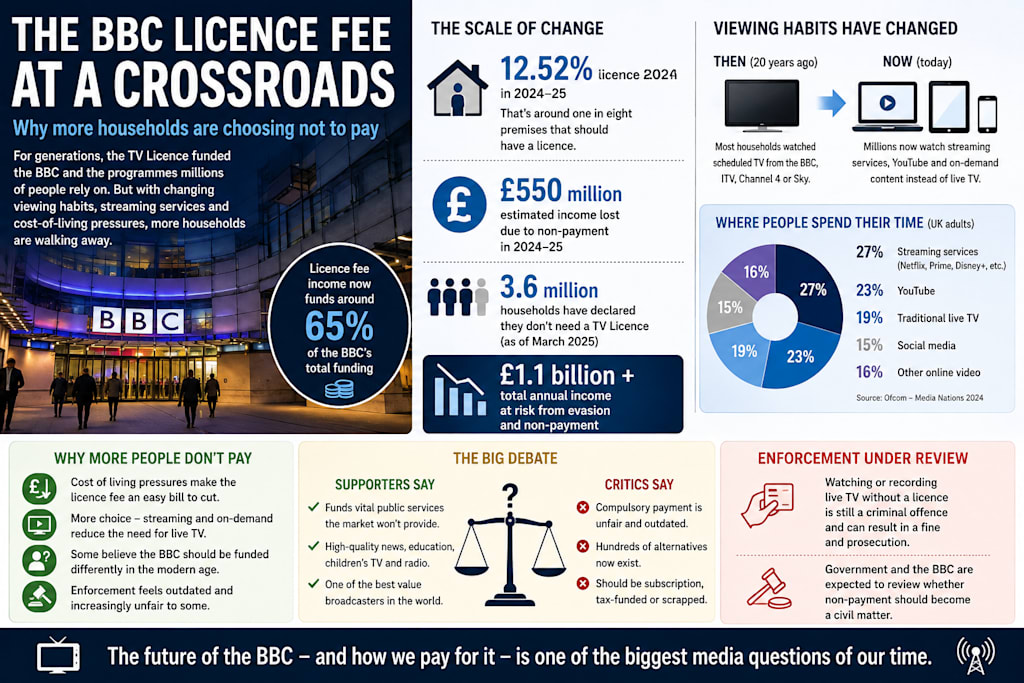
The BBC estimates that licence fee evasion reached 12.52% during 2024–25, meaning roughly one in eight premises that require a licence did not have one. It estimates this resulted in around £550 million of lost income in a single year.
Alongside those figures is another growing trend. By March 2025, around 3.6 million households had formally declared they did not require a television licence because they no longer watched or recorded live television or used BBC iPlayer. Combined with estimated licence fee evasion, the BBC has calculated that more than £1.1 billion of potential annual income is now being lost. The reasons behind this change are varied.
The most obvious is that television itself has changed. Twenty years ago, most households watched scheduled broadcasts from the BBC, ITV, Channel 4 or Sky. Today, millions of viewers spend much of their viewing time on Netflix, Amazon Prime Video, Disney+, Apple TV+, YouTube or other on-demand platforms. Someone who watches only subscription streaming services and never watches live television or BBC iPlayer may not need a TV licence under the current rules.
Cost is another important factor. As household budgets have come under increasing pressure, some people have decided that the licence fee is an expense they can avoid by changing their viewing habits. Others continue watching licensable content without purchasing a licence, creating the growing evasion problem highlighted by the BBC. There is also a philosophical debate taking place.
Supporters of the licence fee argue that it funds services which commercial broadcasters would struggle to provide on the same scale. The BBC operates national and local radio stations, children's programming, educational resources, orchestras, news services and extensive online content. It also produces programmes that may not attract large commercial audiences but are considered valuable public services.
Critics, however, argue that the media landscape has fundamentally changed. They question why households should be required to pay a compulsory licence fee when consumers now have access to hundreds of competing services funded by subscriptions, advertising or a combination of both. Some suggest that the BBC should move to a subscription model similar to Netflix, while others favour direct taxation or a mixed funding approach.
Questions about BBC impartiality have become particularly intense over its coverage of the Israel-Gaza conflict, where critics argue that the choice of stories, language, images, interviewees and sources can sometimes create the impression of a particular narrative rather than detached reporting. The controversy became more serious after the BBC documentary Gaza: How to Survive a Warzone failed to tell viewers that its 13-year-old narrator was the son of a figure in the Hamas-run administration. The BBC's own review subsequently found that this omission breached its accuracy guidelines, while Ofcom went further and ruled that the failure to disclose the connection was materially misleading, although the BBC review did not find a separate breach of its impartiality rules.
This does not prove that everything the BBC broadcasts about Gaza is biased, and interestingly the Corporation has also been accused by some of having an anti-bias towards Israel, demonstrating just how contested reporting on this war has become. Nevertheless, when an organisation funded through a compulsory television licence presents itself as a trusted and impartial public-service broadcaster, even the appearance of political or ideological bias matters. Viewers should be able to expect the BBC to challenge claims from Israel, Hamas, the Palestinian authorities and campaign organisations with equal determination, clearly identify the origins of casualty figures and other disputed information, provide relevant context, and distinguish verified facts from allegations.
The BBC's enforcement of licence fee non-payment has also become increasingly controversial. Watching or recording live television without a valid licence remains a criminal offence in the UK and can result in prosecution and a fine. Successive governments have examined whether non-payment should instead become a civil matter, and the issue is expected to remain part of discussions surrounding the BBC's next Royal Charter.
The BBC itself recognises that the current model is under pressure. Licence fee income still provides around 65% of the corporation's funding, but declining licence sales and increasing evasion have prompted growing discussion about how public service broadcasting should be funded in the future.
The debate is no longer simply about whether people enjoy BBC programmes. It has become a wider discussion about fairness, technology and changing viewing habits. Many households continue to believe the BBC represents excellent value and are happy to support it. Others believe that, in an age of streaming and on-demand viewing, compulsory funding no longer reflects how people consume media.
Whatever view people take, one thing is becoming increasingly clear. The traditional television licence model is facing pressures that scarcely existed a decade ago. With more households deciding they do not need a licence, others choosing not to pay, and viewing habits continuing to evolve, the question is no longer whether the funding model will be debated, but what will eventually replace it, or whether it can be adapted to survive.
The outcome will shape not only the future of the BBC but also the future of public service broadcasting in the United Kingdom. Whether that future is funded by a licence fee, a subscription, taxation or an entirely new model remains one of the biggest media policy questions of the coming years.
About the Creator
Alan Spencer
Have been an author and writer for over 20 years. Have been a journalist, editor, proofreader, and a designer and presenter of training courses. Have written over 100 articles, two books, and around 20 training courses.
Enjoyed the story? Support the Creator.
Subscribe for free to receive all their stories in your feed. You could also become a paid subscriber, letting them know you appreciate their work.
Comments
There are no comments for this story
Be the first to respond and start the conversation.