
Disney Is Why You’re Sad
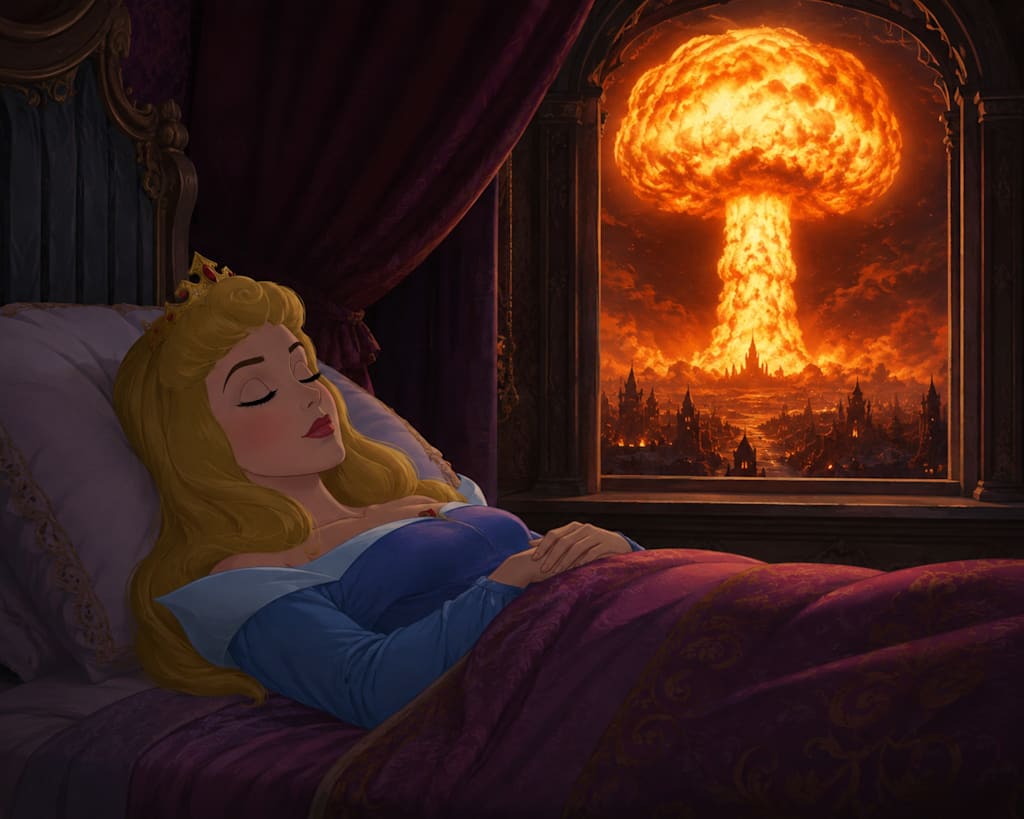
The difference between dropping a nuclear bomb and getting one dropped on you

I have come to the conclusion that Disney is overrated.
I realize this is dangerous territory. Americans will tolerate criticism of their government, their religion, possibly even their mothers, but tell them The Little Mermaid might not be the pinnacle of children’s storytelling and suddenly you’ve gone too far.
But I started thinking about this while watching Assassination Classroom with my son.
Which is a strange place to discover healthy parenting advice.
If you’ve never seen it, Assassination Classroom is a Japanese anime about a classroom full of struggling students whose teacher is a giant yellow tentacled creature who has destroyed part of the moon and is threatening to destroy Earth.
Naturally, the children are assigned to assassinate him.
This sounds considerably less psychologically healthy than a singing mermaid.
And yet the more I watched it with my son, the more I noticed something strange.
The lessons were fantastic.
The teacher, Koro-sensei, doesn’t tell his students that they’re secretly special and therefore everything will work out. He doesn’t promise them that the universe rewards good people. He doesn’t rescue them from every failure.
He prepares them for failure.
He studies their weaknesses. He forces them to confront their limitations. He teaches them to adapt. When they lose, he helps them understand why they lost.
And then they try again.
The underlying message is remarkably consistent:
The world may not change for you, so you need to become capable of facing the world.
Compare that with the mythology Americans have been feeding children for generations.
Cinderella is miserable.
What does she do?
She remains Cinderella.
She doesn’t overthrow the household. She doesn’t build a business. She doesn’t expose the labor violations occurring in the basement. She is a “good girl” that basically survives long enough for magical intervention.
Eventually a fairy godmother appears, gives her a makeover, and she meets a wealthy man.
Problem solved.
Sleeping Beauty takes an even more aggressive approach to personal development.
She becomes unconscious.
Then she waits for a man.
Snow White cleans a house for seven strange men before also becoming unconscious and waiting for a man.
There seems to have been a period at Disney where female unconsciousness was considered a legitimate plot device for character development.
Obviously I’m exaggerating. Disney movies have changed enormously, and plenty of them contain genuinely worthwhile lessons.
But underneath the old Disney mythology is an idea I increasingly dislike:
If you are good enough, eventually life will recognize it.
That’s a beautiful idea.
It’s also not true.
And teaching children beautiful things that aren’t true can become surprisingly expensive when they grow up.
Because adulthood doesn’t work like Disney.
Sometimes you work harder than everyone else and still lose.
Sometimes the person who deserves the promotion doesn’t get it.
Sometimes someone doesn’t love you back.
Sometimes marriages fail.
Sometimes parents disappoint their children.
Sometimes children disappoint their parents.
Sometimes terrible things happen to wonderful people and wonderful things happen to complete assholes.
There is no narrator making sure the story resolves properly before the credits.
And nobody is guaranteed a prince.
Maybe the prince isn’t late.
Maybe there was never supposed to be a prince.
That realization sounds depressing.
I think it’s liberating.
Because if nobody is coming to save you, something interesting happens.
You start learning how to save yourself.
The Country That Dropped the Bomb and the Country It Landed On
There is a provocative historical contrast underneath American and Japanese storytelling that I can’t stop thinking about.
America dropped the atomic bomb.
Japan had the atomic bomb dropped on it.
Obviously, that single historical fact doesn’t explain two enormous cultures or everything they’ve created. Japan has escapist entertainment. America has brutally realistic literature. Disney itself has produced stories about grief, death, responsibility and perseverance.
But cultural experiences leave fingerprints.
Postwar America emerged extraordinarily powerful, wealthy and optimistic.
Postwar Japan had to rebuild from catastrophic defeat and destruction.
And when you watch enough Japanese animation, you begin noticing how comfortable it can be with an idea American children’s entertainment often tries desperately to avoid:
Life isn’t fair.
That’s not necessarily pessimism.
It can actually be preparation.
Dragon Ball Z certainly isn’t realistic in the conventional sense.
I’ve never personally had to defend Earth against a genetically engineered monster while waiting for my dead friend to finish training in another dimension.
But psychologically?
DBZ understands something very real.
You aren’t strong because you discover that you’re perfect.
You’re strong because you discover that you’re not strong enough.
Then you train.
You fail.
You get hurt.
You train again.
Someone stronger appears.
Everything you thought was impressive suddenly isn’t.
So you adapt.
Goku’s solution to discovering someone stronger than him isn’t to complain that the universe has violated the terms of his protagonist contract.
He’s thrilled.
Now he has something else to overcome.
That is an extraordinarily useful philosophy to give a child.
And Assassination Classroom takes the idea much further.
The students in Class 3-E are literally designated as failures.
Their school uses them as a warning to everyone else.
They are socially humiliated so that the successful students will work harder because they’re terrified of becoming them.
A Disney version of this story would probably reveal that every member of Class 3-E was secretly exceptional all along.
Koro-sensei teaches them something better.
Their weaknesses are real.
So are their strengths.
They don’t need someone to pretend their shortcomings don’t exist.
They need someone who cares enough about them to help them improve.
That’s psychologically healthy.
Maybe Happy Endings Make Unhappy Adults
I’ve started wondering whether some of our unhappiness comes not from how difficult life is, but from the difference between the life we expected and the life we actually received.
Imagine being taught from childhood:
Follow your dreams.
Be yourself.
True love conquers everything.
Good people eventually win.
Everything happens for a reason.
Then adulthood arrives.
You follow your dream and discover your dream has terrible health insurance.
You “be yourself” and discover several people find yourself annoying.
You fall madly in love and learn that love doesn’t automatically make two people compatible.
You do the right thing and lose anyway.
Now you aren’t simply suffering.
You’re confused.
Because according to the stories, this wasn’t supposed to happen.
Maybe that’s one reason I find the lessons in Assassination Classroom so refreshing while watching it with my son.
It doesn’t promise him that he will win.
It teaches him what to do when he loses.
There is an enormous difference.
One philosophy tries to protect children from the knowledge that life can hurt them.
The other tries to make them strong enough to survive when it inevitably does.
I know which lesson I’d rather give my son.
Hope Without the Contract
None of this means children shouldn’t dream.
I want my son to dream.
I want him to believe enormous things are possible.
I want him optimistic enough to attempt things that sensible people would consider ridiculous.
But I don’t want him believing optimism is a contract with the universe.
Dreams aren’t promises.
Being good doesn’t guarantee you’ll be rewarded.
Being talented doesn’t guarantee you’ll be recognized.
Loving someone doesn’t guarantee they’ll stay.
Working hard doesn’t guarantee you’ll win.
Those things still matter.
In fact, I think they matter more once the guarantee disappears.
If kindness automatically produced rewards, kindness would just be a good investment strategy.
If courage guaranteed victory, courage wouldn’t require much courage.
If perseverance guaranteed success, perseverance would simply be patience.
Character matters precisely because life isn’t fair.
You choose kindness when kindness costs you something.
You choose courage when you might actually lose.
You get back up without knowing whether you’ll eventually win.
That’s what makes it character.
Maybe Disney isn’t why you’re sad because it taught you to dream.
Maybe Disney is why you’re sad because somewhere along the way, you confused the dream with a promise.
The world never signed that contract.
And strangely enough, realizing that doesn’t make me less hopeful.
It makes hope more meaningful.
There may be no fairy godmother.
There may be no glass slipper.
The prince may not be coming.
Fine.
Get up.
Figure out what went wrong.
Train.
Learn something.
Become stronger.
And tomorrow, try again.
Koro-sensei would probably approve.
About the Creator
Jesse Lee
Jesse Lee is a comedian and writer that investigates ordinary experiences until they reveal extraordinary truths about being human.
socials:
Enjoyed the story? Support the Creator.
Subscribe for free to receive all their stories in your feed. You could also become a paid subscriber, letting them know you appreciate their work.
Comments
There are no comments for this story
Be the first to respond and start the conversation.