
An Apology to Trees
for what Kilmer did


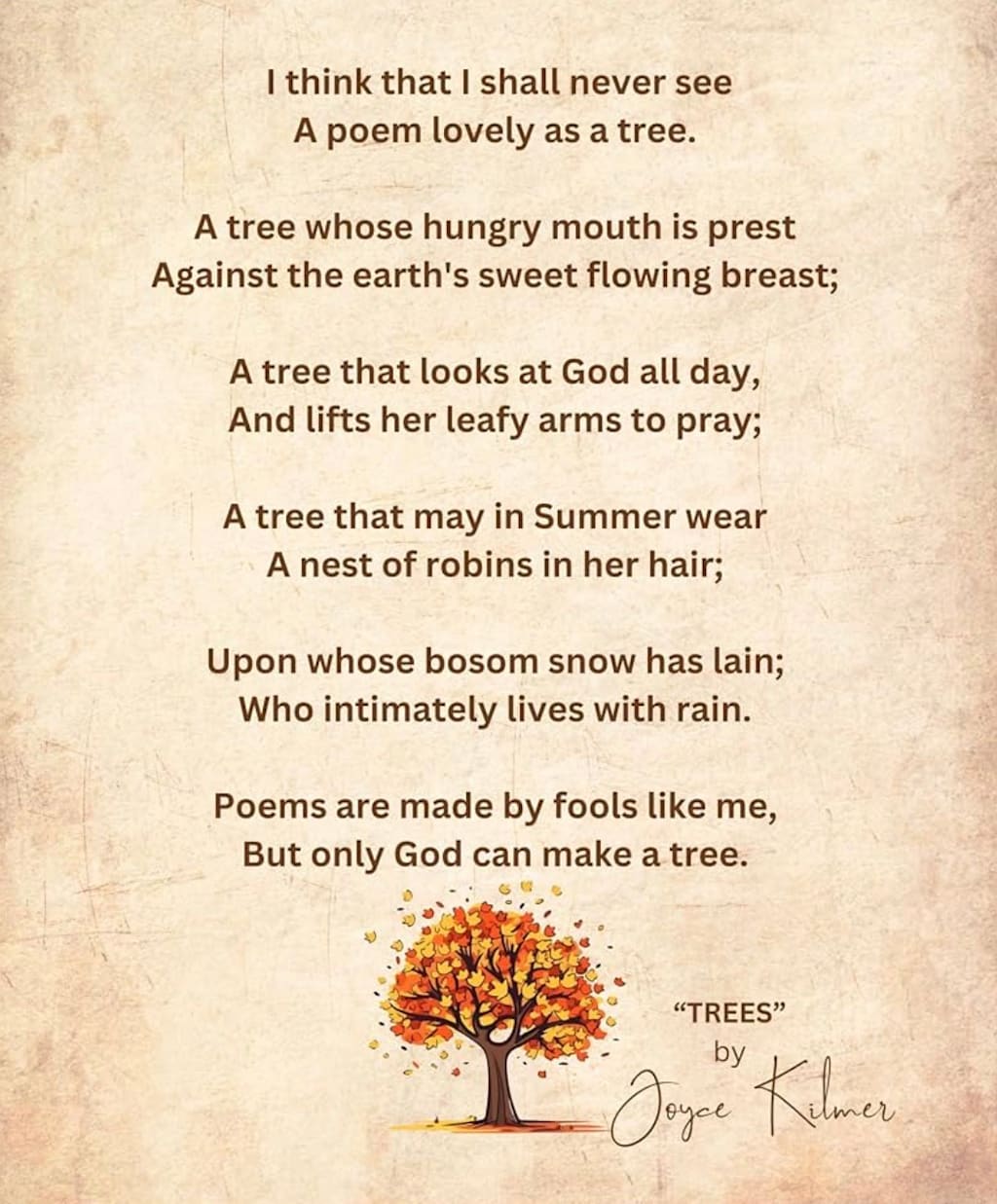
Did you have to memorize and recite Joyce Kilmer’s “Trees” in elementary school ? I think I was in fourth grade when it was forced on me. It was an assignment, counted as a test grade. I was young, knew nothing about poetry, but I knew I hated this poem. Perhaps anthropomorphic poetry was cutting edge in 1913, when it was published. However, you’ll be hard-pressed to convince this reader that 12 lines of rhyming couplet iambic tetrameter could ever be wedged into anyone’s definition of avant garde.
There’s no escaping the singsong end rhyme. It’s aggressive, this assault of evenly-metered, rhyming personification of a tree. I cannot deduce any reason to poison children against poetry by inscribing this atrocity on their brains in Sharpie. Robert Frost’s “Nothing Gold Can Stay” or Yeats’s “The Lake Isle of Innisfree” would be far better choices for children to recite in class, as they’re both far better poems than Kilmer’s “Trees.”
Why do I bring this up over forty years after I suffered memorizing and reciting this poem? I bought a book for a friend from one of the outlets on Amazon. I had it shipped to me, as I intend to give it to the recipient in person. I opened the book and flipped through it. A paper bookmark fell out.
This is the book. The bookmark was printed on both sides, one promoting the retailer, the other depicting an oak tree and the Joyce Kilmer poem. I personalized the book mark.
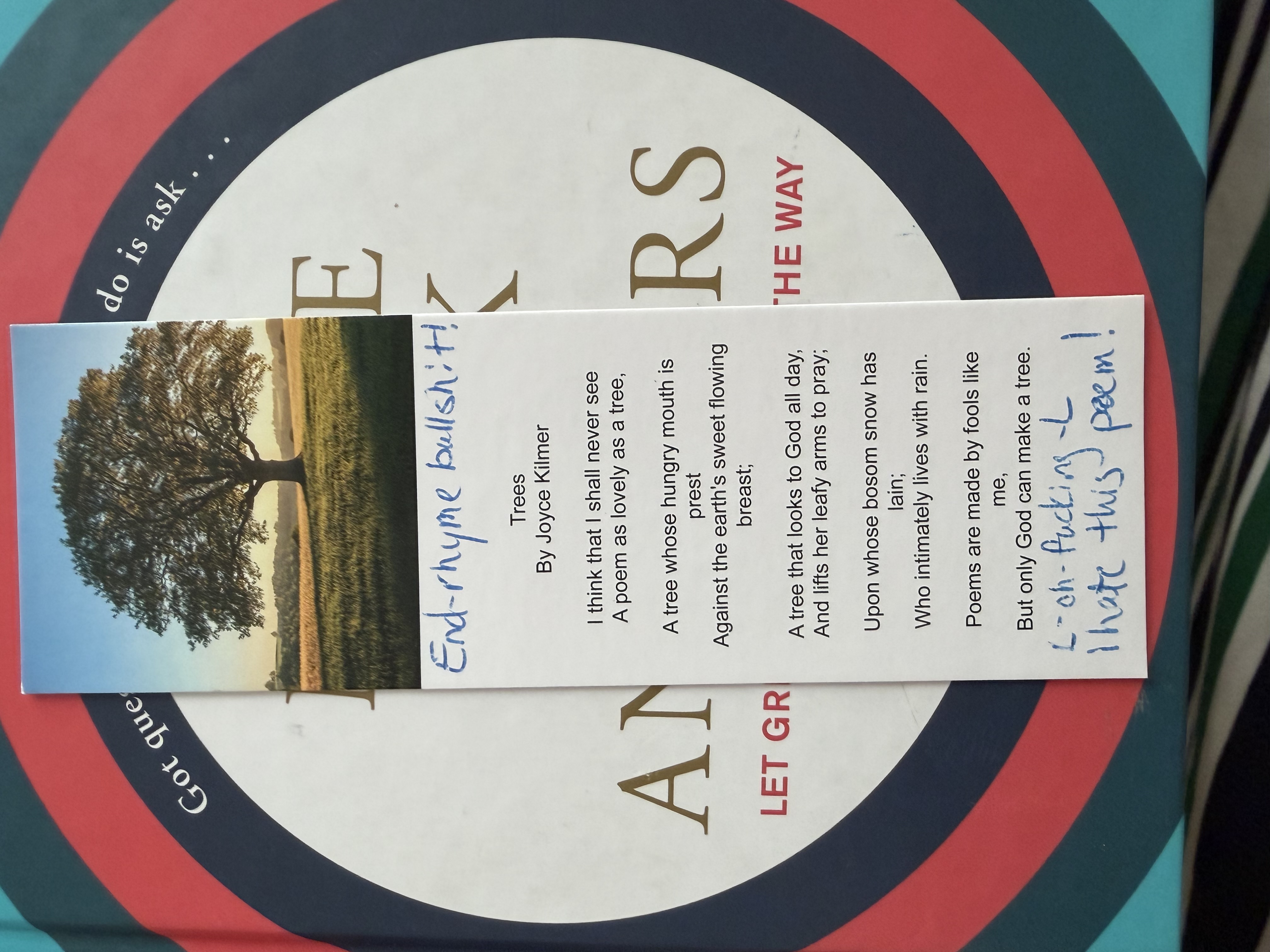
The penultimate line is my least hated, but the over-the-top sentimental vibe doesn’t just make me cringe; I shudder and recoil away from everything in this poem, except the tree itself. I want to find this specific tree and whisper into its roots that I’m sorry it was reduced to a simplistic rhyme that’s focused on how the speaker perceives the tree.
The first element of Kilmer’s lyric that offends me is the archaic spelling of pressed—“prest.” My immediate sense is that Kilmer is talking down to me within the text, and man oh man, do I hate that. A condescending text automatically puts a question in my mind: just how stupid does this person think I am? In the case of Kilmer, it appears that he was preventing me from putting an extra syllable in pressed—press-ed. In standard usage, when a terminal past tense ending is intended to receive this type of pronunciation, an accent is placed over the final e. Perhaps Kilmer thinks readers don’t know this. Or even worse, he was chasing visually identical endings, failing to achieve it with more than two letters. Pretentious and condescending or weirdly obsessed with the visual aspect of the words on the page is my takeaway.
What attributes has Kilmer assigned to the tree? Do any complex ideas present themselves through the tree? Sadly, no. This tree eats, prays, and wears hair ornaments. Yawn.
It gets worse. The anthropomorphism/personification rejects the physical structure of the human body when it goes off the rails in the couplet about snow and rain. Wouldn’t the tree’s “bosom” be roughly a third of the way down from the top (or two-thirds up from the ground)? Seems like a preposterous place for snow to have lain, amiright? Our descent into hell isn’t complete. Dante’s compass drew more circles, and the second half of the precipitation couplet takes the escalator down. This tree “intimately lives with rain.” Stop for a minute and think about where rain lives. Rain lives in clouds that release it onto the earth. According to Kilmer, oaks are shacking up inside clouds. Unlikely, to say in the least, before we even get into what it means to “live intimately” with another. According to Merriam-Webster, which is where I went with unfamiliar words, “intimate with” specifically means to have sexual relations with. Super appropriate for nine-year-olds.
Okay, so we have mouth, breasts (the earth’s), arms, hair, and breasts again—“bosom” ( the tree’s) before we get intimate with the rain. It’s beginning to feel like Kilmer didn’t merely personify the tree, he feminized and sexualized it into his own image. The trunk is oddly ignored, probably too phallic for Kilmer’s pretty, devout, sexy tree. The bark gets no mention either, presumably too rough and masculine for this dainty woman with a bird’s nest barrette fastened to her tresses.
This is my apology to the tree Kilmer objectified—I presume it will continue to outlive him for centuries to come. The rest of us don’t reduce you to a confused human female body, even if we indulge ourselves by anthropomorphizing you. I’m not without sin in this regard, but I explore your wisdom, your longevity, your adaptability, and your steadfastness. I think you’re beautiful even when your limbs are bare, and I have far too much respect for you to reduce you to cheap end rhyme with no intellectual depth to converse with your subterranean roots.
About the Creator
Harper Lewis
Ekke Ekke Ekke Ekke Ptang Zoo Boing!
Intrusive rhyme bothers me, except as a weapon.
Intertextuality is my passion.
Formalist/ New Critical are my guiding theories.
My words are mine, not a robot’s.
MA English literature, CofC
Enjoyed the story? Support the Creator.
Subscribe for free to receive all their stories in your feed. You could also become a paid subscriber, letting them know you appreciate their work.
Comments
There are no comments for this story
Be the first to respond and start the conversation.