

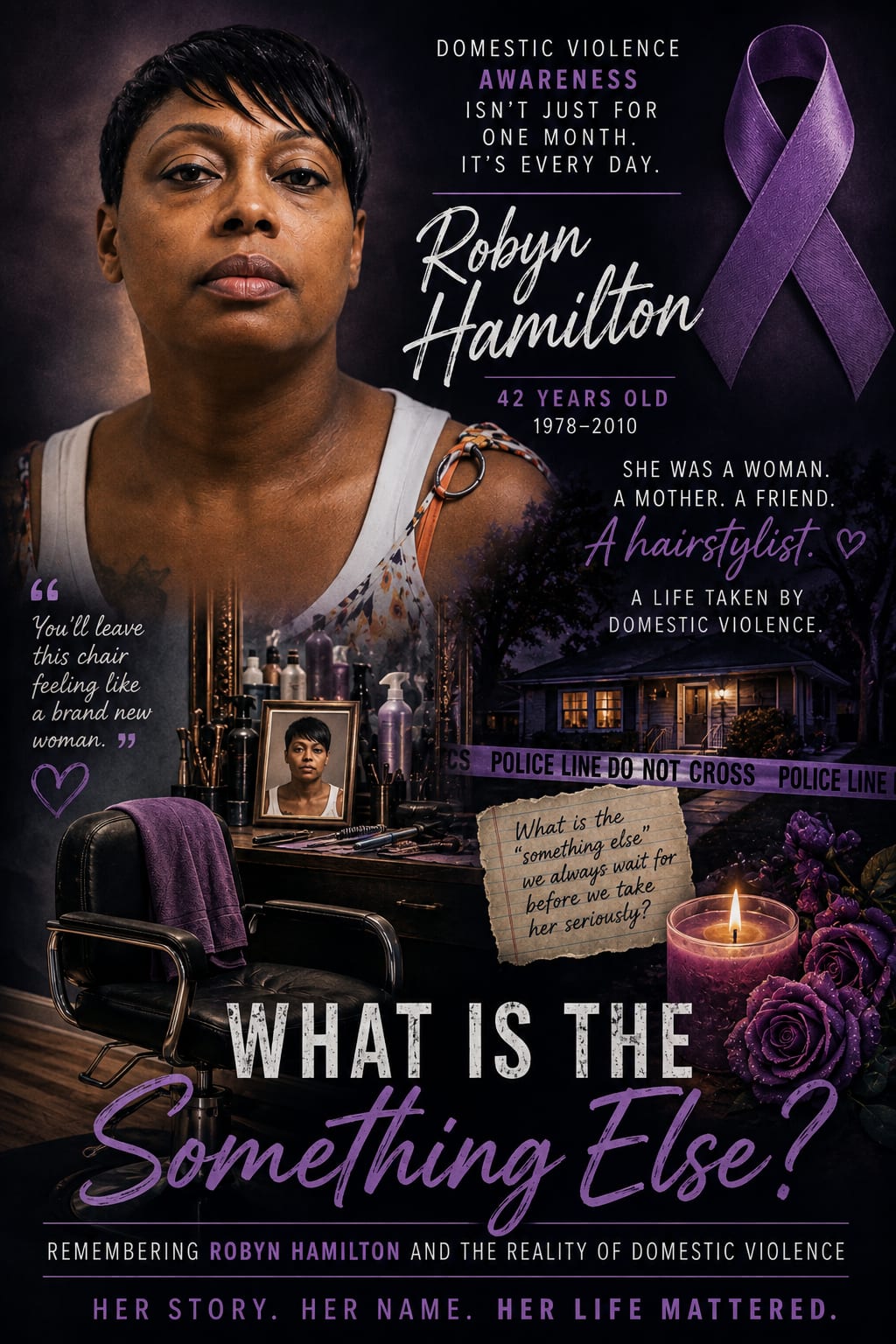
What Is the "Something Else"?
Remembering Robyn Hamilton and the Reality of Domestic Violence
Her name was Robyn Hamilton.
Before I ever saw her face attached to a homicide story, I knew that face from somewhere completely different.
A mirror.
More specifically, the mirror in front of a hairstylist's chair.
Robyn did hair.
She did my sister's hair regularly. She did my hair several times. My sister's best friend knew her as well. Robyn wasn't my best friend, my auntie or somebody I talked to every day, and I don't want to rewrite history now that she's gone and pretend we had a relationship we didn't have.
She was my hairdresser.
But if you're a Black woman, you probably understand why saying just my hairdresser doesn't quite explain it.
There is an intimacy in the relationship between Black women and the women who do our hair.
You sit in somebody's chair for hours.
They wash your hair. Part it. Comb it. Pull it. Press it. Braid it. Curl it.
And while their hands are working, mouths are usually working, too.
We talk.
We laugh.
We gossip.
We complain about work.
We talk about our children.
We talk about men.
Sometimes we talk about things we probably wouldn't tell anybody else.
And sometimes we don't talk about anything important at all.
That's what I remember about Robyn.
I remember laughing.
I just don't remember the joke anymore.
---
I Wish I Remembered What Was So Funny
That bothers me more than I expected it to.
It has been almost sixteen years.
Memory is strange like that.
I can remember Robyn's personality better than I can remember specific conversations.
She was outspoken.
Funny.
A little intimidating.
Not intimidating in the sense that I was afraid of her. Robyn was just one of those women who had a presence. She didn't have to announce herself. You knew when she was in the room.
She had a way of talking that could make something ordinary funny.
And she could do some damn hair.
Baby, when I tell you Robyn could lay your hair?
You weren't getting out of that chair looking crazy.
I wish I could recreate one of those afternoons perfectly.
I wish I could remember exactly what she said that made us laugh.
Maybe we were talking about somebody's trifling boyfriend.
Maybe somebody had done something ridiculous.
Maybe we were talking about whatever foolishness everybody was talking about in 2010.
I don't know.
And I'm not going to invent a conversation and give it to a woman who isn't here to tell me I got it wrong.
What I know is that we laughed.
I know what it felt like to be in her space.
I know I saw her husband before.
I didn't know him in any meaningful way. I didn't have conversations with him that stuck with me. He was simply a man I had seen around a woman I knew.
At the time, there was no reason for my brain to preserve those moments.
Why would it?
Nobody sits in their hairstylist's chair thinking:
Pay attention. Memorize her voice. Memorize this joke. Memorize everybody who walks through this room.
You assume there will be another appointment.
Another hairstyle.
Another conversation.
Another laugh.
Until suddenly there isn't.
---
October 26, 2010
Robyn Hamilton was 42 years old when she was killed.
Police were called to a residence in the 5000 block of George Road in Kansas City, Missouri, at approximately 2:30 in the morning.
When officers arrived, Robyn was dead.
She had been shot.
Witnesses told police she had been arguing with her husband before he shot her.
Police took him into custody.
Robyn's death was classified as domestic-violence related.
Three years later, a Jackson County jury convicted her husband, Robert L. Washington, of first-degree murder and armed criminal action in her death.
Those are the facts.
But I hate how efficiently facts can erase a woman.
Female.
42.
Shot.
Domestic violence.
Husband arrested.
That's enough information for a police report.
It isn't enough information for a life.
Because before Robyn became a homicide victim, she had already lived 42 years.
She had laughed.
She had gotten angry.
She had made people laugh.
She had relationships.
She had people who knew her.
She had clients.
She had hands that knew exactly what to do with a head of hair.
She existed before somebody killed her.
And I think we sometimes forget that when we talk about women murdered by intimate partners.
We meet them at the end of their stories.
---
What Is the "Something Else"?
There is a sentence I have heard as a survivor of domestic violence.
Some version of:
"We can't do anything until he does something."
Or:
"There isn't anything we can do unless something happens."
And every time I think about language like that, one question bothers me.
What is the something?
A threat?
A punch?
A broken bone?
A gun?
Does he have to show up at her house?
Does he have to violate the order?
Does he have to put his hands on her again?
How frightened does a woman have to become before her fear counts as evidence that she may be in danger?
How badly does somebody have to hurt her before everybody agrees that he is capable of hurting her?
And what happens when the "something else" everybody is waiting for is the last thing he ever does to her?
Robyn's story forces me to sit with that question.
Because her something happened.
And she didn't survive it.
I am not saying I know whether Robyn sought police protection before her murder. I don't know that, and I will not create a history for her that I cannot document.
But I know what ultimately happened to her.
Her husband shot her.
And afterward, the system was finally able to do everything systems know how to do.
Police investigated.
A man was arrested.
Prosecutors prosecuted.
A jury deliberated.
There was a conviction.
Justice after a murder matters.
Accountability matters.
But there is an uncomfortable question underneath all of it:
What does justice mean when the woman it is supposedly for is already dead?
---
Domestic Violence Doesn't Always Look Like Domestic Violence
This is one of the things I wish more people understood.
We have created an image of what an abused woman is supposed to look like.
Scared.
Quiet.
Bruised.
Isolated.
Maybe wearing sunglasses to cover a black eye.
Maybe crying.
Maybe somebody asks what's wrong and she looks over her shoulder before answering.
Real life doesn't always cooperate with that picture.
A woman experiencing abuse can still be hilarious.
She can be loud.
She can be successful.
She can be outspoken.
She can go to work.
She can take care of her children.
She can do somebody's hair.
She can make appointments.
She can laugh until her stomach hurts.
She can be the strongest woman you know.
She can even be intimidating.
And she can still be in danger.
That's important to me when I think about Robyn.
I don't want to look backward and manufacture warning signs.
I don't remember Robyn sitting me down and telling me she was being abused.
I don't remember witnessing her husband assault her.
I don't remember looking at her and thinking, Something is wrong in this house.
And I won't pretend I did simply because I now know how the story ended.
What I remember is normalcy.
Hair.
Talking.
Laughing.
Life.
And perhaps that's one of the most frightening things about domestic violence.
From the outside, life can look completely ordinary.
---
In 2010, I Didn't Understand It the Way I Do Now
I was 31 when Robyn died.
I'm 47 now.
At 31, I already knew something about domestic violence because I was dealing with it in my own life.
But knowing you're living through something and understanding it are not always the same thing.
I know considerably more now.
I've survived violence myself.
I've asked institutions that are supposed to protect people for help.
I've experienced the frustration of trying to explain danger before the worst possible thing has happened.
So when I write about Robyn, my experiences inevitably affect the way I see her story.
But this isn't my story.
I'm still here to tell mine.
Robyn isn't.
That's precisely why I want to use my voice for hers.
---
We Have to Stop Asking the Wrong Question
Whenever a woman is abused, eventually somebody asks:
Why didn't she leave?
I hate that question.
Because embedded inside it is the assumption that the person with the responsibility to stop the violence was the person being hurt.
Why didn't she leave?
Why did she go back?
Why did she answer the phone?
Why did she forgive him?
Why did she have children with him?
Why did she marry him?
Why didn't she call the police?
Why didn't she get an order of protection?
Why didn't she tell somebody?
Maybe we should become equally obsessed with another question.
Why did he hurt her?
And another:
Why didn't he stop?
Leaving an abusive relationship isn't a magic trick.
A woman doesn't pack a bag, walk out the door and automatically become safe.
Abuse is about power and control. Losing control of a victim can make an abusive partner more dangerous, not less.
There may be children.
Money.
Housing.
Transportation.
Threats.
Fear.
Shame.
Love.
Isolation.
Years of manipulation.
And sometimes the simple, terrifying knowledge that the person making the threat knows exactly where you sleep.
Telling a woman to "just leave" is easy when you're not the person who has to survive leaving.
---
The Law and the Woman Standing in Front of the Officer
There is something else worth acknowledging.
The law on paper is not quite as simple as "police can't do anything."
Missouri law gives officers authority to make an arrest when there is probable cause to believe domestic violence has occurred, even when the alleged violence did not happen in front of the responding officer.
That's important.
But so is what victims experience when they actually seek help.
A statute lives on paper.
A terrified woman lives in the real world.
She has to make the phone call.
She has to convince somebody that the threat is serious.
She may have to tell the most humiliating details of her life to a stranger.
She may have to document messages.
She may have to go to court.
She may have to seek an order of protection.
Then she may still have to go home and wonder what happens when the person she's afraid of finds out she reported him.
And when a survivor hears some variation of we can't do anything yet, the word that matters most is:
Yet.
Because "yet" means everybody agrees something might happen.
They just disagree about whether enough has happened already.
---
October Is Domestic Violence Awareness Month. Robyn Died in October.
I had forgotten that October is Domestic Violence Awareness Month until I began thinking seriously about writing this.
Then I looked again at the date Robyn died.
October 26, 2010.
There is something painfully cruel about that.
During a month dedicated to awareness of domestic violence, a 42-year-old woman in Kansas City became another victim of it.
But I'm writing this before October.
Because women aren't only abused in October.
They don't only need protection when purple ribbons start appearing on social media.
Domestic violence doesn't check the calendar before somebody raises a hand.
It doesn't wait for an awareness campaign.
And the women we've lost deserve to have their names spoken during the other eleven months, too.
---
Her Name Was Robyn
Sixteen years later, I wish I remembered more.
I wish I remembered one complete conversation.
One joke.
One ridiculous story.
One afternoon from beginning to end.
I don't.
Maybe my sister remembers things I don't.
Maybe her old friends remember things none of us knew.
Maybe there are dozens of people walking around Kansas City carrying tiny pieces of Robyn that nobody else has.
That's how a life survives.
In pieces.
Someone remembers your laugh.
Someone remembers the way you cooked something.
Someone remembers an argument you had twenty years ago.
Someone remembers the perfume you wore.
Someone remembers the way you said their name.
And somebody remembers sitting in your chair while you did her hair.
That's my piece.
Her name was Robyn Hamilton.
She was 42.
She was funny.
She was outspoken.
She could be intimidating.
She could lay some damn hair.
She was a woman before she was a victim.
And on October 26, 2010, domestic violence took away every appointment she would have had after that day.
Every hairstyle she would have done.
Every joke she would have told.
Every birthday she would have celebrated.
Every ordinary Tuesday she should have been allowed to live.
So when we talk about domestic violence, maybe we need to stop waiting for the "something else."
Because sometimes "something else" is a bruise.
Sometimes it's a broken bone.
Sometimes it's a bullet.
And sometimes, by the time everybody agrees that something has finally happened, there is nobody left to protect.
I don't remember what Robyn and I laughed about anymore.
I wish I did.
But I remember her.
And sixteen years later, I can still say her name.
Robyn Hamilton.
She was here.
She mattered.
And she should still be here.
About the Creator
Dakota Denise
Every story I publish is real lived, witnessed, survived, by myself or from others who trusted me to tell the story. Enjoy 😊
Enjoyed the story? Support the Creator.
Subscribe for free to receive all their stories in your feed. You could also become a paid subscriber, letting them know you appreciate their work.
Comments
There are no comments for this story
Be the first to respond and start the conversation.