
Taxiway Collision at LAX: Delta and Air Canada Aircraft Involved in Minor Wingtip Strike, Prompting Federal Investigation
A routine ground maneuver at one of the world’s busiest airports turned into a complex logistical incident when a departing Delta jet clipped the tail of a stationary Air Canada aircraft, triggering an NTSB probe but miraculously resulting in zero injuries among the 290 people aboard.

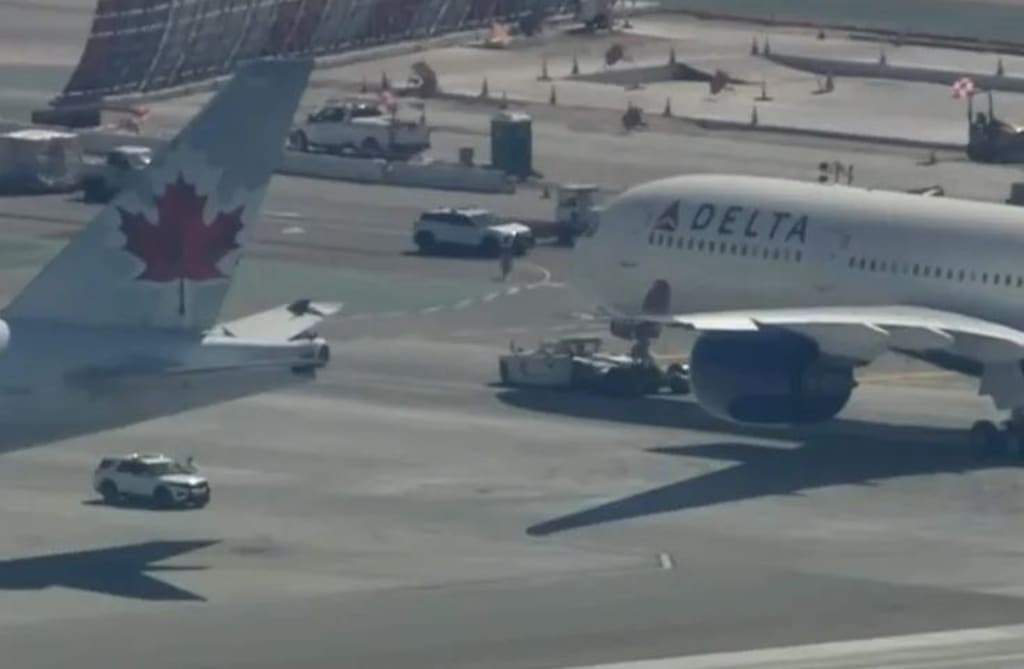
Los Angeles International Airport (LAX) was the site of a startling ground collision on Tuesday, October 6, when a Delta Air Lines flight taxiing for departure made contact with a stationary Air Canada aircraft. The incident, which occurred at approximately 10:30 a.m. local time, involved Delta Flight 7, which was preparing to depart for Tokyo Haneda with 275 passengers and 15 crew members on board, and Air Canada Flight 875, which had recently arrived from Toronto and was being towed to its gate. According to a statement from the Federal Aviation Administration (FAA), the Delta aircraft’s left wingtip clipped the horizontal stabilizer, the perpendicular fin at the rear of the tail of the Air Canada jet.
Despite the alarming nature of the contact, authorities confirmed that no injuries were reported on either aircraft. However, the visual evidence of the incident was striking. Aerial footage obtained by local news outlet KTLA 5 via its Sky 5 Telecopter showed the aftermath on the tarmac: a portion of the Delta plane’s wing was visibly dangling, having become lodged or caught on the Air Canada plane’s rear stabilizer. The footage also captured the swift mobilization of airport ground crews and maintenance teams, who surrounded the two aircraft to assess the damage and begin the complex process of disentangling the jets, all while other planes continued to operate on adjacent taxiways and runways.
In the immediate aftermath, both airlines and airport authorities moved quickly to address the situation and reassure the public. A spokesperson for Delta Air Lines emphasized the carrier’s primary commitment to safety, stating, “Nothing is more important than the safety of our customers and people, and we apologize to our customers for the experience and delay in their travels.” The airline confirmed that its maintenance crews, alongside airport teams, are conducting thorough assessments of the aircraft, and Delta has pledged full cooperation with the National Transportation Safety Board (NTSB) as the investigation unfolds.
Similarly, an Air Canada spokesperson, Sean Davidson, clarified the sequence of events from his airline’s perspective. He noted that the aircraft had just completed its journey from Toronto and was in the process of being towed to the gate when it “stopped short,” at which point the Delta aircraft made contact with its tail. Davidson confirmed that no one on the Air Canada flight was injured, but the aircraft has been officially removed from service to undergo rigorous structural inspections and necessary repairs.
A spokesperson for LAX was careful to distinguish the nature of the event, noting that the collision occurred on a taxiway, not an active runway. This is a critical distinction in aviation safety metrics, as runway incursions carry a significantly higher risk of catastrophic mid-air or high-speed collisions. “No injuries have been reported, and flights at LAX continue to operate normally,” the LAX representative stated, directing further questions regarding the cause of the incident to the NTSB.
The involvement of the NTSB and the FAA ensures that a comprehensive, multi-layered investigation will be conducted. Investigators will likely examine a variety of factors, including air traffic control communications, cockpit voice recordings, ground radar data, and the protocols followed by the towing crew. Ground collisions, while less frequent and less deadly than in-flight incidents, remain a persistent challenge at mega-hubs like LAX. The sheer density of aircraft movements, complex taxiway geometries, and the reliance on precise, real-time coordination between pilots, tug operators, and ground controllers create a high-stakes environment where even a minor misjudgment can lead to physical contact.
For the 290 passengers and crew aboard Delta Flight 7, the incident undoubtedly caused significant disruption to their travel plans to Japan. While the physical safety of everyone involved was preserved, the logistical fallout of grounding a wide-body international aircraft and managing the rebooking of hundreds of passengers is a complex operational hurdle for the airline.
As the NTSB begins its probe, the aviation industry will be watching closely. The findings from this investigation will not only determine the specific cause of this October 6 incident but may also prompt a review of ground-handling procedures and taxiway safety protocols at LAX and other major international airports. For now, the swift response of ground crews and the absence of injuries stand as a testament to the robust safety nets in place, even when the unexpected occurs on the tarmac.
About the Creator
Mark Lim
Hi I am mark an automotive student and a car, tech and food enthusiast ! Im gonna try and post daily & hope you enjoy what I write and do share my page with people you know. I would gladly appreciate it! Cheers
Enjoyed the story? Support the Creator.
Subscribe for free to receive all their stories in your feed.
Comments
There are no comments for this story
Be the first to respond and start the conversation.