Secrets
I Found a Hidden Room in My Grandmother’s House — What I Discovered Changed Everything. AI-Generated.
When my grandmother passed away last winter at the age of 92, she left behind more than a lifetime of stories — she left behind her house. A creaky, vine-covered Victorian home that had stood at the edge of our small New England town since before the Great Depression.
By Aliabout a year ago in Confessions
How a Taxi Driver Became My Unlikely Therapist
It was one of those nights — the kind that makes you feel like the world has given up on you, and you’re just too tired to care. I had missed a major deadline at work, had a fight with my best friend, and was on the verge of a quiet breakdown. When I stepped into the taxi just after midnight, all I wanted was silence and a ride home.
By shoaib khanabout a year ago in Confessions
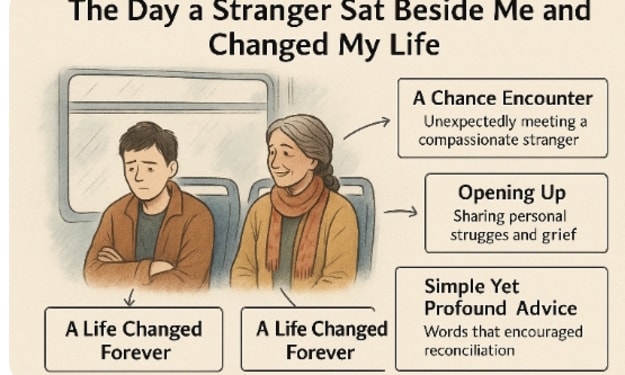
: “The Day a Stranger Sat Beside Me and Changed My Life”
I wasn’t supposed to be on that bus. My car had broken down two days earlier, and everything since had been a blur of borrowed rides, rescheduled shifts, and growing panic. I was already skating on thin ice at work, and one more delay could cost me my job. To top it off, rent was due, my savings were gone, and my sister hadn’t spoken to me since the funeral.
By Izazkhanabout a year ago in Confessions
The Art of Stillness: How to Sit, Eat, and Suffer Quietly in a Noisy World
Life doesn’t come with a manual, but sometimes we all wish it did. There are moments when we feel unsure of even the smallest things—like how to sit in peace, how to eat with care, or how to carry pain without making too much noise. These simple acts can say a lot about how we treat ourselves and the world around us. In this article, we’ll explore these three basic, yet powerful human actions: sitting, eating, and suffering. You might be surprised at how deep they really go.
By ibrahim khanabout a year ago in Confessions
A Light That Burned in the Dark
There was a time when Nathan didn’t know how to breathe. He wasn’t choking, not in the physical sense. But every morning felt like drowning inside a glass room, suffocating without water, without a cause, without a way out. People around him would casually say, “It’s just a phase,” as if agony was temporary like a passing flu, or a scratched record you could replace. But Nathan knew otherwise. Inside him, there was a silence deafening, persistent that crushed every budding thought before it could bloom into hope.
By Ashraf about a year ago in Confessions
Behind Smiles
Behind Smiles You see her every day. She's the kind of person who makes others feel lighter just by entering the room. Her smile is radiant, her laugh contagious. She remembers birthdays, sends late-night encouragement messages to friends, and cracks jokes even during tense meetings. Everyone calls her "sunshine." She's the one people lean on when things go wrong. Her name is Ayesha. She's twenty-six, working at a fast-paced digital agency, always dressed in vibrant colors, always humming some old Bollywood tune. If you didn’t know better, you’d say she’s the happiest person alive. But no one sees her after the lights go out. No one sees her come home to an empty apartment, place her phone face-down, and curl up on the corner of her bed, hugging a pillow that smells like memories. No one sees the moments where she stares blankly at the ceiling, eyes open, heart heavy, wondering what it’s like to live without pretending. No one hears the silence she drowns in every night — the silence she tries to fill with noise all day long. Ayesha wasn’t always this way. There was a time she dreamed freely — of writing books, traveling solo, laughing with her mother over tea on rainy evenings. But life had other plans. Her mother passed away suddenly when Ayesha was nineteen. A year later, her elder brother moved abroad, never to return. Her father stopped speaking to her after she refused an arranged marriage, saying she had "shamed" the family. So, Ayesha became her own home. Her own family. Her own comfort. She wore her smile like armor. She began journaling daily. Page after page of affirmations, goals, gratitude — but also pain. The kind of pain too raw to share. One page read: > “Everyone thinks I’m healing. But sometimes, I think I’ve just gotten better at hiding.” Work became her escape. So did social media. Her Instagram bloomed with golden hour shots, captions about self-love, coffee aesthetics, and book recommendations. People followed her for “positivity.” They never saw the drafts folder full of unsent goodbyes. Until one Thursday, everything collapsed. Ayesha didn’t get out of bed. Her limbs wouldn’t move. Her chest felt like it had caved in. Her mind — numb. Her phone kept buzzing: meetings, reminders, voice notes. She ignored them all. By evening, a close colleague who lived nearby grew concerned and came over. When she didn’t respond, he got the landlord to unlock the door. There she was. Not hurt. Not unconscious. Just sitting by the window, her face pale, her eyes swollen from crying. On the mirror in her bedroom, written in lipstick, were the words: “I’m tired of pretending.” She was taken to the hospital. Diagnosed with severe emotional exhaustion and clinical depression. The doctor called it an “internal breakdown” — the kind no one sees until it’s too late. And the people around her? Shocked. “I never knew…” “She was always so happy…” “She checked on me last week!” That’s the thing about people like Ayesha. They give so much light, hoping others don’t see their darkness. Weeks passed. Slowly, she began to speak. In therapy, at first. Then to herself in the mirror. Then finally, to the world. She posted on Instagram — no filter, no caption aesthetics: > “To those who think smiles mean strength: they don’t. I smiled to survive. I smiled to distract. I smiled so no one would ask if I was okay. But I wasn’t. And if you're reading this, and you’re tired too — please, speak up. Pretending will kill you in silence.” The post went viral. Messages poured in. Not of pity — but resonance. “I feel seen.” “This is my story too.” “You just saved me.” Ayesha changed that day. She didn’t become weak. She became real. Now, she laughs — but not to hide. She cries — without shame. And when someone says, “You seem so positive,” she smiles softly and says, “Sometimes. But not always. And that’s okay.” She leads mental health workshops at work now. She talks about the importance of checking in on “the strong ones.” She listens more. Speaks slower. Pauses often. And sometimes, when she looks at the mirror, she still sees that old version of herself — the girl who smiled to survive. But now, she reaches out — and comforts her. Because behind the brightest smiles are often the quietest screams. And Ayesha? She’s done hiding.
By TrueVocalabout a year ago in Confessions
She Was My Best Friend for 20 Years — Until I Found Out the Truth About Her Past
When a Stranger Becomes Your Person We met in college, in one of those large, echoing lecture halls where nobody really knows anyone unless they make the effort. Emily chose the seat next to me because every other seat had been taken. I remember she smiled like she already knew a secret about me. It was disarming. She borrowed a pen, cracked a joke about the professor’s monotone voice, and by the end of class, I knew I wanted her to be part of my life.
By Izazkhanabout a year ago in Confessions
Israel’s Strikes on Iran Ignite Global Debate: Is Regime Change the Real Goal?
As tensions in the Middle East reach a boiling point, Israel's latest airstrike campaign on Iran has not only escalated regional instability but also reignited one of the most controversial geopolitical topics: regime change in Tehran. With air raids targeting Iranian nuclear and military infrastructure, Israeli officials have started suggesting a broader objective — one that could reshape the power balance in the Middle East for decades. But as the smoke clears, a familiar voice is pushing back — former U.S. President Donald Trump. Though supportive of Israel’s security efforts, Trump appears to be drawing a red line when it comes to the idea of toppling Iran's leadership. Israel’s Precision Airstrikes: A Show of Military Power On Friday, Israel launched one of the most extensive and daring air raids in recent history, penetrating deep into Iranian territory. The targets included suspected nuclear facilities, long-range missile depots, intelligence sites, and even state media offices, which Israel claims serve a dual military purpose. According to Israeli defense officials, the mission aimed to "cripple Iran’s capability to build and launch nuclear weapons." The IDF (Israel Defense Forces) also suggested that some of the strikes were preemptive, intended to neutralize possible retaliation from Iran following recent escalations. But Israeli Prime Minister Benjamin Netanyahu hinted at something more during interviews over the weekend. He spoke of a “historic opportunity” to weaken Iran’s ruling elite, openly suggesting that eliminating Ayatollah Ali Khamenei — Iran’s Supreme Leader — could permanently change the equation. This rhetoric has shocked global observers and sparked fears of a broader war or collapse within Iran — something that could have ripple effects far beyond the Middle East. Trump’s Strategic Resistance: “Don’t Remove the Devil You Know” Interestingly, former President Donald Trump has reportedly rejected similar ideas during his administration, according to senior aides who spoke to Axios. While Trump championed aggressive sanctions and cyberattacks against Iran’s nuclear program, he was adamantly opposed to assassinating Ayatollah Khamenei or destabilizing the regime outright. His rationale? The fear of unintended consequences. “Trump believed in deterrence, not chaos,” one former official said. “He didn’t want to create a power vacuum in Iran. You get rid of the devil you know, you might end up with one you don't.” Even now, Trump remains supportive of Israel's military operations but has distanced himself from any language suggesting full-blown regime change. His messaging strikes a balance — supporting allies while avoiding entanglement in foreign overthrows. The World Reacts: A Mixed Bag of Alarm and Endorsement Global leaders are watching closely. While many Western nations have condemned Iran’s support for terrorism and nuclear ambitions, they also fear that an Israeli-led regime change effort could trigger massive unrest, unleash civil war, and potentially open the door for even more extreme factions within Iran. European diplomats have called for de-escalation. The United Nations Security Council has convened for emergency consultations. Meanwhile, Middle Eastern neighbors like Saudi Arabia and the UAE — long critics of Iran’s policies — are wary of the fallout. Publicly, they applaud Israel’s decisive action, but privately, many worry that regime collapse in Iran could lead to refugee crises and destabilize already fragile borders. 🛡️ Iran’s Regime: Shaken But Not Toppled Despite the damage from Israeli airstrikes, Iran's government remains intact — at least for now. Supreme Leader Khamenei appeared on state television dismissing the attacks as “cowardly” and vowing retaliation. While some Iranians took to social media to express outrage or fear, the streets of Tehran have not seen the kind of widespread uprising that some Israeli hawks had hoped for. Experts point to Iran’s unique political system — power is diffused across various institutions, including the Islamic Revolutionary Guard Corps (IRGC), religious bodies, and elected parliament. Even if Khamenei were removed, the regime would not crumble overnight. This complexity is likely why Trump, and many within the U.S. intelligence community, resist the idea of pushing for regime change. Removing a symbolic figurehead doesn’t guarantee democratic reform — and could potentially empower hardliners even more radical than the current leadership. 🕊️ Diplomacy on the Back Burner? Though missiles are flying, diplomacy isn’t completely off the table. Behind closed doors, U.S. and Israeli diplomats are reportedly working through back channels in Oman, Qatar, and Switzerland to keep communication open with Iran’s moderate elements. Some sources suggest that Trump’s team is exploring ways to restart nuclear talks if the situation stabilizes. The aim would be to reinstate controls on Iran’s uranium enrichment program while offering economic incentives. But for now, these plans remain hypothetical, as Iran’s leadership has shown no signs of yielding. 📌 Final Thoughts: Regime Change or Strategic Containment? Israel’s recent military action has reignited the long-dormant debate over regime change in Iran. While the airstrikes have showcased Tel Aviv’s military prowess and resolve, they also risk destabilizing a volatile region and drawing the world into a wider conflict. Trump’s caution highlights a recurring lesson from U.S. foreign policy — removing a dictator is easy; rebuilding a stable nation afterward is much harder. As both allies and rivals consider next steps, one thing is clear: the fallout from Israel’s strikes will shape the Middle East’s future for years to come. rael Iran conflict 2025
By NextGen Mobile Techabout a year ago in Confessions
Second, that changed everything
In the middle of the city’s chaos, under the glow of neon lights bouncing off the wet streets, there were Lily and Mark. A young couple, totally head over heels for each other. They always talked about their dreams, the kind of future they hoped to build together — simple things, like Saturday mornings with coffee, traveling, maybe a little dog.
By Esovrukaveabout a year ago in Confessions
The Day I Realized I Was Living Someone Else’s Dream
I didn’t realize it at the time, but I was living a life that wasn’t mine. It’s funny how we go through the motions of life — school, college, work, relationships — thinking that we’re in control, when really, we’re just ticking boxes someone else handed us. For me, that “someone else” was a mix of society, family expectations, and the invisible pressure to be “successful” — whatever that meant.
By Irfan Khanabout a year ago in Confessions
Bentley Kyle Evans Affair Cheating: Love Affair With Tiffany Walker
My Passionate, Sensual Affair With Bentley Kyle Evans From The Tiffany Walker Herself I didn’t plan on falling in love or even dating a married man. That man being Hollywood producer Bentley Kyle Evans. He often would say the same thing. He would say he didn’t think I would be so sweet. He said that he didn’t view me as a fling, that I was way more than that to him. That he loved me and I'm his girlfriend. At first glance I found Bentley Kyle Evans attractive, but he was married, and relationships are not my forte, if were being honest. I initially came to his wrap party for "Mind Your Business" with intentions to network as an actress. I even shook his wife's hand twice and she told me I was so pretty. Networking being this fine is harder than expected.
By Tiffany Lily Walkerabout a year ago in Confessions