Secrets
"The Blind Date That Taught Me to Love Myself". AI-Generated.
INTRODUCTION I remember the day we met like it was yesterday. It was a blind date, set up by mutual friends who swore we’d hit it off. I was skeptical, but my friends wouldn’t let up. They said we shared similar interests and values. I doubted it, but I agreed to meet him anyway.
By M.Changerabout a year ago in Confessions
The House I Grew Up In Doesn’t Remember Me
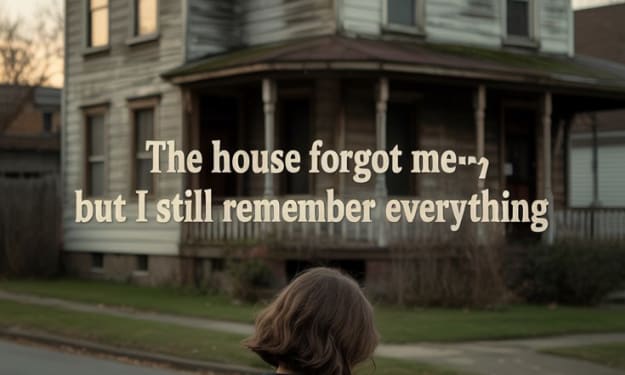
The porch steps creaked under my weight, though not out of familiarity. It was the kind of groan that old wood gives to strangers, not to long-lost children coming home. I hadn’t stood on this porch in over twelve years. And yet, every crack in the concrete walkway, every wind chime clinking in the dry summer air, every flake of peeling paint on the door had been preserved in my memory. I knocked anyway. Out of habit, maybe. Or respect. Or just fear. No one answered, of course. The house had been sold two years ago, shortly after my mother passed. I wasn’t able to come back for the funeral—work, distance, the messy nature of grief—but I told myself I’d visit soon. And now, finally, I had. The woman who now owned the house wasn’t home, or at least hadn’t responded to the letter I mailed weeks ago asking if I could come by. So I just stood there, tracing my fingers along the faded grooves in the doorframe where I used to measure my height with a pencil. A hundred tiny lines—proof that I had once existed here. But the pencil marks were painted over now. Gone. The tree in the front yard was still there, though taller, casting a wider shadow. I remembered tying a rope to one of its limbs and swinging wildly as a kid, daring gravity to knock me off. The swing was gone. The rope too. But the ghost of my laughter felt caught in the wind. I stepped back and looked at the house from the sidewalk. From this angle, it looked like a stranger’s home. The color had changed—from sunflower yellow to a tasteful gray—and the windows wore modern blinds that made it feel colder, cleaner, emptier. The flower bed where my mother used to plant daisies had been replaced with gravel and mulch. More efficient, I suppose. I didn’t cry. Not yet. Instead, I walked to the side of the house and peered into the backyard. The wooden fence, once sagging and marked with cartoonish graffiti from my teenage years, had been replaced. The cracked patio was now a sleek wooden deck with clean railings and a barbecue grill that gleamed in the sun. This wasn’t my backyard. This wasn’t my house. I sat on the curb out front and watched the sunlight shift slowly across the face of the building. It was strange. I had spent seventeen years inside those walls, but now I couldn’t even remember the exact sound the kitchen floor made when someone walked across it at night. I used to know that sound intimately. I used to hear it in my dreams. When I left home at seventeen—angry, idealistic, desperate to become someone else—I thought I’d never miss this place. I packed my bags and barely looked back. I told myself I’d been confined. That the town was too small, the house too loud, the people too controlling. I didn’t understand back then that you can’t really escape your past. You only delay the day you have to look it in the eye. And now that day had come. And the house didn’t know me. I think that’s what hurt the most. It had moved on. Just like I had. A soft voice broke through my thoughts. “You okay?” I turned. A teenage girl stood at the edge of the yard, holding a leash attached to a golden retriever. She must’ve lived nearby. “Yeah,” I said, clearing my throat. “Just… remembering.” She nodded, as if she understood, then added, “You used to live here?” “Yeah. A long time ago.” “My mom said the lady who lived here before us used to make the best lemon pies.” I smiled. “That was my mom.” “She sounds cool,” the girl said. Then she smiled politely and kept walking, the dog trotting beside her. Cool. My mom would’ve liked that. She used to bake lemon pies on Sundays, always leaving one to cool on the windowsill—like we lived in a storybook. The neighborhood kids would sneak bites, and she always pretended not to notice. Maybe that was the point. Maybe this house wasn’t supposed to remember me. Maybe houses aren’t built to hold onto people. Maybe they’re meant to carry new lives, new laughter, new memories in the same spaces where old ones faded. Still, as I stood up to leave, I noticed something near the base of the mailbox—a small crack in the concrete where I had once etched my initials with a rock. I bent down, brushed away some dirt, and there it was: L.W.—faint, but there. Proof. Maybe the house didn’t remember me. But it didn’t forget everything. Thank you for reading this ♥️.
By Azmat Roman ✨about a year ago in Confessions
The Letter I Never Sent to My Estranged Parent
The Envelope That Never Left My Desk I sat in my childhood bedroom, the air thick with dust and memories, holding a pen that felt heavier than it should. It was a rainy Tuesday in October, the kind where the world feels gray and endless. In front of me lay an envelope, its edges curling from weeks of hesitation. Inside was a letter I’d written to my estranged father—a letter I’d never send. The words were raw, jagged, a confession of pain I’d buried for years. I traced his name on the front, my handwriting shaky, and wondered if I’d ever find the courage to mail it.
By Hewad Mohammadiabout a year ago in Confessions
The Thing I Found on My Partner’s Phone Changed Everything
I wasn’t snooping. That’s what I tell myself when I replay the moment over and over. He was in the shower. I was just grabbing the charger off his nightstand when I saw his phone light up. A notification.
By HAFSAabout a year ago in Confessions
I Cheated… and It Made Me a Better Partner
I never thought I’d be the kind of person who cheats. It sounds self-righteous now, but I genuinely believed I was above that. I had opinions—harsh ones—about people who strayed. I judged them in silence. Called them selfish. Weak. Cowardly. I was sure I would never become the villain in someone else’s love story.
By HAFSAabout a year ago in Confessions
Why Does the Universe Ask more of me than most?
What I survived one does not talk about out of curtesy of others. It is socially inapriprate and one must cage the situation with caution because of social norms I soppose. People naturally can only handle so much. But naturally as a neurodivergent person I struggled to understand a social ques. Problem? I have no filter, and I am as bizarre as they come. I know people judge me to be quite odd or eccentric, for being to open. However, having cerebral palsy in the early 2000's made me a social outcast and I had zero social skills and no impulse control. When you are born with cerebral palsy there is damage to the frontal lobe and that really affects who you become in regards to your personality. I blame this reason alone for being such a bold person, Also people with disabilities ( I am sorry to be so honest) are stronger than the rest of population by the laws of the survival of the fittest. They have more tenacity and grit then you could ever imagine. You dont know how strong you have to be in life until you are given no choice or alternative. Naturally as a result, we face life fearlessly and with a kind of strength and courage no one could define unless they had a disability.Please keep in mind that I am very aware that everyone has a disability of certain severity, and in reality we are all disabled. However, it seems to be the case that more more "soul strength" is required of the people that are severely disabled and have very heavy bodies more sickly bodies with limited mobility. I was contently frustrated ands in a state of mental and physical exhaustion and still you must do what the world demands of you. I cannot tell you how many times I have pleaded in complete mercy to God, " Why are you asking me to do the impossible everyday- I'm tired."People always assumed I lived with my parents, live in a group home or some institution- and were shocked to learn I live on my own. When I am in a hospital, I feel helpless at times because the doctor and nurses assume I am incompetent regarding my care and condition of my health. They also talked to me and treated me differently. I remember them begging to treat my skin infection on my foot before it naturally enntered my bloodsteam and I found myself bedbound again due to extreme weakness. No one listened and I was asked to take anibiotics for weeks untuil the problem spiralled out of control and required hospitalization. Sometimes I arrived so overwelmed by the inflection I was no longer able to walk with my walker. I was using everything I had to make it to the ER in hopes I would be nursed back to health. But they always discharged me and I was always worried if my body was strong enough to make it home. These were dark times, it really did make me belief that my life had lost all of its quaility and I lived in a constant state of suffering and agony. I did not have my motorized wheelchair at the time and all I had to make it in the world was my walker. But due to illness I could no longer walk safely, and it seemed to also rob me of my balance and stability. But still I was told to take the antibiotics that were not working and sent home only to decline rapidly over time over and over requiring hospitalization. I had lost complete and utter hope and honestly thought I would showily die of an infection over a long sufferuing time period.But I had always been a fighter and suviver, I was not the type to just lay down and die, I was young and still had a life to live! I learned through research that the simple act of putting vasicine on my toes would end my horrific wounds and elevate the problem. I worked with specialists, wound care nursews and endless doctors and no one offered a solution or an answer to why it was happening. They only threw pills at me. Meanwhile the wound nurses were making the problem worse my putting thick bandages on my feet that only caused them to rub together more. It honestly stabs me in the heart recalling this time in my life. I felt subhuman to the healthcare system and neglected terribly.
By Julia Stellingsabout a year ago in Confessions
Why Showing You Care Early in Dating Is Powerful
Remember when dating felt like a game of who can care less? When showing your feelings too soon meant you were “too much,” “too clingy,” or “scaring them away”? Yeah, same. But guess what? That cold, guarded approach is slowly melting—and a new wave is crashing in, one filled with openness, emotional honesty, and something the internet calls yearning.
By Testabout a year ago in Confessions
The Viral Morning Routine Everyone Is Talking About—Does It Really Work?
You’ve seen the videos. A guy wakes up at 5 a.m., drinks something green, runs 10 miles, journals like a monk, and somehow has deep life clarity before sunrise. Social media makes it look effortless, aesthetic, and borderline superhuman.
By Kamran Zebabout a year ago in Confessions
The Day I Walked Away from Everything
I didn’t pack a suitcase. I didn’t leave a note. I didn’t cry. I simply stood up from the life I had built for ten years, turned the key in the door behind me, and walked away. There was no dramatic blowout, no final straw. Just a moment of stillness so loud it felt like a scream in my chest. For months—maybe years—I had been waking up with a knot in my stomach, waiting for the motivation to return. Waiting to feel something other than numb. But it never came. It wasn’t always like that. Once, I was the person who chased dreams with fire in my veins. I had a vision for my life, for my relationship, for who I wanted to become. But somehow, in the process of trying to meet everyone’s expectations—my partner’s, my parents’, society’s—I stopped meeting my own. I was thirty-two and living a life that looked great on paper. A stable relationship. A well-paying corporate job. A decent apartment in a respectable neighborhood. But beneath the surface, I was drowning. Every conversation felt like performance. Every day felt like a copy of the last. I started dreading Mondays, then Tuesdays. Eventually, I dreaded waking up altogether. The relationship had long gone stale. We stopped laughing. We stopped touching. We stopped caring. He was a good man, but not the right man—for me, or maybe for anyone. We were roommates pretending to be lovers, sharing meals but not moments, passing each other like ghosts in the same haunted house. One morning, I looked at myself in the mirror and didn’t recognize the eyes staring back at me. They were tired. Not just physically, but spiritually exhausted. I heard a quiet voice in my head say: You don’t have to stay. It was the first honest thing I’d allowed myself to think in a long time. So I didn’t. That afternoon, I walked to the edge of my old life and didn’t look back. I didn’t have a plan, just a backpack, my journal, and a bank account that could stretch if I was careful. I took a bus to a small town three hours away where no one knew my name. I checked into a modest inn and slept for fifteen hours straight. The first few days were terrifying. I questioned everything. Had I made a huge mistake? Was I selfish? Irresponsible? A quitter? But somewhere between morning walks and quiet cups of coffee, I started to breathe differently. For the first time in years, I wasn’t performing for anyone. I didn’t have to smile unless I meant it. I didn’t have to explain myself. I was just me—messy, uncertain, raw—and that was enough. I found a part-time job at a local bookstore, the kind with creaky wooden floors and handwritten staff recommendations on every shelf. The owner, a woman in her sixties named Marla, took me in without questions. She seemed to understand that I needed space more than sympathy. At night, I wrote. Not emails or reports—real writing. I poured the truth onto the page. The anger. The fear. The grief. But also the hope. The tiny seeds of self-trust that were beginning to sprout. Three months passed. I made friends. I learned how to be alone without being lonely. I stopped checking my phone every five minutes. I stopped apologizing for things that didn’t require apologies. I stopped shrinking myself to fit into a life that had outgrown me. One afternoon, I returned to the place I once called home—not to stay, but to say goodbye properly. I gathered my things, hugged the version of me that had survived so much, and left a simple note on the kitchen table: Thank you for the lessons. I’m ready now. Walking away from everything was the hardest thing I’ve ever done. But it was also the most honest. Sometimes, healing doesn’t look like fighting harder to keep it together. Sometimes, it looks like letting go—with no guarantees of what comes next. I don’t have all the answers. I still have days where I doubt myself. But I know this: I am no longer afraid of beginning again. Because the day I walked away from everything was the day I finally walked toward myself. Thank you for reading this 🥰.
By Azmat Roman ✨about a year ago in Confessions
Going Viral: The Dark Psychology Behind Online Fame
It starts with a ping. A sudden spike in views, an influx of likes, a flurry of comments from strangers across the world. You’ve gone viral. For a moment, you feel untouchable—validated, important, seen. But beneath that glittering surface, something darker is brewing.
By Kamran Zebabout a year ago in Confessions