Humanity
Unspoken
I’ve always believed that the most powerful stories are the ones no one ever hears. They live quietly, tucked inside us — in half-written journals, in unfinished letters, in the moments when we stare at the ceiling and wonder what if. They never make it to stages or bookshelves. They don’t go viral. But they shape us more than any story we tell out loud. This is one of mine. I met her in the quietest winter of my life. I was 21. Lost, like most people are in their early twenties — pretending I knew who I was, what I wanted, what healing looked like. I had dropped out of university the semester before. Depression doesn’t ask for permission — it just shows up and stays until you forget who you were before it arrived. I’d spend most of my days sitting on the park bench at the corner of Fifth and Willow, clutching a notebook I rarely opened. Writing had always been my release, but at that time, even words felt too heavy to carry. And then she sat down next to me. No introduction. No small talk. Just a soft, tired sigh and the unwrapping of a chocolate bar. I glanced at her. She looked… ordinary. Messy bun, oversized coat, sneakers with worn-out laces. But her eyes — her eyes held storms. Not the kind that scared you. The kind that said, I’ve been there too. She offered me a piece of chocolate. I shook my head. "You look like you need it more than me," she said, half-smiling. That was the beginning. Her name was Safiya. We never exchanged numbers. We never asked for last names. But for the next 27 days, she showed up. Same bench. Same time. Two strangers sitting in silence, sometimes sharing chocolate, sometimes stories. She once told me, “People always want to fix you. They throw advice like bandaids. But sometimes, you just need someone to sit in your sadness without trying to solve it.” I didn’t say anything then. But I wrote it down when I got home. On the 10th day, she brought her journal. Not to read from it — just to show me it existed. “I call it The Book of Things I’ll Never Say Out Loud,” she said. I nodded, then slowly handed her mine. She didn’t open it. Just held it like something sacred. We sat that way — two people with matching scars, holding each other’s silence. On the 20th day, she cried. No warning. Just tears falling quietly as the wind pushed against the trees. I didn’t ask why. I just handed her a tissue and sat closer. “I thought I was getting better,” she whispered. “But grief has no expiration date.” Still, I said nothing. That was our language — understanding without questioning. On the 27th day, she didn’t come. I waited. For hours. The next day, I waited again. And the next. She never came back. I don’t know where she went. I don’t know if she moved, relapsed, healed, disappeared. I never saw her again. But sometimes, I imagine she’s sitting on another bench, in another city, handing someone else a chocolate bar and listening to stories they’ll never tell anyone else. Sometimes I think I was just a pause in her journey. A safe corner in the chaos. And maybe that’s enough. A year later, I opened the journal she gave me. I hadn’t dared to until then. There were only two pages filled. Page 1: To the stranger on the bench: Thank you for not asking me why I’m broken. Thank you for just sitting with the pieces. Page 2: If you’re ever brave enough to write again, write the story of us. Not for the world. For yourself. To remember that even on your worst days, someone saw you and stayed. I wept. Not loudly. Not dramatically. The kind of weeping that feels like cleansing — like finally letting go of everything you’ve held too tightly. I’m writing this now, years later, because she was right. Some stories deserve to be written even if no one reads them. Some connections, even nameless, are more real than lifelong friendships. Some moments live longer in memory than entire years. This is not a love story. It’s not a tragedy either. It’s just… human. Two people. One bench. A borrowed journal. Twenty-seven days of unspoken healing. So here it is, Safiya. I finally wrote the story. And if you ever find it… Thank you. For sitting beside me when I couldn’t carry my story alone.
By Muhammad Abuzar Badshah about a year ago in Confessions
The Firefly That Refused to Fade
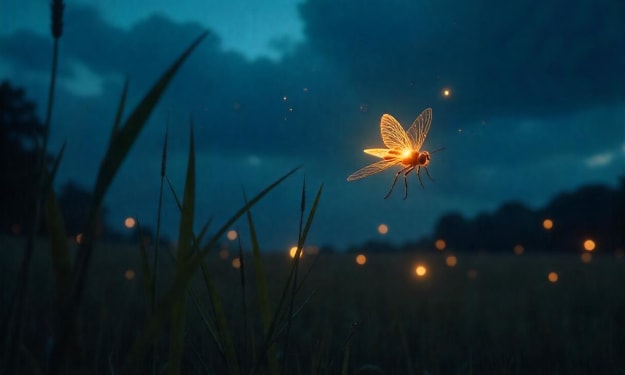
Story: On the edge of a quiet village, nestled in tall blades of grass, lived a firefly unlike any other. His name was Lumo, and unlike most fireflies who blinked their lights for brief moments of courtship or instinct, Lumo carried a different fire—one not just in his abdomen, but deep within his soul. Every night, as the stars blanketed the sky and clouds drifted lazily over the moon, Lumo emerged. Where others flickered for moments and faded into the shadows, he chose to shine longer, brighter, and with purpose. The other insects often whispered, “Why does he burn so bright?” But Lumo never answered. His light was not for them. He had a dream. --- A Fire Born in Silence Lumo was born on a humid summer night. His first memory wasn’t of flight or freedom—it was of stillness. He remembered the suffocating darkness, a world where not even the stars dared peek. But then, for the first time, he felt it—a flicker inside him, warm and glowing. It wasn’t just biology or instinct. It was a calling. That night, he watched as the other fireflies rose for a brief mating flight. They danced, flickered, and faded. But Lumo stayed grounded. He asked himself, “Is my light meant only for survival—or something more?” --- The Path Less Glowed Unlike others, Lumo wandered further than the fields. He soared over rivers, glided through valleys, and even hovered above the rooftops of sleeping villages. Children in their beds would sometimes catch a glimpse of his glow and smile in their dreams. To them, he was a tiny wish flying in the dark. But every journey had its price. There were nights when storms raged, and his fragile wings felt like tearing. Clouds would swallow the stars, leaving him alone in a sky without guidance. At times, his light would dim—not from exhaustion, but from doubt. Why was he the only one still flying? Why did no other firefly share his path? --- The Firefly and the Boy One evening, after a heavy rain, Lumo rested on a blade of wet grass near a small hut. Inside, a little boy sat by the window, silent and sad. His mother had been sick for days, and the boy hadn’t smiled in what felt like forever. Lumo saw him. He knew that sadness. That lonely silence. So, for the first time in many nights, Lumo flew close—not high in the sky, but low, where the boy could see him. He circled the window gently, leaving a soft glowing trail in the misty air. The boy looked up, and for a moment, hope lit his eyes. Lumo didn’t need words. His light said it all: “You’re not alone.” That night, the boy placed a glass jar outside the window—not to catch Lumo, but to invite him. A tiny gesture of trust. Lumo never entered the jar, but he danced around it every night, giving the boy something to wait for. Over time, the mother recovered. The boy smiled more. And Lumo? He kept flying. --- Why Fireflies Don’t Shine in the Day Some ask, “Why don’t fireflies shine during daylight?” Lumo would say, “Because their light isn’t meant to compete with the sun—it’s meant to guide in darkness.” And maybe that’s the most beautiful thing about them. They glow when no one else does. They remind us that even in the deepest night, something soft and small can still be beautiful, powerful, and real. --- Legacy in the Night Lumo became a quiet legend in that village. No one could prove he existed, but stories passed from child to child. "The flying light that healed sadness." "The night flame who never left." "The firefly that refused to fade." Old now, Lumo still glows. His wings slower, his trails shorter—but his light, oh his light—it burns like the first night he felt it awaken inside. He knows now: It was never about being seen. It was about being true. --- Final Thoughts Lumo’s story is not just about a firefly. It’s about all of us—those who feel different, who shine in quiet ways, who carry light when the world turns dark. In a time where people often chase attention, noise, and brightness, maybe we should all learn something from a tiny firefly who chose to glow not for applause—but for purpose. We don’t always need to shine the brightest. We just need to shine when it matters most.
By Ihsan Ullah LLCabout a year ago in Confessions
Evenings I Don’t Live, But Feel
I don’t quite know what it is about the evening, but every time it arrives—especially when the weather turns gentle and the sky takes on that soft golden hue—something stirs quietly inside me. There's a kind of magic in those dusky hours, something almost sacred. The world seems to slow down, stretch itself out, and exhale. And in that pause, I often find myself longing to step outside alone—not for anything grand, but simply to walk beneath the open sky, to breathe in the evening air, to be one with the silence.
By Laiba Gulabout a year ago in Confessions
I Thought I Knew His Story—Until the Truth Came Out
I never planned to adopt. It just… happened. It started with a visit to the children’s home. I was volunteering, helping with medical check-ups during my residency. That’s when I met Liam. He was seven, quiet, and far too observant for his age. While other kids ran around, Liam sat still, watching the world with eyes that had seen too much.
By Jawad Aliabout a year ago in Confessions
Loving You in Secret
They met in the quiet corner of a crowded café, where the world outside seemed to rush past like a distant storm. Amid the chatter and clinking of coffee cups, there was a stillness only they could feel — a connection woven in silence before a single word was spoken.
By Muhammad Tayyababout a year ago in Confessions
Human Monsters Part 2. AI-Generated.
Rawan continued, "Larry, thank you for reminding me of the proudest man on earth... Thank you for reminding me of Daedalus. Do you know why he was the proudest man on earth? He believed he could conquer nature, not just his king! Not just the gods! Nature in all its glory!
By ADIR SEGALabout a year ago in Confessions
When Silence Speaks Loudest
The clock ticked softly, almost too softly for a room so still. Outside, the winter air pressed its foggy fingers against the frosted glass of the living room window. Inside, two people sat, separated by three feet of space and miles of misunderstanding.
By Muhammad Tayyababout a year ago in Confessions
They Left the Basement Door Open
They Left the Basement Door Open It was an unspoken rule on Calderon Street: Don’t ask about the basements. Every house had one—solid concrete stairs leading into a dark below—but they were always sealed. Some with heavy padlocks, others welded shut, and one even bricked over entirely. Kids made up stories, of course. Nuclear shelters. Secret labs. A collective effort to hide something awful.
By Huzaifa Dzineabout a year ago in Confessions
The Day I Died. Content Warning.
I had a long life ahead of me. I had 2 kids and a loving wife. I perfect, sincere job. I was on a run to become the headsman in my institution. Everything looks clean and clear. But there's something we always forget. The ending.
By Kelly Munala Brookesabout a year ago in Confessions
Tea With a Stranger
Every morning at 9:00 sharp, she arrived. The small corner café on Linden Street knew her well. The baristas didn’t ask for her order anymore. A cup of Earl Grey with one sugar — always the same. She sat at the same table by the window, placed her worn brown purse on the right-hand chair, and stared outside like she was waiting for someone who might never come. No one ever joined her. No one ever asked. Until the day he did. --- He was young. Twenty-something, perhaps. A little scruffy, in a gentle way. He walked in, juggling his phone, a laptop bag, and a half-eaten croissant. Looking around, he saw that the café was unusually busy. Except for one table with an empty seat — next to her. He hesitated. She noticed. Their eyes met. And then, softly, he asked, “Excuse me, may I sit here? Just for a minute. I won’t bother you.” She looked at him. Then at the chair. Then at her tea. “Yes,” she replied. “But only if you don’t mind quiet company.” --- He smiled. “I actually prefer it.” Minutes passed. She sipped her tea. He typed on his laptop. And then, without looking up, he asked, “Would you happen to have some sugar?” She slid the tiny glass jar across the table. That’s how it started. With sugar. --- “You come here often?” he asked, chuckling awkwardly at the cliché. “Every day,” she said. “Why?” She paused. “Because it’s the only place that still remembers I exist.” His fingers froze over the keyboard. He looked up, eyebrows raised, unsure what to say. She took another sip of tea, then smiled faintly. “My husband and I used to come here every Sunday. After he passed, I kept coming. Sundays turned into Mondays, Mondays into years.” --- He put his laptop away. “What was he like?” the young man asked gently. She tilted her head, as if surprised anyone wanted to know. “Quiet. Brilliant. He could make me laugh without saying much. He had this way of stirring his tea — like he was composing a song.” They both laughed softly. The young man introduced himself. His name was Nathan. A writer who had lost his way. A dreamer, out of ideas and nearly out of hope. He didn’t know why he sat there that day. Maybe it was the light. Maybe it was her stillness in a world so rushed. --- Days turned into weeks. Nathan came back. So did she. They shared tea. They shared silence. They shared memories. She told him about the house she once owned. The garden she used to love. The cat that never liked visitors. The child she never had. He told her about the city noise he couldn’t escape. The heartbreaks that still echoed. The stories he couldn’t finish. --- One rainy morning, she wasn’t there. He waited. He checked his phone. He asked the barista if she’d come. “No, sir,” the barista replied. “Not today.” Worry sat in his chest like a stone. But the next day, she returned. With a cane. “Fell,” she said simply. “But I couldn’t let you drink bad tea alone.” He smiled. “I’d have brought sugar to the hospital if I had to.” She laughed — really laughed. A sound that hadn’t been heard in that café for years. --- Spring arrived. One morning, Nathan sat down and placed something on the table. A printed page. “Read it,” he said. She adjusted her glasses. It was a story. About a woman who sat by a window, alone. And a stranger who asked for sugar. It was beautiful. Gentle. Alive. She looked at him, her eyes misty. “I never thought I’d become someone’s story.” “You became my beginning,” he said. --- When she didn’t return one Tuesday, he knew. This time, she was truly gone. But on the table by the window, he left something — her sugar jar, and a note that said: > “Thank you for showing me how to begin again.” — N --- Years later, the café still stood. Writers often sat by the window, claiming the spot had "good energy." And every now and then, a barista would set down a cup of Earl Grey — with one sugar — on the right-hand side of the table. Just in case someone came who needed it. ---
By The Pen of Farooq about a year ago in Confessions