Humanity
Thank You Too 2025
THANK YOU 2025 (VOCAL) Reflection of the past five years as we head into 2026 just a few thank yous. 1) Thank you too, my mum and dad for always no matter what being proud of me and letting me reach for the sky's with my wild last minute idea a.k.a traveling to New York on my own and trusting me and knowing that i will be ok, and for also being the best parents a girl could ask for
By H J Myers9 months ago in Confessions
Between Hate and Love
Have you ever paused to wonder how quickly love can turn into hate—or how hate can quietly mask love beneath the surface? One moment you care deeply, and the next you feel anger, resentment, or distance. This emotional tension is something almost everyone experiences, yet few truly understand. Between hate and love lies a powerful, confusing, and deeply human space—one that shapes our relationships, decisions, and even our sense of self.
By John Smith9 months ago in Confessions
The Quiet Power of Presence: Trust, Desire, and the Weight of Being
I can still feel the chill of that evening, the way it made my skin keenly aware of itself. I leaned against the balcony railing of a small apartment, watching the streetlights flicker below, glowing softly through the dimming dusk. He was there, a few steps away, his gaze on the streets as if he could read the rhythm of life beneath him. There was nothing performative in his posture, no dramatic gesture to draw attention. Yet the way he existed in that space—calm, grounded, and unassuming—pulled me in. I became painfully aware of how his presence shaped the air around him, shaping me in subtle, unnameable ways.
By SATPOWER9 months ago in Confessions
Word of the Day: ホチキス. Top Story - December 2025.
I don't know the word for Staples. I remember I used to think that Hochikisu was an Onomatopoeia for a stapler rather than a brand name. I am pretty sure I already have this title as a theme, which is making me feel many sort of ways as Vocal is harassing me about payments currently.
By Kayla McIntosh9 months ago in Confessions
Dialogue Without Words
The three sit together, a loose triangle of bodies and histories. Two talk. One listens. Or tries to. At first, it’s nothing unusual — familiar rhythms, familiar roles. But then something shifts. Not loudly. More like a subtle drop in temperature, the kind you feel before you understand.
By Shannon Lemire9 months ago in Confessions
Charity Never Fades”. Content Warning. AI-Generated.
in a small village surrounded by fields and dusty roads, there lived an elderly woman named Asha. Her house was a tiny mud hut with a leaking roof and cracked walls, but it was always clean. Asha had lived a hard life. She had lost her husband many years ago and had no children to support her. To earn a living, she woke up early every morning, collected wild flowers from the nearby forest, and sold them beside the road.
By M Saif9 months ago in Confessions
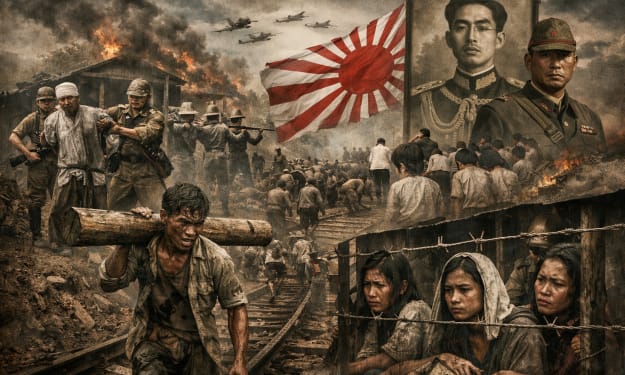
Japan’s Occupation of Indonesia: When “Asian Liberation” Turned Into Systematic Brutality. Content Warning.
During the chaos of World War II, as Southeast Asia became a battleground for competing empires, Japan entered Indonesia under a slogan that appeared revolutionary at the time: Asia for Asians. To a population that had endured more than three centuries of Dutch colonial rule, the collapse of European authority in 1942 seemed, at first, like the dawn of a new era. It was not. What followed was not liberation, but a militarized occupation that proved more violent, more intrusive, and in many ways more destructive than the colonial system it replaced. Within three years, Japan reshaped Indonesian society through fear, forced labor, starvation, and cultural coercion—leaving scars that remain deeply embedded in the nation’s collective memory. Indonesia was, and remains, a predominantly Muslim society. Islam was not only a religion, but the backbone of social organization, education, and moral authority. Mosques, scholars, and Islamic associations connected villages across the archipelago, forming networks capable of mobilizing large segments of the population. To the Japanese military administration, this was not spirituality—it was a potential threat. From the earliest months of occupation, Islam was treated as a security issue. Religious schools were closed or tightly restricted. Sermons were censored, and imams were required to submit their speeches for approval. Major Islamic organizations were placed under constant surveillance, not because they opposed Japan at the time, but because the occupation understood that faith-based unity could quickly turn into organized resistance. The most catastrophic policy imposed on Indonesians was the forced labor system known as Romusha. Entire communities were emptied overnight. Young men were taken by force and transported to work sites deep in jungles, mountains, and remote construction zones. They were used to build roads, military facilities, and railways under inhumane conditions—without adequate food, medical care, or rest. Death was routine. Starvation, disease, beatings, and exhaustion claimed hundreds of thousands of lives, and some estimates suggest the number may exceed one million. There were no proper records. To be taken as a Romusha laborer was, in effect, to disappear. One of the most infamous projects was the Burma–Thailand “Death Railway.” While international narratives often focus on Allied prisoners of war, far less attention has been given to Indonesian Muslim laborers, who constituted a larger portion of the workforce and suffered even higher mortality—without names, graves, or recognition. Women were subjected to a different form of violence. The Japanese military established a widespread system of sexual slavery known as the “comfort women” system. Thousands of Indonesian Muslim girls were abducted from their villages and confined in military facilities, where they were repeatedly abused. For decades, silence surrounded this crime—not because it was unknown, but because shame, fear, and social pressure buried the victims’ voices. Economic life collapsed under the demands of Japan’s total war strategy. Rice harvests were confiscated to supply the military, transforming food into a weapon of control. By 1944 and 1945, famine spread across large parts of Indonesia. Villagers survived on wild plants, while child mortality rates soared. Hunger was not incidental—it was systemic. Any attempt at dissent was met with extreme punishment. Religious scholars who spoke out were executed publicly, imprisoned, or buried alive. Education was restructured to glorify the Japanese emperor, portrayed as a divine figure. Teaching Arabic and the Qur’an was restricted, and children were forced to recite imperial slogans that directly contradicted their religious beliefs. When Japan surrendered in August 1945, it left behind a devastated nation—exhausted, hungry, and traumatized. Yet paradoxically, this period of intense suffering accelerated Indonesia’s path toward independence. Within days of Japan’s defeat, Indonesian leaders declared sovereignty, having learned firsthand that no foreign power’s slogan could substitute for genuine self-determination. Japan’s occupation of Indonesia stands as a stark historical lesson: political narratives of “liberation” can conceal systems of exploitation and mass violence. And for Indonesia’s Muslim population, the cost of that deception was paid in blood, dignity, and generations of silence.
By Echoes of the Soul9 months ago in Confessions
The Ghost on the Floorboards
The house breathes around me. It’s an old house, full of settling groans and the low hum of the refrigerator. Two in the morning, another Tuesday, another bottle of cheap whiskey working its way through my bloodstream. The wife's asleep upstairs, snoring softly, a familiar, comforting sound, if you don’t think about it too hard. The kids, grown now, gone. Just me, the bottle, and the goddamn moonlight pouring in through the living room window, painting stripes across the hardwood.
By HAADI9 months ago in Confessions
God Interviewed Me
I have been interviewed hundreds of times during my life. I have been asked questions by employers when applying for a job or promotion. Up until now, I have had to answer questions about my life, my hopes, my dreams, my strengths, my weaknesses, my finances, my health, my spirituality, and my plans for the future.
By Margaret Minnicks9 months ago in Confessions
The Love That Still Haunts Her
Juliet was thirteen the first time the world truly broke her. Before that, she'd always known she was different — but it hadn’t been punished yet. She thought maybe, if she was just sweet enough, just smart enough, just kind enough, the world would leave her alone. It didn’t.
By Shelley Rosetti9 months ago in Confessions
World War 3: Why the Fear Is Growing, Why the Future Is Not Decided
World War 3: Why the Fear Is Growing—and Why the Future Is Not Decided In recent years, the phrase “World War 3” has moved from history books into daily conversation. It appears in news headlines, political speeches, social media debates, and comment sections across the internet. For many people, it represents a growing fear that the world is drifting toward another global catastrophe. But fear alone does not explain why this idea has become so powerful—or why it demands careful discussion rather than panic.
By Wings of Time 9 months ago in Confessions
The Glare of Ghost Street
The rain was a cold, constant whisper, a thousand tiny accusations hitting the asphalt. It didn’t let up. Just this endless, soft drumming, washing over everything, blurring the edges of a city that never really slept, just sagged into a kind of tired stupor. I watched it pool in the cracks of the sidewalk, each puddle a shattered mirror, catching the smeared smears of neon from the dive bar, the pizza joint, the flashing vacancy sign of the motel that always smelled faintly of disinfectant and stale regret. Red, blue, sickly green, all twisting and shimmering in the black water. Looked like blood in some places, bruising in others.
By HAADI9 months ago in Confessions