Humanity
I Stole Something I Regret
I never thought I would be the kind of person who stole. Not in a big, dramatic way, like the movies show, but small—the kind of theft that whispers its way into your conscience quietly, almost unnoticed. But last year, I did. And the memory of it gnaws at me every time I remember.
By Luna Vani8 months ago in Confessions
The Time I Never Had
There are things you understand late, sometimes too late. Like the fact that I grew up long before I was old enough. Not by choice. Not to prove anything. Just because life pushed me there. In a few weeks, I will be 32. And yet, deep inside, something resists, something asks for the time I never had. When I look back, I don’t really see a childhood. I see silence, heavy responsibilities, decisions made too early. I feel like I skipped an essential step. While others were discovering themselves and making mistakes without consequences, I was already learning how to stand on my own. I don’t have clear, colorful, carefree memories. Everything feels blurred and compressed, as if my childhood was swallowed by the urgency to become strong. As a teenager, I had to be functional. Figure things out. Learn fast. Take hits without asking too many questions. I built myself through constant adaptation, with the idea that I had to keep moving no matter what. I wasn’t taught how to dream, I was taught how to survive. So I did what I could with what I had, pushing aside my emotions, my doubts, my vulnerabilities. People often said I was mature for my age. But no one ever asks what it feels like to be “mature” too early. It is not a badge of honor. It is a mechanism. A form of protection. A shell you build when you have no choice. Behind that maturity, there was a kid who wanted to slow down, make mistakes, be taken care of. But I learned very early that no one would do that for me. What I feel today is hard to explain without sounding ungrateful for my own path. I don’t reject who I’ve become. I know that growing up too fast gave me strength, clarity, and resilience. But it also left me with a deep, old exhaustion. A tiredness that doesn’t come from today but from yesterday, or even before. As I approach 32, I sometimes find myself wanting to go back to my twenties. Not to party again or chase fake carefreeness. But to live what I never really had. Mistakes without consequences. Spontaneous energy. The feeling that everything is still possible. I feel like I was an adult before I was young, and now something inside me is asking for that missing time. There is a constant sense of mismatch. As if my inner age never truly matches my real one. I was too old too early and now I sometimes feel too young inside for the image I give off. This paradox is exhausting. It creates distance — from others, and from myself. I know how to be strong, but I’ve forgotten how to be light. This text is a way of speaking to the person I once was. To that teenager who managed alone without complaining. To that child who never had the time to fully exist. It is also a way to admit that growing up too fast leaves invisible marks. Scars you can’t see but that you feel in your body, in your thoughts, in that strange desire to go back without really knowing where to stop. I’m not looking for pity. I’m looking for truth. Mine. The truth of a man who learned how to be strong before learning how to be happy. Of someone who keeps moving forward, while still carrying this quiet absence inside. Maybe the real work starts now. Maybe, even at 32, it is still possible to recover pieces of that lost youth. Not to erase the past but to finally allow myself to exist fully. Without armor. Without urgency. Just human.
By Baptiste Monnet8 months ago in Confessions
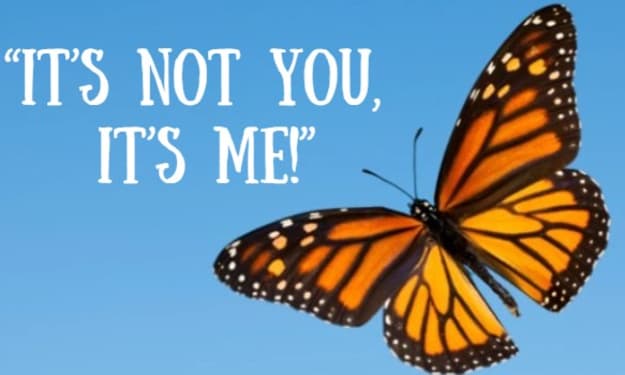
“It’s Not You, It’s Me!”
There comes a time in life when I look at the things I used to do, especially when I was much younger and wanted to get along with others. There were times when I went along with the routines, the invitations, and habits of others that no longer fit me. Theref0re, I am breaking up with those habits.
By Margaret Minnicks8 months ago in Confessions
Love makes yourself blind not your friends
Sunday, 16 March 2025- Camille's House Sometimes during your lifetime, you are going to meet many people, meet many souls, I can tell, but one day you are going to meet someone that your heart beats for, someone who puts you in a trance, someone whose smile gives you not just energy but motivation to be a better person. I am a better person with him. I know he never would hurt me. Since I met him, I am glowing, I am feeling protected, feeling alive.
By Janissa Andrade8 months ago in Confessions
Finding Herself Between Subway Stops
Manthatan Story The morning sun glinted off the glass towers of Manhattan even before Anika stepped off the subway. The city was already humming with life and noise and possibility. Every block felt like a promise waiting to be fulfilled. She had moved here from a small town in Texas with a suitcase full of clothes and an even bigger bag of dreams. Today was her first day at her new job at the publishing house just off Fifth Avenue.
By Ibskins8 months ago in Confessions
Supreme Court Ruling on Tariffs Redefines the Future of Trade Policy
Supreme Court Ruling on Tariffs Redefines the Future of Trade Policy The Supreme Court decision on tariffs marks a critical turning point in the relationship between law, politics, and economic policy in the United States. Tariffs have historically been used as a strategic tool to protect domestic industries, influence foreign governments, and respond to global economic pressures. However, as tariffs increasingly affect consumers, businesses, and international relations, their legality and scope have come under intense judicial scrutiny. The Court’s ruling provides long-awaited clarity on how far tariff authority can extend and who ultimately controls it. In recent years, tariff policies have moved from being technical trade instruments to major political issues debated at the national and global levels. The Supreme Court’s involvement underscores the importance of legal oversight in decisions that have wide-reaching economic consequences. **What Is the Supreme Court Ruling on Tariffs** The Supreme Court ruling addresses whether certain tariffs were imposed within the limits of authority granted by Congress. The case focused on how federal trade laws are interpreted and whether executive actions aligned with legislative intent. By examining statutory language and constitutional principles, the Court clarified how tariff powers should be applied under the law. This decision does not eliminate tariffs as a policy tool, but it defines the legal framework under which they must operate. The ruling emphasizes that tariffs cannot be imposed arbitrarily and must follow clearly defined legal standards. **Why Did the Supreme Court Review Tariff Policy** The case reached the Supreme Court after businesses, industry groups, and trade organizations challenged the legality of the tariffs. These groups argued that the tariffs caused economic harm and exceeded the authority granted to the executive branch. Lower courts issued mixed rulings, increasing the need for a final and authoritative interpretation from the Supreme Court. The Court agreed to hear the case because of its national importance and its impact on constitutional balance. The decision addresses not only trade policy but also the separation of powers between Congress and the President. **How Does the Decision Affect Presidential Authority** The ruling reinforces limits on presidential power in trade matters. While the President retains the ability to act swiftly in response to economic or security concerns, the Court emphasized that such actions must be grounded in clear congressional authorization. This strengthens the system of checks and balances and prevents the expansion of executive power beyond what the law allows. Future administrations will likely face stricter legal standards when attempting to impose new tariffs, especially those with broad economic impact. **What Does the Decision Mean for Businesses** For businesses, the Supreme Court ruling brings greater certainty and stability. Companies involved in global supply chains often face sudden cost increases when tariffs are imposed without warning. By clarifying the legal process behind tariffs, the decision allows businesses to better plan investments, manage risks, and anticipate regulatory changes. Manufacturers, importers, and exporters may also feel more confident challenging tariffs that appear legally questionable, knowing that clear judicial standards now exist. **How Are Consumers Affected by the Ruling** Consumers are often the indirect victims of tariffs, as higher import costs can lead to increased prices for everyday goods. The Court’s decision may reduce the likelihood of abrupt tariff increases, helping stabilize prices over time. While the ruling does not immediately lower costs, it may prevent sudden economic shocks that disproportionately affect households. **What Is the Impact on Global Trade Relations** International trade partners closely watch U.S. tariff policy. The Supreme Court’s decision sends a message that trade actions will be governed by law rather than unilateral discretion. This may strengthen confidence among allies and reduce the risk of retaliatory measures that can escalate into broader trade conflicts. By reinforcing legal consistency, the ruling supports a more predictable and rules-based global trade environment. **Does the Ruling Affect Existing Tariffs** The decision does not automatically cancel existing tariffs. Instead, it establishes legal principles that may influence future court challenges. Some tariffs could face renewed legal review if they are found to exceed the clarified limits of authority. Others may remain in place if they comply with the standards outlined by the Court. **Why Is This Decision Politically Important** Tariffs are often used as political tools during periods of economic uncertainty or geopolitical tension. The Supreme Court ruling limits the ability to use tariffs for purely political leverage without legal justification. This may encourage greater congressional involvement in trade policy and shift debates back to the legislative arena. The decision also highlights the judiciary’s role in shaping economic policy, reinforcing the idea that even powerful economic tools are subject to constitutional constraints. **What Happens After the Supreme Court Decision** Following the ruling, lawmakers may seek to revise or clarify trade legislation to define tariff authority more precisely. Executive agencies are expected to adjust their policies to comply with the Court’s interpretation. Businesses and legal experts will continue to analyze the decision’s long-term effects, particularly as new trade disputes arise. The Supreme Court ruling on tariffs represents a defining moment for U.S. trade governance. By reaffirming legal limits, protecting institutional balance, and promoting economic predictability, the decision will shape how tariffs are used and challenged for years to come.
By America today 8 months ago in Confessions
Word of the Day: 進捗
I came to school with a really heavy bag. I packed both of my computers in my backpack today. I guess I need to actually work too but I am just spending my time here for some reason. I am not getting financial aid, they keep sending me emails about that I made " changes " so I am like... ok I guess I have to handle it. It is very annoying. Hence why I am sitting here. My backpack is super heavy and I don't want to climb all those steps. I haven't eaten a lot lately. I mean I am happy I lost like 4lbs so that's good but, I am pretty miserable for the most part.
By Kayla McIntosh8 months ago in Confessions
A Room where I Finally Met Myself
By Fatima Sami The door clicked shut, and for the first time in three decades, there was nowhere left to run. It was a modest room—four walls painted a shade of eggshell that seemed to bruise in the twilight, a single window facing an oak tree, and a silence so heavy it felt like a physical weight on my chest. I had spent my entire life avoiding this specific brand of quiet. I had filled my hours with the frantic hum of career goals, the static of social media, and the constant, exhausting performance of being "fine."
By Fatima Sami 8 months ago in Confessions