Humanity
I Found a Hidden Room in My Grandmother’s House — What I Discovered Changed Everything. AI-Generated.
When my grandmother passed away last winter at the age of 92, she left behind more than a lifetime of stories — she left behind her house. A creaky, vine-covered Victorian home that had stood at the edge of our small New England town since before the Great Depression.
By Aliabout a year ago in Confessions
How a Taxi Driver Became My Unlikely Therapist
It was one of those nights — the kind that makes you feel like the world has given up on you, and you’re just too tired to care. I had missed a major deadline at work, had a fight with my best friend, and was on the verge of a quiet breakdown. When I stepped into the taxi just after midnight, all I wanted was silence and a ride home.
By shoaib khanabout a year ago in Confessions
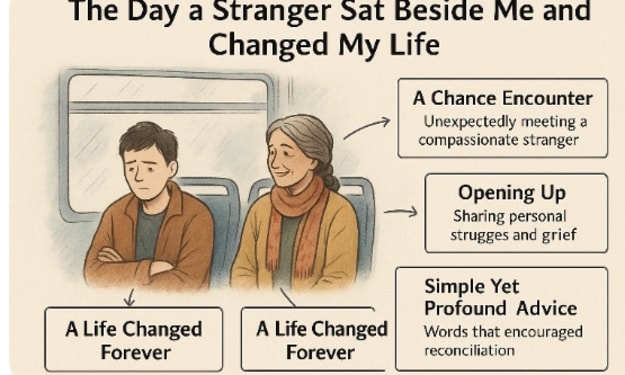
: “The Day a Stranger Sat Beside Me and Changed My Life”
I wasn’t supposed to be on that bus. My car had broken down two days earlier, and everything since had been a blur of borrowed rides, rescheduled shifts, and growing panic. I was already skating on thin ice at work, and one more delay could cost me my job. To top it off, rent was due, my savings were gone, and my sister hadn’t spoken to me since the funeral.
By Izazkhanabout a year ago in Confessions
The Art of Stillness: How to Sit, Eat, and Suffer Quietly in a Noisy World
Life doesn’t come with a manual, but sometimes we all wish it did. There are moments when we feel unsure of even the smallest things—like how to sit in peace, how to eat with care, or how to carry pain without making too much noise. These simple acts can say a lot about how we treat ourselves and the world around us. In this article, we’ll explore these three basic, yet powerful human actions: sitting, eating, and suffering. You might be surprised at how deep they really go.
By ibrahim khanabout a year ago in Confessions
A Light That Burned in the Dark
There was a time when Nathan didn’t know how to breathe. He wasn’t choking, not in the physical sense. But every morning felt like drowning inside a glass room, suffocating without water, without a cause, without a way out. People around him would casually say, “It’s just a phase,” as if agony was temporary like a passing flu, or a scratched record you could replace. But Nathan knew otherwise. Inside him, there was a silence deafening, persistent that crushed every budding thought before it could bloom into hope.
By Ashraf about a year ago in Confessions
Behind Smiles
Behind Smiles You see her every day. She's the kind of person who makes others feel lighter just by entering the room. Her smile is radiant, her laugh contagious. She remembers birthdays, sends late-night encouragement messages to friends, and cracks jokes even during tense meetings. Everyone calls her "sunshine." She's the one people lean on when things go wrong. Her name is Ayesha. She's twenty-six, working at a fast-paced digital agency, always dressed in vibrant colors, always humming some old Bollywood tune. If you didn’t know better, you’d say she’s the happiest person alive. But no one sees her after the lights go out. No one sees her come home to an empty apartment, place her phone face-down, and curl up on the corner of her bed, hugging a pillow that smells like memories. No one sees the moments where she stares blankly at the ceiling, eyes open, heart heavy, wondering what it’s like to live without pretending. No one hears the silence she drowns in every night — the silence she tries to fill with noise all day long. Ayesha wasn’t always this way. There was a time she dreamed freely — of writing books, traveling solo, laughing with her mother over tea on rainy evenings. But life had other plans. Her mother passed away suddenly when Ayesha was nineteen. A year later, her elder brother moved abroad, never to return. Her father stopped speaking to her after she refused an arranged marriage, saying she had "shamed" the family. So, Ayesha became her own home. Her own family. Her own comfort. She wore her smile like armor. She began journaling daily. Page after page of affirmations, goals, gratitude — but also pain. The kind of pain too raw to share. One page read: > “Everyone thinks I’m healing. But sometimes, I think I’ve just gotten better at hiding.” Work became her escape. So did social media. Her Instagram bloomed with golden hour shots, captions about self-love, coffee aesthetics, and book recommendations. People followed her for “positivity.” They never saw the drafts folder full of unsent goodbyes. Until one Thursday, everything collapsed. Ayesha didn’t get out of bed. Her limbs wouldn’t move. Her chest felt like it had caved in. Her mind — numb. Her phone kept buzzing: meetings, reminders, voice notes. She ignored them all. By evening, a close colleague who lived nearby grew concerned and came over. When she didn’t respond, he got the landlord to unlock the door. There she was. Not hurt. Not unconscious. Just sitting by the window, her face pale, her eyes swollen from crying. On the mirror in her bedroom, written in lipstick, were the words: “I’m tired of pretending.” She was taken to the hospital. Diagnosed with severe emotional exhaustion and clinical depression. The doctor called it an “internal breakdown” — the kind no one sees until it’s too late. And the people around her? Shocked. “I never knew…” “She was always so happy…” “She checked on me last week!” That’s the thing about people like Ayesha. They give so much light, hoping others don’t see their darkness. Weeks passed. Slowly, she began to speak. In therapy, at first. Then to herself in the mirror. Then finally, to the world. She posted on Instagram — no filter, no caption aesthetics: > “To those who think smiles mean strength: they don’t. I smiled to survive. I smiled to distract. I smiled so no one would ask if I was okay. But I wasn’t. And if you're reading this, and you’re tired too — please, speak up. Pretending will kill you in silence.” The post went viral. Messages poured in. Not of pity — but resonance. “I feel seen.” “This is my story too.” “You just saved me.” Ayesha changed that day. She didn’t become weak. She became real. Now, she laughs — but not to hide. She cries — without shame. And when someone says, “You seem so positive,” she smiles softly and says, “Sometimes. But not always. And that’s okay.” She leads mental health workshops at work now. She talks about the importance of checking in on “the strong ones.” She listens more. Speaks slower. Pauses often. And sometimes, when she looks at the mirror, she still sees that old version of herself — the girl who smiled to survive. But now, she reaches out — and comforts her. Because behind the brightest smiles are often the quietest screams. And Ayesha? She’s done hiding.
By TrueVocalabout a year ago in Confessions
Israel’s Strikes on Iran Ignite Global Debate: Is Regime Change the Real Goal?
As tensions in the Middle East reach a boiling point, Israel's latest airstrike campaign on Iran has not only escalated regional instability but also reignited one of the most controversial geopolitical topics: regime change in Tehran. With air raids targeting Iranian nuclear and military infrastructure, Israeli officials have started suggesting a broader objective — one that could reshape the power balance in the Middle East for decades. But as the smoke clears, a familiar voice is pushing back — former U.S. President Donald Trump. Though supportive of Israel’s security efforts, Trump appears to be drawing a red line when it comes to the idea of toppling Iran's leadership. Israel’s Precision Airstrikes: A Show of Military Power On Friday, Israel launched one of the most extensive and daring air raids in recent history, penetrating deep into Iranian territory. The targets included suspected nuclear facilities, long-range missile depots, intelligence sites, and even state media offices, which Israel claims serve a dual military purpose. According to Israeli defense officials, the mission aimed to "cripple Iran’s capability to build and launch nuclear weapons." The IDF (Israel Defense Forces) also suggested that some of the strikes were preemptive, intended to neutralize possible retaliation from Iran following recent escalations. But Israeli Prime Minister Benjamin Netanyahu hinted at something more during interviews over the weekend. He spoke of a “historic opportunity” to weaken Iran’s ruling elite, openly suggesting that eliminating Ayatollah Ali Khamenei — Iran’s Supreme Leader — could permanently change the equation. This rhetoric has shocked global observers and sparked fears of a broader war or collapse within Iran — something that could have ripple effects far beyond the Middle East. Trump’s Strategic Resistance: “Don’t Remove the Devil You Know” Interestingly, former President Donald Trump has reportedly rejected similar ideas during his administration, according to senior aides who spoke to Axios. While Trump championed aggressive sanctions and cyberattacks against Iran’s nuclear program, he was adamantly opposed to assassinating Ayatollah Khamenei or destabilizing the regime outright. His rationale? The fear of unintended consequences. “Trump believed in deterrence, not chaos,” one former official said. “He didn’t want to create a power vacuum in Iran. You get rid of the devil you know, you might end up with one you don't.” Even now, Trump remains supportive of Israel's military operations but has distanced himself from any language suggesting full-blown regime change. His messaging strikes a balance — supporting allies while avoiding entanglement in foreign overthrows. The World Reacts: A Mixed Bag of Alarm and Endorsement Global leaders are watching closely. While many Western nations have condemned Iran’s support for terrorism and nuclear ambitions, they also fear that an Israeli-led regime change effort could trigger massive unrest, unleash civil war, and potentially open the door for even more extreme factions within Iran. European diplomats have called for de-escalation. The United Nations Security Council has convened for emergency consultations. Meanwhile, Middle Eastern neighbors like Saudi Arabia and the UAE — long critics of Iran’s policies — are wary of the fallout. Publicly, they applaud Israel’s decisive action, but privately, many worry that regime collapse in Iran could lead to refugee crises and destabilize already fragile borders. 🛡️ Iran’s Regime: Shaken But Not Toppled Despite the damage from Israeli airstrikes, Iran's government remains intact — at least for now. Supreme Leader Khamenei appeared on state television dismissing the attacks as “cowardly” and vowing retaliation. While some Iranians took to social media to express outrage or fear, the streets of Tehran have not seen the kind of widespread uprising that some Israeli hawks had hoped for. Experts point to Iran’s unique political system — power is diffused across various institutions, including the Islamic Revolutionary Guard Corps (IRGC), religious bodies, and elected parliament. Even if Khamenei were removed, the regime would not crumble overnight. This complexity is likely why Trump, and many within the U.S. intelligence community, resist the idea of pushing for regime change. Removing a symbolic figurehead doesn’t guarantee democratic reform — and could potentially empower hardliners even more radical than the current leadership. 🕊️ Diplomacy on the Back Burner? Though missiles are flying, diplomacy isn’t completely off the table. Behind closed doors, U.S. and Israeli diplomats are reportedly working through back channels in Oman, Qatar, and Switzerland to keep communication open with Iran’s moderate elements. Some sources suggest that Trump’s team is exploring ways to restart nuclear talks if the situation stabilizes. The aim would be to reinstate controls on Iran’s uranium enrichment program while offering economic incentives. But for now, these plans remain hypothetical, as Iran’s leadership has shown no signs of yielding. 📌 Final Thoughts: Regime Change or Strategic Containment? Israel’s recent military action has reignited the long-dormant debate over regime change in Iran. While the airstrikes have showcased Tel Aviv’s military prowess and resolve, they also risk destabilizing a volatile region and drawing the world into a wider conflict. Trump’s caution highlights a recurring lesson from U.S. foreign policy — removing a dictator is easy; rebuilding a stable nation afterward is much harder. As both allies and rivals consider next steps, one thing is clear: the fallout from Israel’s strikes will shape the Middle East’s future for years to come. rael Iran conflict 2025
By NextGen Mobile Techabout a year ago in Confessions
In the Garden
Maya stood at the edge of the overgrown plot, staring at the patch of land behind her grandmother’s cottage. Weeds climbed over broken bricks, and the scent of damp soil clung to the air like a forgotten promise. It had once been a garden of roses and tomatoes, her grandmother’s pride, but years of neglect had turned it into a jungle of thorns and decay. She hadn’t intended to stay this long in the village. A corporate layoff had sent her reeling, and the silence of the countryside seemed like a balm. But every day she passed that abandoned garden, something inside her tugged gently. It wasn’t just soil and weeds. It was a metaphor, she realized—a mirror of her life, once thriving, now overrun by uncertainty. On a rainy Tuesday morning, Maya knelt on the cracked flagstones with a pair of rusted shears. The first snip echoed louder than it should have, a symbol of her decision. She pulled up thorns, broke up hardened earth, and discovered stubborn roots that refused to yield. It was backbreaking work, but with each hour spent, her mind grew lighter, as if the weeds had grown in her thoughts as well. Every day brought small victories: a clear path between rows, a cluster of worms enriching the soil, a bird’s nest tucked in the crook of an old cherry tree. She began to understand that growth wasn’t only about planting but also about clearing. Before new life could thrive, the old had to be removed, even if that meant facing the pain of the past. Her neighbors watched from a distance, some skeptical, others intrigued. An old man offered her a tray of seedlings—basil, lavender, and two tomato vines. “My wife used to say a garden will listen better than people,” he chuckled. Maya smiled and took the tray, her hands dirty but her heart a little lighter. Weeks turned into months. Calloused hands and sunburned arms became her badge of transformation. When she looked in the mirror, she no longer saw the defeated executive, but a woman who wasn’t afraid to dig deep, who could kneel in the dirt and still rise with purpose. The garden began to bloom—modest at first, then wild with color. With every petal that unfurled, Maya saw parallels in her life. The setbacks she once mourned were now stepping stones. The job she lost? A blessing in disguise. The silence she feared? A symphony of self-discovery. She wasn’t just growing flowers. She was regrowing herself, nurturing a soul that had long been forgotten beneath deadlines and office walls. One afternoon, a group of children came to visit. They crouched next to her, planting marigolds and giggling when the soil tickled their fingers. “Why do you do this every day?” one of them asked. Maya paused, wiping sweat from her brow. “Because gardens remind us that even the broken ground can be beautiful again.” That evening, she sat on the stone bench at the heart of her garden. Fireflies blinked lazily in the dusk, and the breeze carried the scent of lavender and warm soil. She realized that she no longer needed to rush back to the city. She had everything she needed right here—peace, purpose, and the powerful knowledge that she could begin again, no matter how lost she once felt. Her garden became a sanctuary not just for her but for others. Locals came with seeds, stories, and sorrow. Maya welcomed them all. The garden grew richer with every soul it touched, a living canvas of resilience and hope. It wasn’t just a place anymore. It was a reminder that from the darkest soil, the brightest blooms emerge. Life, like a garden, will test your patience. There are seasons of drought, of overgrowth, of biting frost. But there is also warmth, renewal, and joy. Maya's journey taught her what most of us forget in the rush of everyday life—true growth is quiet, persistent, and messy. And it always starts by getting your hands dirty. You don’t need perfect conditions to start again. Sometimes, all you need is a small patch of earth, a pair of willing hands, and a heart ready to heal. The rest will come with time, care, and the courage to keep going when nothing seems to bloom. In the end, Maya’s greatest harvest wasn’t tomatoes or roses. It was the understanding that life is cyclical. Loss does not mean the end. It's merely an invitation to plant something new. And even the most abandoned garden can blossom again with love, effort, and belief. So, what’s your “garden”? Is there something in your life waiting for you to return, to begin again, to nurture it back to life? Share your thoughts in the comments—what would you plant in the garden of your second chance? If this story inspired you, don’t forget to tap the heart, leave a comment, or share with someone who may need to hear this today. Let's grow hope together, one story at a time.
By Sophia Grayabout a year ago in Confessions
My First Entry into University Life
The moment I stepped through the tall glass doors of the university, a mix of excitement and sheer terror washed over me. Everything around me seemed to move in fast forward—students laughing, others pacing with phones, some looking as lost as I felt. My heart pounded against my chest, and for a moment, I wondered if I had made a huge mistake. I had dreamed about university life for years, but no one really prepares you for the reality of it. The sudden independence, the pressure to find your place, the silent fear of failure—it hit all at once. And yet, somewhere beneath that anxiety, a small ember of hope quietly glowed. I remember clutching my student ID like it was a golden ticket. My backpack was brand new, my notebooks pristine, and my mind was filled with what-ifs. What if I didn’t make friends? What if I picked the wrong major? What if I failed? Orientation day felt like walking into a different universe. The campus was enormous—bigger than anything I’d known. Every hallway seemed to stretch into possibility, and every classroom whispered the start of a story I hadn’t written yet. The first lecture hall I entered felt like a theater. Hundreds of seats curved upward, and I sat as close to the middle as possible. Not too eager, not too indifferent—just trying to blend in. The professor’s voice boomed through the mic, and suddenly I wasn’t in high school anymore. In the cafeteria, I sat alone at a corner table, pretending to scroll through my phone. Around me, groups were forming effortlessly, laughter and inside jokes blossoming like flowers in fast-forward. I wanted to be part of that. I wanted to belong. But in that solitude, I made an important discovery—growth often begins in discomfort. I realized that if I wanted a new experience, I’d have to step into unfamiliar spaces, no matter how uneasy they made me feel. So the next day, I joined a study group for my sociology class. That one decision shifted everything. I met people with the same fears, the same confusion, the same hunger to find meaning in this new world. We laughed over shared struggles, formed bonds over late-night cramming, and supported each other when things got tough. Living on campus was another journey altogether. Sharing a dorm room with a complete stranger was terrifying at first. My roommate, Alex, was from a completely different background. We clashed over lights-off times, room temperature, and even toothpaste brands. But time and patience do amazing things. We found common ground in unexpected ways—shared love for music, the same weird obsession with pineapple on pizza, and a mutual understanding that we were both simply trying to survive this big change. My first university party was chaotic but unforgettable. Music thumped through the walls, strangers danced like they’d known each other forever, and I stood on the edge trying to figure out where I fit. Eventually, someone pulled me into a dance circle, and for the first time in days, I let go of my overthinking. Academics weren’t easy. I failed my first calculus quiz and cried in the library, convinced I wasn’t cut out for this. But I didn’t quit. I found a tutor, asked questions, and learned how to learn all over again. I wasn’t perfect, but I was trying—and that was enough. I also discovered parts of myself I never knew existed. I joined a debate club and found my voice. I started journaling at dawn in the campus garden and found my calm. University life didn’t just challenge me—it unraveled me, and in the unraveling, I found who I truly was. Not every day was magical. There were moments of homesickness, days I skipped meals to stretch a tight budget, and nights I questioned everything. But those moments, too, were part of the story. They taught me resilience, empathy, and the strength to keep showing up. Friendships deepened over time. We celebrated birthdays with midnight cupcakes, comforted each other through heartbreaks, and survived exam weeks with too much coffee and too little sleep. These people, once strangers, became my family. I also learned the value of failure. A rejected internship application stung deeply, but it pushed me to seek new paths. I started a blog, sharing my university journey with honesty and humor. To my surprise, others began to resonate with it. My voice, once shaky, now inspired. As the semester progressed, so did my confidence. I learned how to balance deadlines and downtime, how to say no when needed, and how to trust that I was exactly where I needed to be. I wasn’t just surviving anymore—I was evolving. Looking back, my first entry into university wasn’t just a date on the calendar. It was the day I began to rewrite my story, one brave step at a time. It was the day I stepped out of the familiar and into the extraordinary unknown. The fears that once paralyzed me became fuel for growth. The questions that haunted me led to answers I found in libraries, lecture halls, and late-night conversations. The loneliness I feared birthed connections that changed my life. University life didn’t just give me knowledge—it gave me perspective. It taught me that learning happens both inside and outside classrooms. That people from different walks of life can teach you more than any textbook. And that courage isn’t loud—it’s choosing to try again each morning. My journey is far from over, but I’ll never forget how it started—with trembling steps, an open heart, and the willingness to keep going even when I was scared. And if you’re about to start your own university chapter, remember this: the first step is always the hardest, but it’s also the most powerful. So take that step. Walk through those doors, sit in that seat, introduce yourself to that stranger. You’ll be amazed at who you become by the end of it all. What about you? If you’ve already stepped into university life, what was your biggest fear or most beautiful discovery? And if you’re still on the edge of that leap, what’s holding you back? Drop your thoughts in the comments below—let’s connect and support each other through this incredible journey. Don’t forget to share this story with a student or dreamer who might need it today. If this story resonated with you, tap the heart, leave a comment, and follow for more personal journeys that uplift and inspire. Every story matters—including yours.
By Sophia Grayabout a year ago in Confessions
Don’t expect a smile from the woman you took everything from
In the small, sleepy town of Willow Creek, nothing ever really happened. At least, that’s what the teenagers always said. Jake, Sarah, Max, and Emily — they were that group. You know the one. The kind of kids who hung around parking lots, dared each other to climb water towers, and acted like the town was their personal playground. They weren’t bad kids, just… restless. Always looking for something bigger, louder, riskier.
By Esovrukaveabout a year ago in Confessions
The Day I Realized I Was Living Someone Else’s Dream
I didn’t realize it at the time, but I was living a life that wasn’t mine. It’s funny how we go through the motions of life — school, college, work, relationships — thinking that we’re in control, when really, we’re just ticking boxes someone else handed us. For me, that “someone else” was a mix of society, family expectations, and the invisible pressure to be “successful” — whatever that meant.
By Irfan Khanabout a year ago in Confessions