Friendship
A Confession of Letting Go
I never thought I’d find myself here, pouring out my heart in a confession meant for no one but myself. But here I am, writing these words in the hopes of untangling the web of emotions that has entangled me for far too long. The truth has a way of haunting you, doesn’t it? It’s a ghost that lingers, a shadow that refuses to be cast aside. I wish I could say that I’m free from its grip, but I’m not. Not yet.
By Zidaneabout a year ago in Confessions
Word of the Day: 電波
I don't think I can afford to write right now but I feel like, since I am not taking medication and also self medicating with weed, I need to take journaling seriously as a form of therapy. Since I am feeling very odd, even if it isn't "dangerous" I still feel I need to treat it as if I was in a full blown bad mood right now. I am not sure what I am upset about, I guess because everything feels pointless and I am not sure what I am going to do in my future. I mean that is something to complain about for now to take me out of the moment, but I really don't know what is going on. I am really thinking the celestial placements are causing this turbulence. My only solution though is to just ignore it until tomorrow, which... I mean, I have no better option in front of me at the moment.
By Kayla McIntoshabout a year ago in Confessions
what i'll never get to say. Top Story - October 2025.
i never exaggerated. i have trauma about telling my truth and being called a liar so we're gonna start here. every. single. thing. i told you happened, happened. some happened this year, last year, earlier. i told you that, too. but it all happened the way i said it did.
By Maia Gadwall the metAlchemistabout a year ago in Confessions
Your Future Self is Watching
When sitting in a quiet setting like at home when the lights go off, or in an office where I have to wait for a long while, or simply on a long trip when the noise settles in the bus. I often reflect on how I got this far. The decisions which led me here, the fortunate and unfortunate events which shaped this moment, and how all this could have been different if certain things didn’t happen. I also imagine how different my life would have been if I had made some other choices. For better or worse, I’ll never really know how things could have turned out. All I can do is assume they turned out for the best.
By real Jemaabout a year ago in Confessions
The Two Breads That Saved a Soul
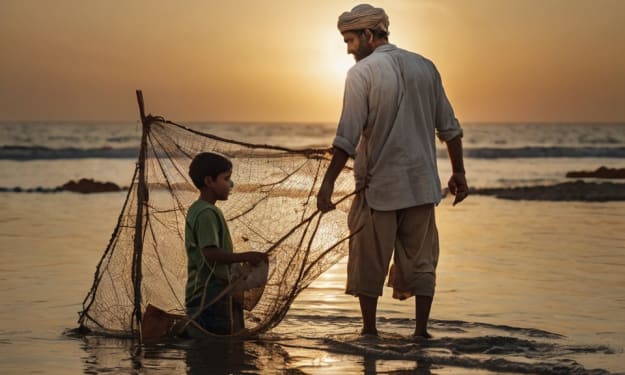
The Bread of Faith: The Story of Abu Nasr Al-Iyad BY ubaid Once upon a time, there lived a man named Abu Nasr Al-Iyad. He was a poor man who struggled each day to provide for his wife and two young children. Poverty had wrapped its chains around him so tightly that hope seemed to fade with every passing day. One morning, his children lay weak and crying from hunger. His wife, pale and helpless, tried to comfort them, but her own stomach had long been empty. Unable to bear the sight of his family’s suffering, Abu Nasr left his home, his heart heavy with sorrow and despair. As he wandered aimlessly, he came across a wise and kind scholar named Sheikh Ahmad bin Miskeen. Seeing the pain etched on Abu Nasr’s face, the Sheikh gently asked, “My son, why do you look so burdened?” Abu Nasr replied with tears in his eyes, “O Sheikh, I am crushed under the weight of poverty. My family starves, and I can do nothing.” The scholar smiled kindly and said, “Come with me, and I will show you something that may change your fate.” They walked together until they reached the seashore. There, the Sheikh handed Abu Nasr a fishing net and said, “Perform two units of prayer, call upon the name of Allah, and then cast this net into the sea.” Abu Nasr did as he was told. To his amazement, when he pulled the net out of the water, a large fish was caught in it. The Sheikh instructed him, “Go to the market, sell this fish, and buy food for your family. Allah has provided for you.” Grateful and filled with hope, Abu Nasr hurried to the market, sold the fish, and with the money bought two stuffed flatbreads—one savory and one sweet. Remembering the kindness of the Sheikh, he returned to him and said, “O Sheikh, please accept one of these breads as a token of my gratitude.” But the wise man smiled and said, “My son, I helped you for Allah’s sake, not for a reward. These breads are your family’s right—go and feed them.” Touched by his words, Abu Nasr turned back toward home. But on his way, he came across a poor woman sitting by the roadside, weeping. Beside her sat a frail child, his face pale and his eyes sunken from hunger. Abu Nasr looked at the two breads in his hands, then at the woman and her child. He whispered to himself, “My wife and children are hungry... but so are they. Is their pain any less than ours?” Tears welled in his eyes. At last, he stepped forward and handed both breads to the woman. “Take these,” he said softly. “Eat, and feed your son.” The woman’s face lit up with gratitude, and her child smiled for the first time in days. Abu Nasr felt a strange peace in his heart, though he knew he was returning home empty-handed. As he walked through the streets, lost in thought, he heard a man calling out, “Is there anyone who knows Abu Nasr Al-Iyad? I must find him!” People pointed toward him and said, “There he is!” The caller hurried over and said, “Twenty years ago, your father entrusted me with thirty thousand dirhams. I have searched for you ever since. Today, by the will of Allah, I have found you. Take what is rightfully yours.” Stunned and overjoyed, Abu Nasr accepted the money. Overnight, his life changed. He built homes, expanded his trade, and became one of the city’s wealthy men. But unlike before, his heart remained humble. He gave generously in charity, sometimes donating a thousand dirhams at once, always remembering his days of hunger. Years later, Abu Nasr had a dream—a dream so vivid that it felt more real than life itself. He saw himself standing on the Day of Judgment, before a grand scale of justice. His deeds were being weighed—good on one side, sins on the other. To his horror, the side of sins was heavier. He cried out, “What about my charity? The gold and silver I gave for Allah’s sake?” But the angels replied, “Those deeds were tainted with pride and the desire to be seen. They hold little weight today.” Tears streamed down his face. “Then how will I be saved?” he asked. Suddenly, a voice said, “There are still two small deeds left uncounted.” Then, the two breads he had once given to the hungry woman were brought forth and placed on the scale of good deeds. The balance began to tip—but only slightly. Next, the woman’s tears of gratitude were added to the scale, and the side of goodness grew heavier. Finally, the child’s innocent smile—born of those two simple breads—was placed upon the scale. The weight of that pure, selfless moment overpowered all his sins. A voice declared, “This man is saved!” When Abu Nasr awoke from the dream, his eyes were wet with tears. He whispered to himself, “O Abu Nasr, it was not your gold or wealth that saved you—it was those two small breads you gave for Allah’s sake.” --- Moral of the Story Never look down upon a small act of kindness. Even the simplest deed done with sincerity can outweigh years of grand but hollow gestures. True charity lies not in wealth or display, but in the quiet goodness that expects no reward—only the pleasure of the Almighty.
By Ubaid about a year ago in Confessions
When the Mirror Learns to Speak.
When you’re little and start showing signs of adolescence, it’s both a shy and awakening stage. You don’t quite know who you’re becoming yet — you’re caught between childhood and womanhood, between wanting to be invisible and wanting to be understood. If you have a caring family, that transition feels easier, almost gentle. They guide you through it without judgement. But when your family is the type that points and questions, conforming becomes a way of survival.
By Gladys Kay Sidorenkoabout a year ago in Confessions
The Weight of Labels
I did not get angry because I was attacked. I got angry because I felt invisible. That is what labeling does. It reduces a human being—a soul with thoughts, experiences, and convictions—into a set of categories that can be dismissed before they even speak.
By Peter Thwing - Host of the FST Podcastabout a year ago in Confessions
The Last Letter
Rain tapped gently against the cracked window as Evelyn sat at her old wooden desk, staring at the faded envelope in her trembling hands. Her name was written in a familiar handwriting—looped, elegant, and painfully recognizable. She hadn’t seen it in fifteen years, not since the day Daniel left.
By Waqas Ahmadabout a year ago in Confessions
The Symphony of Us
My world had become a museum of quiet. Each room in my apartment was a carefully curated exhibit of a life I no longer lived. The grand piano in the corner was the centerpiece, a silent, polished beast under a sheet of dust and regret. I hadn't touched the keys since the accident. The music, once the very blood in my veins, had drained out of me, leaving behind a hollow shell named Elara.
By noor ul aminabout a year ago in Confessions