Family
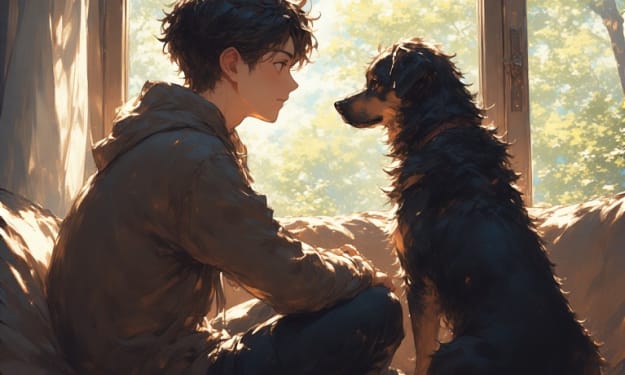
My dog didn’t just fill the silence—he became my voice
There was a time in my life when silence wasn’t peaceful—it was painful. The kind of silence that gets into your bones. The kind that, after loss, after loneliness, after life, takes away those few voices that used to make you feel seen.
By Echoes of Lifeabout a year ago in Confessions
The Last Light in My Father's Eyes
Story: They say you don’t truly understand a man until you’ve walked a mile in his shoes. I never even glanced at my father’s. He was quiet, almost invisible in the loudness of our household. My mother was the storm—fierce, passionate, unfiltered. My siblings? Noisy, brilliant, chaotic. And me? I was the observer, the dreamer, the one who thought he saw everything. But I never really saw him. My father worked the night shift at a factory two towns over. Every morning, I’d wake up to find a fresh piece of toast waiting for me, cut in half, crusts removed—just the way I liked it. I never said thank you. I just ate it. When I got accepted into university, it was my mother who screamed, danced, and cried. My father just nodded and handed me an envelope with some cash. "For books," he said simply. Books. That was all. No advice. No speeches. Just money, and silence. I thought it was cold. I thought he was cold. I was wrong. --- He passed away suddenly on a Tuesday morning. Heart failure. The hospital called me, the eldest son, and I drove home under gray skies and heavier thoughts. In his room, everything smelled like him—wood shavings, old spice, and quiet sacrifice. Tucked in the top drawer of his dresser, under a pile of worn-out socks, was a bundle of letters. Each one addressed to me. Dated. Handwritten. Labeled for years: Age 5, Age 10, Age 15, Age 20… There were over twenty letters. Hands trembling, I opened the first. > "You just turned five today. You told me you want to be a lion when you grow up. I didn't correct you. I just said, 'Be the loudest lion you can be.' I hope I always encourage you, even if I don't have the words. Words have always failed me." The next: > "You're ten. You asked why I never come to your school plays. The truth? I'm terrified. I work two jobs so your mother doesn't have to. I miss everything. But I never miss loving you." Each letter peeled back a layer of the man I had never tried to understand. He wrote about his fears, his sacrifices, his love—raw and unspoken. He apologized for being absent, for not knowing how to express pride or sorrow or affection the way others did. But every letter ended the same way: > “I love you, more than you know. I see you, even when you don’t see me.” I cried for hours. Not because I lost a father—but because I had never found him while he was here. --- The last letter was labeled: Open only when I’m gone. > “By now, I imagine you’ve read the others. You know more about me than I ever managed to say aloud. I hope you forgive me. Not for dying—but for not showing you how deeply I loved while I lived.” > “If there’s one thing I want you to carry from this moment forward, it’s this: do not wait. Do not love in silence. Do not assume people know how you feel. Tell them. Every day. Loudly.” > “Be the lion, son. Be the lion I couldn’t be.” --- That day, I didn’t just lose a father. I found a man I wish I had known sooner. Now, I write letters to my daughter. She’s only two, but I write anyway. I tell her how her laugh saved me from grief. How her eyes remind me of him. How I’ll never let her wonder if I loved her—because I’ll tell her every single day. My father taught me that love is not about grand gestures or loud words. Sometimes, it’s a piece of toast. Sometimes, it’s a drawer full of letters. --- Author Note: This story is inspired by true fragments of people I’ve loved and lost. If it touched you, share it with someone who might need a quiet reminder that even in silence, love can echo for generations.
By Tariq Shahabout a year ago in Confessions
The Clock Strikes Her Name
The old grandfather clock stood in the corner of the dimly lit parlor, its wooden case scarred by decades of neglect. It hadn’t worked for years—no one in the Hawthorne family had bothered to wind it since the accident. But tonight, as midnight approached, something stirred inside the ancient mechanism.
By ATTAULLAH SHAHabout a year ago in Confessions
The Ones Who Never Learned to Numb
I’ve always admired people who can shut things off. The ones who can bury their emotions like they were never there. The ones who don't cry in public. The ones who can read the news and not flinch. The ones who can walk past a homeless man and not carry his story in their chest for the rest of the day.
By Prince Esienabout a year ago in Confessions
I Took a DNA Test for Fun. What I Found Out Made Me Move Cities
I didn’t think twice when I ordered the DNA test. I wasn’t chasing some long-lost family mystery. I wasn’t adopted. I wasn’t even curious, really. It was just one of those impulsive decisions — like ordering sushi at midnight or downloading a sleep-tracking app I’d forget about in two days. Everyone was doing it. Spit in a tube, ship it off, get your ethnic pie chart and laugh about being 4% Scandinavian. That’s all I expected. What I got instead made me pack my bags, leave my hometown, and completely rethink the people I trusted most. It Started Like a Joke The kit arrived in a cheerful little box — bright colors, friendly fonts, instructions that made it seem like a party trick. “Discover who you are!” Cute. I spit in the tube, sealed it up, and dropped it in the mail without another thought. A few weeks later, the results popped up in my inbox. I opened the email, half-asleep, expecting something basic. Maybe some percentage of Irish I’d never heard about. Instead, I saw this: > “You have 1,347 DNA matches.” What? Then I Saw Him I clicked through, assuming most matches would be distant cousins or algorithmic noise. Then I saw the “Close Family” section. At the top, in bold letters: > Henry Wells — Parent/Child Match (99.98%) I stared at the screen. My stomach dropped. My father’s name is Martin Caldwell. He raised me. Loved me. He’s my dad — always has been. Who the hell was Henry Wells? I clicked on his profile. Public. Early 50s. A lawyer. Lived just a few hours away. No connection. No shared friends. Nothing familiar. Until I saw his high school photo. My heart stopped. Same eyes. Same smirk. Same awkward ears I’d spent my whole life hating. It was like looking into a time machine. The Message That Changed Everything Later that night, I got a message through the app: > “I believe I’m your biological father. I took this test two years ago. I didn’t expect this either. I’m open to talking — if you are.” I sat there, staring at my phone, the hum of my fridge sounding like a jet engine in the background. This couldn’t be real. I called my mom. "There’s Something I Never Told You..." She didn’t answer the first two times. When she finally did, her voice was shaky. I didn’t even ask a question. I just said his name: > “Mom... who is Henry Wells?” Silence. Then a sigh I’ll never forget. She told me everything. Back in college, she’d had a brief relationship with someone she barely knew. They were on a break, she said. It was a mistake. A one-night stand. When she found out she was pregnant, she told Martin — my dad — and they decided to move forward together. No paternity test. No doubts. Just love, and a shared choice to raise me as theirs. The Fallout It felt like someone had pulled a trapdoor under my life. I stopped returning texts. I stopped going home for dinner. I didn’t know who to be angry at. My parents — both of them — had built their world on silence, thinking it was protection. But silence ages badly. Eventually it cracks. And here I was, standing in the rubble. Meeting the Stranger in My DNA 🧬
By Shoaib Afridiabout a year ago in Confessions
I Am A Winner
Introduction I joined Vocal for the big prize money. That never happened. I have two challenge placements, an "honourable" mention, some Top Stories and a couple of Resource pieces, but Vocal and a lot of creators see me as a thorn in Vocal's side.
By Mike Singleton 💜 Mikeydred about a year ago in Confessions
Why I Stopped Trying to Be ‘Enough’ and Finally Found Freedom
For most of my life, I was on a treadmill, running faster, pushing harder, and trying to be “enough.” Enough as a mom, enough as a friend, enough at work, enough in every single role I thought I had to play. I thought if I just did more, smiled brighter, looked better, and kept up appearances, I would finally feel satisfied. I thought I’d finally fill that deep, aching hole inside me that kept whispering I wasn’t good enough.
By The Arleeabout a year ago in Confessions
Your Comeback Starts in Silence
There comes a point in life when everything goes quiet. The friends disappear. The excitement fades. The spotlight moves on. And you're left alone—with nothing but your thoughts, your pain, and the question: “What now?” For many, that moment feels like the end. But what if I told you—it’s actually the beginning? Because that silence? That’s the birthplace of your comeback. ---The Fall No One Talks About
By Hk Onlineabout a year ago in Confessions
Under the Moonlight of Memories
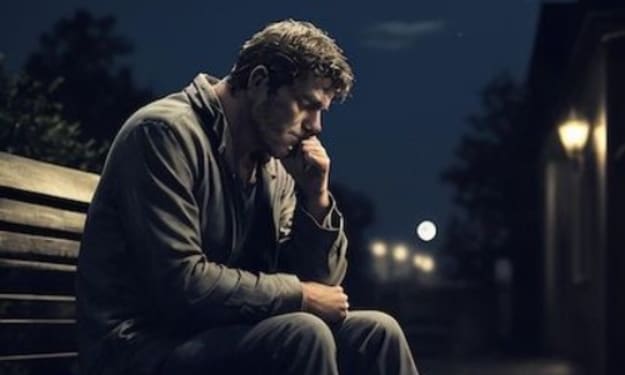
It was a quiet night, the kind where even the wind forgets to whisper. The moon hung high in the sky, casting a soft glow on the empty streets. Thomas sat alone on a wooden bench, his head bowed and hands clenched tightly. The world around him was asleep, but his mind was wide awake, racing with thoughts he couldn’t outrun. Regret had become his only companion. He had once been full of life — a man with dreams, laughter, and love. But life, as it often does, had chipped away at his joy slowly, piece by piece. He lost his job, then his friends, and finally, the woman he loved. He didn’t even realize how much he had changed until the night she walked away. Her last words echoed in his head: “You’re here, but you’re not really here.” Thomas had tried to be strong, to move forward, but everything reminded him of her. The coffee shop where they shared laughs, the bookstore where they dreamed about the future. Now, all that remained were memories that refused to fade. He would walk past those places, forcing a smile that didn’t reach his eyes. But tonight, the sadness was too heavy to carry.
By The Pen of Farooq about a year ago in Confessions
The Hands That Braided My Hair
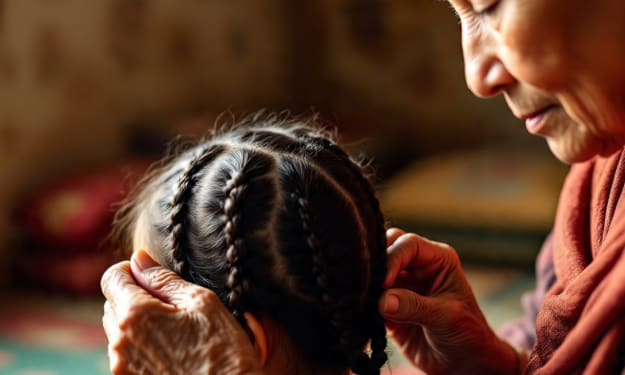
When I was a child, Daadee’s hands were magic. They could soothe any fever, find anything I lost, and braid my hair so perfectly that not a strand dared fall out of place. She wasn’t loud, like Dada. She didn’t tell jokes or command attention at family dinners. But her presence filled the room in quieter, stronger ways. She was the one who remembered everyone’s favorite dishes, who never missed a prayer, who sewed little patches inside our old school uniforms so they’d last another year. Her wisdom wasn’t in books. It was in the way she spoke, slow and thoughtful, as if every word deserved its time. --- As I grew older, I started to forget how powerful her silence was. Life got louder — school, friends, phones, college applications. I’d visit her on weekends, sit for tea, take pictures for Instagram. She’d still braid my hair when I let her, her hands slower now, her fingers trembling just a little more each time. Then one day, she stopped braiding altogether. --- We first noticed something was wrong when she began forgetting names. Nothing alarming at first — she’d call my cousin “Beta” instead of his name. But then she forgot birthdays. Forgot she had already eaten. Forgot she had told a story just an hour ago. “She’s just tired,” Ammi said. But tiredness doesn’t explain confusion. It doesn’t explain getting lost in your own home. --- The doctor’s words came gently, but hit like thunder: "It’s the early stages of dementia. Possibly Alzheimer's." It was like a slow unraveling of the woman we thought would never change. Her world began to shrink. The house she had lived in for 40 years became unfamiliar. Mirrors confused her. She once screamed at her own reflection, thinking a stranger had entered her room. It broke us. But somehow, even in her decline, she remained soft. Not once did she raise her voice. Not once did she forget to say "Shukriya" when we helped her. She still called me to her room sometimes, asked me to sit by her, and gently touched my hair like she used to. Her eyes no longer remembered me — but her hands did. --- One winter morning, I visited her alone. She was wrapped in a shawl, looking out the window, mumbling a lullaby I hadn’t heard in years. I sat next to her, quietly, and placed her hand in mine. After a few minutes, she turned to me and whispered, “I had a granddaughter… she had thick black hair like yours.” Tears burned my eyes. “I’m right here, Daadee,” I said. She looked at me for a long moment. Then smiled. “I know.” I don’t know if she really did. But that smile was enough. --- Her last days were peaceful, in a strange, aching way. She stopped eating much. Slept more. Talked less. Sometimes she hummed songs from her youth. Sometimes she stared at the ceiling and laughed softly, like someone was telling her a private joke. We tried to prepare ourselves. We prayed, took turns sitting with her, combed her hair gently. I would read aloud from her favorite book, even though I knew she didn’t follow the words anymore. One night, I stayed over. She was breathing slow and light, like the air itself didn’t want to disturb her. I held her hand and told her all the things I should’ve said earlier. I told her how her hands raised a whole family. How her food tasted better than any restaurant. How her lullabies still echoed in my dreams. And how I would never let my daughter grow up not knowing her name. She didn’t respond. But her fingers tightened slightly around mine. Just once. --- She passed away the next morning. There were no hospital lights. No tubes. No machines. Just family, quiet sobs, and the scent of rosewater in the air. We buried her beside Dada, under the same tree where they once used to sit every evening. The house felt colder after that. The walls seemed too quiet. Her chair remained untouched for weeks. But her presence — it was everywhere. In the prayer mat she had embroidered. In the spices she blended herself. In the braid that I still make in my own daughter’s hair. --- Grief doesn’t end. It softens, then resurfaces, then softens again. But love — especially the kind Daadee gave — becomes the thread that stitches us back together.
By Muhammad Usamaabout a year ago in Confessions