Embarrassment
Forgiveness is not Forgetting the Pain
The scent of brine and ozone filled Elara’s lungs, a familiar comfort that had been hers since childhood. She stood on the cliff edge, the North Sea churning below, its endless roar a constant reminder of both peace and turbulence. It had been twenty years since the accident, twenty years since the waves had stolen her brother, Liam, and left her with a scar that no passage of time, no amount of forgiveness, could truly erase.
By millyanneabout a year ago in Confessions
For Ana de Armas, Keanu Reeves’ Co-Star 10 Years Ago and Once Again, ‘Ballerina’ Is a Pirouette
Ana de Armas has returned to her roots. The Cuban-Spanish actress reunites with Keanu Reeves in Ballerina, the eagerly awaited John Wick spin-off, ten years after they first appeared together on screen in Knock Knock (2015). For de Armas, this reunion is more than just a new job; it's a pirouette, a tasteful comeback to a well-known partner in a very different setting.
By Tanvir Shahariarabout a year ago in Confessions
Word of the Day: Schadenfreude
Have you ever found yourself secretly smiling when someone else trips, makes an error, or experiences an inconvenience? Whether it was someone at work, in celebrity media coverage, or even someone close to you who got their own back? Unfortunately this feeling often unsaid is quite common, yet rarely spoken aloud. In German there's even a special word that perfectly captures it: Schadenfreude
By Robert Brownabout a year ago in Confessions
I Lied About My Age for 3 Years—And He Still Chose to Believe Me
I didn’t mean to lie, at first. It wasn’t premeditated. It was one of those little things that slip out and hang in the air longer than you expect them to. We were at a bar, I was with a friend, he was sitting alone, and we started talking. I was 29. I told him I was 25.
By Noman Khan about a year ago in Confessions
Why Did Yulissa Leave the Villa? ‘Love Island’ Star Exits After Racist Remarks Surface
After contestant Yulissa abruptly left the villa, the most recent season of Love Island was plagued by scandal. The fan-favorite islander's sudden departure startled fans, but it quickly became clear that her expulsion from the show was due to the resurfacing of racist sentiments from the past. The Unexpected Departure Yulissa, who had already established herself as a prominent figure in the villa, was observed developing close relationships with other islanders. She led the competition thanks to her charisma and self-assurance, so when she abruptly departed the show, many were perplexed. Producers initially said nothing more than that she had gone for "personal reasons." But soon enough, the truth came to light.
By Tanvir Shahariarabout a year ago in Confessions
From Shadows to Strength
Once upon a time, in a quiet town nestled between rolling hills and whispering forests, lived a young woman named Mira. For many moons, Mira’s world was clouded by a heavy fog — a deep sadness that wrapped around her like a thick, cold blanket. Each day felt like wading through a river of invisible weight, and her heart whispered that she was lost in a place with no clear path home. Mira’s days passed in silence and solitude. She struggled to find joy in the things she once loved — the blooming flowers by the window, the songs of morning birds, and the warm sunlight that kissed her skin. The mirror reflected a face she barely recognized, tired and distant. She felt stuck, overwhelmed by shadows that seemed endless. One chilly evening, as the stars began to sprinkle the sky, Mira sat quietly by her window. The night held a gentle calmness, and in that stillness, a small thought flickered in her mind: What if she could find a way to lift the fog, one step at a time? With a soft breath, she decided to try. Not to suddenly erase the heaviness, but simply to move, even if just a little. The next morning, Mira woke before the sun and stepped outside. The air was crisp and fresh, and the world around her was slowly waking up too. She took a slow walk through the neighborhood, feeling the earth beneath her feet and noticing the details she had long ignored — the way leaves danced with the breeze, the laughter of children playing, the smell of fresh bread from a nearby bakery. That small walk became her first act of discipline — a promise to herself that she would keep moving forward, even when it felt hard. Each day after, Mira built upon her promise. She began setting little goals: to write a single sentence in a journal, to drink a glass of water first thing in the morning, to stretch her arms toward the sky and breathe deeply. These acts were simple, but they were powerful. They were her way of planting seeds of hope in the soil of her heart. Slowly, Mira noticed changes. The fog didn’t disappear all at once, but the shadows began to soften. She felt stronger, not because her problems vanished, but because she had found a quiet strength within herself. Discipline became her light — not as a rigid rule, but as a caring guide that reminded her she mattered. There were days when the fog tried to creep back in. When sadness whispered doubts and tiredness pulled her down. But Mira learned to welcome those feelings, not as enemies, but as old friends she no longer feared. She reminded herself that healing wasn’t about perfection, but about kindness and patience. One afternoon, Mira sat beneath the old oak tree in the forest. The sunlight filtered through the leaves, casting warm patterns on the ground. She closed her eyes and smiled softly. She realized that her journey was more than just a battle with sadness — it was a discovery of resilience, courage, and the gentle power of self-love. From the shadows of her deepest struggles, Mira had walked into a new dawn. A dawn where discipline wasn’t punishment but a bridge to peace. Where every small step was a victory. Where healing was a journey, not a destination. And as the stars began to twinkle again that night, Mira whispered a thank you to herself — for the bravery to keep going, for the love to keep healing, and for the light she found inside her own heart. And with that, she drifted into a peaceful sleep, ready to greet tomorrow with hope.
By Rizwan about a year ago in Confessions
I Am Lost
There are mornings when I wake up and forget who I’m supposed to be. I lie there, staring at the ceiling, the weight of everything pressing on my chest like an invisible hand. The world outside keeps moving—cars pass, people rush, alarms go off—but inside me, everything feels still. Not peaceful still, but empty still. Like drifting in space with no stars to guide me.
By Ashley Anthonyabout a year ago in Confessions
How I Found Light in My Darkest Days
There’s this moment when life feels so heavy that even getting out of bed seems impossible. For me, that moment hit hard and out of nowhere. It felt like I was drowning in darkness, and no matter how much I tried, I couldn’t find my way back to the light. But what I didn’t realize then was that light is often hiding right where you least expect it — waiting quietly for you to find it.
By Muhammad asifabout a year ago in Confessions
My Life Looked Perfect Until Tuesday
Everyone said my life looked perfect. And honestly… they weren’t wrong. At least, not on the surface. I had the kind of life people double-tap on Instagram without thinking. A cute apartment with matching throw pillows. A fiancé who brought me coffee in bed. A marketing job that paid me more than I deserved, and a dog who followed me around like I was his whole world.
By Asmatullah Afridiabout a year ago in Confessions
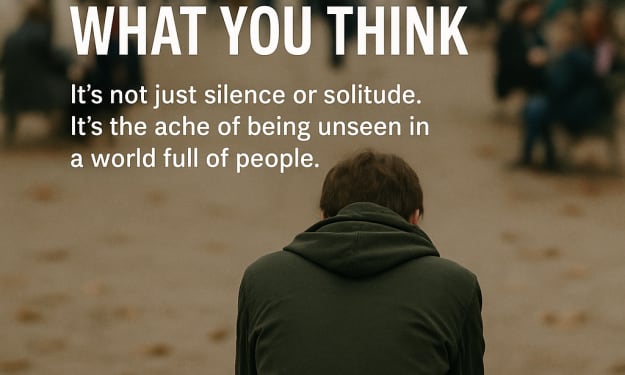
This Is What Being Truly Lonely Feels Like—and It’s Not What You Think
Loneliness is one of those emotions that we think we understand—until we really feel it. Most people equate loneliness with being alone. An empty house. A quiet night. A lack of invitations or phone calls. But that’s not what true loneliness feels like. Because true loneliness doesn’t wait for silence. It shows up in the middle of a conversation. It sneaks into rooms full of people. It hides behind forced laughter, busy schedules, and the constant hum of everyday life. You can be surrounded—completely—and still feel like you’re drowning in a sea of strangers. Being truly lonely feels like existing behind a pane of glass. You can see everyone else clearly, hear the noise, feel the movement. But no one can reach you. Your smiles don’t stick. Your voice doesn’t carry. Your presence is somehow… invisible. You wave, and no one waves back. Not because they don’t care—but because they never really saw you in the first place. There was a time in my life when I was always around people. Work meetings, group texts, dinner plans. I was never physically alone—but I felt emotionally abandoned. I started to notice that conversations became surface-level. That people asked, “How are you?” without really listening to the answer. That my emotions, if expressed, were often too much—or too confusing—for others to handle. So I stopped sharing. I started nodding and smiling and saying “I’m good,” even when I wasn’t. I kept the truth tucked deep inside: that I felt like a ghost walking through my own life. I was disconnected, unmoored, adrift in a world that kept spinning without me. Loneliness, when it’s real, doesn’t just hurt. It erodes you. It makes you question your value. You start to wonder: If no one really sees me, do I even exist in the way I think I do? The lack of reflection—the absence of genuine feedback—creates a kind of identity blur. You stop recognizing yourself in the mirror. You begin to shrink, internally. Your voice gets quieter, even in your own mind. And the worst part? It becomes easier to stay that way. To hide. To avoid the risk of rejection by never reaching out. To trade authenticity for safety. After all, if no one really knows you, then they can’t hurt you. But they also can’t love you. Not truly. That’s the paradox of loneliness—it builds walls when what we really need are doors. We talk so much about physical isolation, but emotional isolation is just as real. You can be married and lonely. Popular and lonely. Accomplished and lonely. Loneliness doesn’t care about status, beauty, or charisma. It’s not about how many people are around you—it’s about how connected you feel to them. How safe you feel to be seen. And let’s be honest—many of us are hiding. We hide behind curated versions of ourselves online. We hide behind jokes, behind sarcasm, behind competence. We keep things “light” because we’re afraid of being “too much.” We wear masks so long, we forget what our real face looks like. But somewhere deep down, we’re all craving something more. Real conversation. Real connection. That moment when someone looks you in the eyes and says, “I get it. I’ve been there.” That moment when your guard drops, and someone doesn’t run away. That moment when you feel held—not physically, but emotionally. Seen. Known. True connection is rare, yes—but it’s not impossible. Sometimes, it starts with one brave moment. A message sent. A truth spoken out loud. A risk taken. Vulnerability is terrifying—but it’s also magnetic. It invites others to let their guard down too. And suddenly, in a space where there was once silence, there’s understanding. Empathy. Maybe even healing. If you’re feeling truly lonely right now, I want you to know this: you are not broken. You are not invisible. You are not unworthy of love, attention, or presence. What you’re feeling is real. And it matters. It’s okay to name it. It’s okay to say, “I’m lonely.” That’s not weakness—it’s courage. And it’s the first step toward connection. So send that message. Make that call. Ask someone a question that goes deeper than small talk. Tell someone how you really are—and let them surprise you. Because sometimes, the door to connection doesn’t need to be kicked down. Sometimes, it just needs to be gently knocked on. And maybe—just maybe—someone’s on the other side, waiting to let you in.
By Zeeshan Khanabout a year ago in Confessions
Dealing with Slut-Shaming
Let's be real for a moment: society has some serious hang-ups about women exploring their sexuality. While men are often celebrated for their sexual conquests, women face a frustrating double standard that labels them negatively for the same behavior. If you're navigating what some call a "ho phase" – a period of sexual exploration and freedom – you've likely encountered slut-shaming firsthand.
By LaMarion Zieglerabout a year ago in Confessions