Embarrassment
When I Chose Peace Over Pleasing: The Day My Silence Stopped Serving Everyone but Me
I used to be proud of how “easygoing” I was. The one who didn’t make waves. The one who could be counted on to “understand.” I became the friend who always said yes, the partner who never argued, the daughter who swallowed her pain with a smile. People praised me for being mature, calm, and emotionally intelligent—but really, I was just quiet. Quiet because I thought peace meant avoidance. Quiet because I believed being loved meant being agreeable. Quiet because I thought being needed was the same as being valued. But that wasn’t peace. That was suppression dressed up as serenity. And the cost? My peace. My voice. And eventually, every relationship that was built on the condition that I stay silent. --- It started small. The friend who always vented to me but never asked how I was. The coworker who took credit for my ideas. The partner who made jokes at my expense and told me I was "too sensitive" when I flinched. I let it go. Every time I felt the sting of a crossed boundary, I brushed it off. “It’s not worth a fight,” I’d tell myself. “Pick your battles.” But I never picked any battles—not because they weren’t worth it, but because I didn’t believe I was. I was terrified that if I spoke up, people would leave. I thought love was fragile, something that only existed if I played the part that others needed from me. The accommodating friend. The chill partner. The daughter who didn't talk back. So I silenced myself for peace. But it was never peaceful inside me. --- Then one day, I cracked. It wasn’t some dramatic blowout. No shouting, no tears. Just a quiet, firm decision. I was on the phone with a friend I’d known for years. She was in the middle of another hour-long rant about her boyfriend, her job, her mother. She didn’t ask about me—not that she ever really did. But that day, I needed her to. I had just gone through something painful, and I was raw. “I actually have something I need to talk about too,” I said softly. There was a pause. Then she sighed. “Can it wait? I’m really overwhelmed right now.” And I realized—it would always have to wait. My feelings. My voice. My needs. Unless I changed the rules. So I said no. “Actually, it can’t wait anymore.” It wasn’t just a conversation. It was a turning point. --- One by one, the relationships fell away. Not because I was cruel. Not because I became unkind. But because I started showing up differently. I began saying “no” without guilt. I started expressing when I was hurt instead of stuffing it down. I stopped apologizing for having boundaries. And the people who had loved my silence? They didn’t know what to do with my voice. Some called me “difficult.” Others said I’d “changed.” They were right. I had. I was no longer interested in relationships that required me to disappear in order to be accepted. --- It was lonely at first. The silence after losing people is different from the silence you choose for yourself. It’s louder. Heavier. At times, I questioned whether I had made the right choice. But over time, the emptiness became space. Space for honesty. Space for alignment. Space for people who weren’t just comfortable with my silence—but honored my voice. And most importantly, space for me to hear myself. --- Here’s what I’ve learned: Peace isn’t the absence of conflict. It’s the presence of truth. Love that depends on your silence is not love. It’s control. And your voice—even if it shakes—is a revolution in a world that teaches you to be small. --- I used to think that speaking up would destroy the relationships I cared about. And it did. But only the ones that were never real in the first place. Because anything that crumbles when you stop betraying yourself wasn’t built on love. It was built on silence. And that’s no foundation worth keeping. So yes—my peace cost me relationships. But losing them gave me back myself. And I’ve never been more whole. Thank you for reading ❤️.
By Azmat Roman ✨about a year ago in Confessions
Worth
Introduction I took a selfie wearing a favourite shirt for a poem/playlist that I wrote which you can check out here: I thought I would use the picture for my Facebook Avatar, and yes, you expect a few likes, but at the moment they are at sixty, and that got me thinking, possibly spurred on by a quote from Ozzy Osbourne, who we just lost.
By Mike Singleton 💜 Mikeydred about a year ago in Confessions
The way he made me feel
It all started with a wave to a kid, who came like an angel who made a path in my love life. Our first meeting wasn't so dramatic like Hollywood movies or any K-drama moment. His smile towards me felt so genuine, soft enough to catch my attention. It felt so secret that it didn't felt like as if i was in love. I saw something in his eyes.... a lightness, a kindness, something that made the room feel less cold. For the first time in my life, i felt noticed. I have had crushes before but it never felt so unreal like he made me feel.
By Lee Jessicaabout a year ago in Confessions
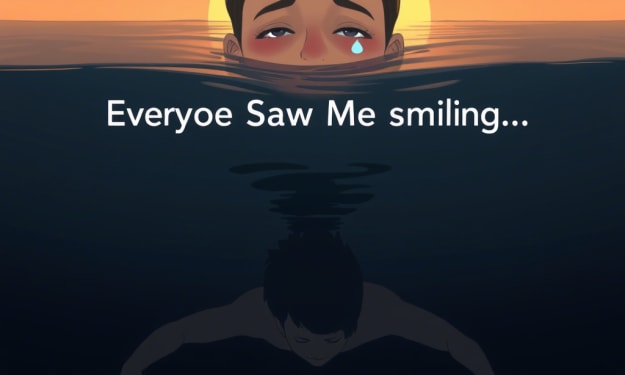
Everyone Saw Me Smiling. No One Saw Me Drowning.
Everyone thinks they know the strong ones. The ones who always smile. The ones who show up. The ones who laugh the loudest in the room and make others feel better. The ones like me. But no one ever stopped to ask how I was really doing. Not once. --- I remember the day it all started — or maybe, the day it started breaking. I was twenty-four, working at a creative agency, managing campaigns, juggling tight deadlines, and saying "I'm fine" like it was my birthright. People called me dependable. Energetic. A real "ray of sunshine." What they didn’t know was that I barely slept. What they didn’t see were the panic attacks in the office bathroom. What they couldn’t hear was the silence I went home to — the kind that makes your chest feel like it's caving in. --- Every morning, I applied my mask with precision: Smile? Check. Humor? Sharp as ever. Optimism? Overcompensated. And God forbid anyone see me struggle — vulnerability was a luxury I couldn’t afford. I answered “How are you?” like it was a rhetorical question. “Good, you?” “Doing great!” “Living the dream!” Lies. Polished, rehearsed, Instagram-filtered lies. The truth was darker than I wanted to admit: I felt like I was drowning in plain sight. And the scariest part? No one noticed. --- I didn’t want attention. I wanted connection. I wanted someone to see me — not the version of me I projected, but the one screaming silently behind the smile. But we’ve been taught to fear being “too much.” So I shrank. I became what everyone needed me to be: the helper, the listener, the cheerleader. Meanwhile, no one asked me if I needed saving. --- One night, after another long day of pretending, I sat on the edge of my bed staring at my phone. I was about to text a friend. I typed, “I don’t think I’m okay.” Then I deleted it. What would they even say? Would they be uncomfortable? Would I regret saying anything at all? Instead, I posted a story on Instagram of my dinner — some artsy shot of a salad and wine glass with the caption: “Self-care night.” It got 32 likes. Everyone saw me smiling. No one saw me drowning. --- It wasn’t one big event that broke me. It was a slow erosion — little moments of invalidation, months of ignoring myself, years of believing that being “strong” meant being silent. But burnout doesn’t arrive like a storm. It sneaks in like a leak in the ceiling, dripping quietly until one day — everything collapses. And collapse, I did. --- The day it all unraveled, I was in a meeting. My manager asked me about a campaign delay, and I couldn’t even form a sentence. My hands shook. My throat tightened. My vision blurred. I excused myself to the bathroom and cried in a stall like I was five years old again. Except I wasn’t a child. I was a grown adult who had run out of emotional credit. That night, I didn’t post anything. No curated shots. No witty captions. Just silence. And that silence — terrifying as it was — became the beginning of honesty. --- I started therapy. I deleted the “smile through the pain” playbook. I began telling the truth, even when my voice trembled: “I’m not okay right now.” And slowly, I found people who didn’t run from my mess. They leaned in. They held space. Turns out, I wasn’t alone. Most of us are drowning in one way or another — but we’ve been taught to tread water with a grin. --- If you’re reading this and you feel the same way — like you’re smiling on the outside and crumbling on the inside — please know: You don’t have to keep pretending. You are allowed to say, “I’m not okay.” You are allowed to need help. You are allowed to be human. Because strength isn’t in the smile you force. It’s in the truth you share. It’s in asking for a hand when you feel yourself sinking. --- Everyone saw me smiling. No one saw me drowning. But now, I speak before I sink. And maybe, just maybe — so can you. Thank you for reading.
By Azmat Roman ✨about a year ago in Confessions
Being the ‘Strong One’ Nearly Destroyed Me
They called me the “strong one.” It was meant as a compliment, I think. I was the one everyone leaned on. The one who stayed calm in a crisis. The one who didn’t cry at funerals. The one who offered advice, gave rides, picked up the pieces. I was the dependable one. The helper. The fixer. And I wore that label like armor. I convinced myself that being strong meant being silent. That my emotions were a burden no one else should have to carry. So I smiled while I was hurting. I cracked jokes when I felt like screaming. I became so good at pretending that even I started to believe the lie. But let me tell you something they don’t say out loud: Being the “strong one” is lonely. Exhausting. And sometimes, it breaks you. --- It started subtly. I was tired, sure—but wasn’t everyone? I had headaches that wouldn't go away, but I blamed my screen time. My sleep was a disaster. I’d lie awake, mind racing through other people’s problems while ignoring my own. Then came the anxiety. The random crying spells I’d hide in the bathroom. The sudden moments where I felt completely numb, surrounded by people who loved me but didn’t really see me. Because when you’re the strong one, people don’t ask if you’re okay. They assume you always are. And the worst part? I let them. I didn't know how to say, "I can't keep doing this." --- I hit my breaking point in the middle of a grocery store. I was standing in the produce aisle, trying to remember if I needed lemons or limes, and suddenly—everything felt too loud. Too bright. My chest tightened. My hands shook. I couldn’t breathe. Right there, between the cucumbers and the carrots, I had my first panic attack. And no one knew. Not the strangers shopping nearby. Not the cashier. Not my family. Because I pushed my cart to the side, walked out the door, sat in my car, and cried until I couldn’t anymore. Then I wiped my face, drove home, and made dinner like nothing happened. That’s what being the strong one looks like. --- Eventually, my body refused to cooperate with the façade. The burnout became physical. I got sick. I stopped caring. I isolated myself. I canceled plans. I withdrew. And still, no one really asked why. Because strong people don’t unravel. Strong people don’t quit. Strong people keep going. Right? --- Here’s the truth I wish someone had told me earlier: Strength isn’t about enduring pain in silence. It’s about knowing when to speak. When to rest. When to let others help. I started therapy. Not because I had the time, but because I couldn’t afford not to. I learned how to set boundaries. How to say no without guilt. How to disappoint people in order to save myself. It wasn’t easy. People didn’t understand at first. They thought I was “changing” or “not being there like I used to.” And they were right. I wasn’t. Because I couldn't be that person anymore. --- Now, I choose softness over stoicism. I choose rest over martyrdom. I cry when I need to. I ask for help—even when it’s uncomfortable. I let people see me, messy and human and flawed. And the people who truly love me? They didn’t walk away. They leaned in. Turns out, they just didn’t know I needed them—because I never let them see I did. --- If you’re reading this and you’re the “strong one” in your circle, let me say this as clearly as I can: You deserve care, too. You’re allowed to be tired. You’re allowed to stop pretending. Being strong isn’t about carrying everyone else’s pain at the cost of your own peace. Sometimes, the bravest thing you can do… is to finally put it down.
By Azmat Roman ✨about a year ago in Confessions
The Biggest Mistake of Your Life - Reddit. AI-Generated.
“What’s your biggest regret?” That was the question on Reddit. Thousands of comments poured in—confessions, missed chances, unspoken apologies. I didn’t expect to see myself reflected in so many of them. But there I was, in every regret typed anonymously into the void.
By sasha jaiabout a year ago in Confessions
Top 5 Viral Scandals of July 2025 That Broke the Internet
July 2025 didn’t just bring the heat — it brought the drama. Social media feeds exploded with scandals that had people gasping, meme-ing, and fighting in the comment sections like their lives depended on it. From a kiss-cam moment gone painfully wrong to surprise celeb breakups and marketing stunts that backfired in real time, this month has been an absolute rollercoaster.
By Kamran Zebabout a year ago in Confessions
Cabin on the Lake
I had come to the cabin to write and was left alone. It was the last month of fall, the kind of weather that smelled like stale wood smoke and wet pine. I had six weeks of vacation, a suitcase, five unread novels, and every intention of going back to my old self. No phone. No internet. Just books and silence.
By Echoes of Lifeabout a year ago in Confessions
The Summer Fireworks Never Came
The cicadas were louder than usual that summer. Their voices echoed through the empty streets of my hometown, a sleepy coastal city where nothing ever really changed. The train still clattered past the rice fields at the same slow pace. The air smelled of salt, cut grass, and memories.
By Takashi Nagayaabout a year ago in Confessions
The Day I Stopped Apologizing for Existing. AI-Generated.
Title: The Day I Stopped Apologizing for Existing For as long as I can remember, I apologized for simply existing. It started small. “Sorry for bothering you.” “Sorry for asking.” “Sorry, I didn’t mean to take up space.” At first, it just seemed like good manners. A way to be polite. A way to avoid making people uncomfortable. But over time, it became something deeper—something more damaging. By the time I was a teenager, it was automatic. I apologized when someone bumped into me. I said sorry for expressing my feelings. I apologized for asking for help. I stayed quiet in rooms where I should’ve spoken up, where I had something to say. All because deep down, I believed I wasn’t enough—that my voice wasn’t worth hearing, and my presence was a burden. The worst part? I thought shrinking myself made me kind. I thought if I took up less space, I’d be more likable. I thought being silent made me safer. But it didn’t. Playing small doesn’t protect you. It erases you. It took me years to see that. Years of being overlooked, dismissed, or walked over. And I wondered why I always felt invisible—like I was fading out of my own life. Then one day, the truth showed up—quietly, like it always does. It wasn’t some big dramatic moment. It didn’t happen during a breakdown or a major life event. It happened in a plain conference room, during a regular team meeting at my job. Everyone was tossing around ideas—some bold, some bizarre, some brilliant. People laughed, debated, interrupted each other without hesitation. No one apologized. No one seemed scared to speak. Then it was my turn. I started with, “Sorry if this sounds dumb, but…” Before I could finish, my manager stopped me—calmly but firmly. “Hey,” she said, “stop apologizing for thinking. Your ideas matter. Speak like you believe that.” It was such a small moment. Barely a sentence. But something cracked open inside me. It was like someone held up a mirror, and for the first time, I saw myself clearly. I saw how often I dimmed my own light before anyone else had a chance to notice it. How I silenced myself before the world even had to try. And how all those tiny apologies added up to one big lie: that I wasn’t good enough. That night, I went home and just sat with the feeling. No distractions. Just me, sitting with the weight of years of false apologies. Then I made a quiet promise to myself: No more apologizing for existing. Not for speaking. Not for thinking. Not for being here. Not for wanting more. Not for being human. The next day, I began to practice. At first, it felt awkward. Like learning a new language. I’d catch myself slipping into “Sorry,” pause, and rephrase. Instead of “Sorry I’m late,” I’d say, “Thanks for waiting.” Instead of “Sorry to ask,” I’d say, “I have a question.” Over time, something inside me shifted. I stood taller. My voice became clearer. And slowly, I started to believe what I was saying. It wasn’t about arrogance. It wasn’t about being loud or taking over. It was about belonging. It was about self-worth. And guess what? People noticed. People respected me more—not because I demanded it, but because I respected myself. I wasn’t hiding behind apologies anymore. I was just… showing up. I stopped tying my value to how small I could make myself. And I started tying it to how honest I was willing to be. I still catch myself sometimes—about to apologize for something that doesn’t need one. Old habits take time to break. But now, when I feel it coming, I stop. I take a breath. I remind myself: You belong here. You always have. No apology necessary. We don’t have to shrink to be accepted. We don’t have to stay silent to be safe. And we don’t have to say “sorry” for showing up as we are. You are allowed to take up space. You are allowed to be seen. You are allowed to speak your truth—even if your voice shakes. And maybe, just maybe, the world doesn’t need a quieter you. Maybe it’s been waiting for the real one all along.
By Straylightabout a year ago in Confessions