Dating
Her Own Terms
Nina stared at her phone, thumb hovering over Ava's contact name. They'd been texting back and forth for weeks now—ever since they'd been paired for the literature project. What started as discussions about symbolism in poetry had somehow evolved into late-night conversations about everything and nothing.
By Parsley Rose about a year ago in Confessions
Two strangers seated side-by-side on a long overnight train ride. Content Warning.
The notebook feels cheap under my fingers, the cardboard cover flimsy. This pen is already starting to skip. But it’s midnight, and the train is a dark serpent sliding through the sleeping countryside, and I can’t sleep. The hum is in my bones. That low, metallic thrumming that feels like being inside a giant, moving creature. It’s the sound of distance being eaten. The sound of leaving.
By Chahatabout a year ago in Confessions
The Things We Do in the Dark. Content Warning.
October 12th I saw him again today. It’s stupid, really. The way my body reacts. A full-system reboot from a thirty-second interaction in a coffee line. It’s not even about the words. It’s about the space between them.
By Chahatabout a year ago in Confessions
The Prize Hunter and the Junkyard Trick
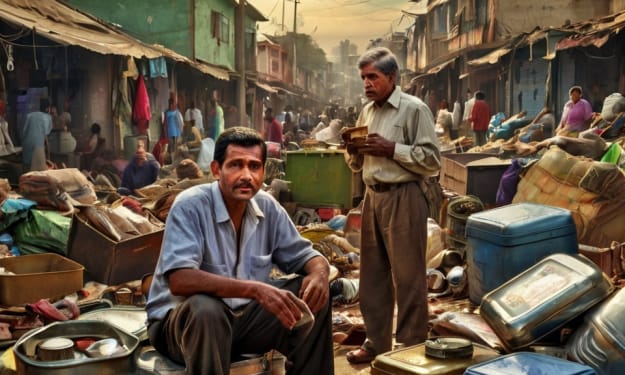
The Prize Hunter and the Junkyard Lesson BY:Khan Bashir Ahmed Bhatti, my old friend, has an unusual obsession. He is always chasing after prize schemes. Over the years, he has won several items through lucky draws—small and big prizes alike. A washing machine, a motorcycle, household appliances—he has collected them all, free of cost. The secret of his winnings lies not in luck alone but in his peculiar habit. He never throws away wrappers. Soap wrappers, tea packets, biscuit covers—even empty cigarette packs—he hoards them all in his house like a treasure trove. Whenever a company announces prizes through a lucky draw, he is the first one to pull out a stack of wrappers, scribble his name, ID card number, and mobile phone on them, and drop them into the entry boxes. Most people buy the products just to participate in the scheme, but my friend never spends a dime. He scavenges wrappers from wherever he can find them—at shops, in trash heaps, or even in the junkyard. For him, every wrapper is a lottery ticket, and the more entries he sends, the better his chances of winning. And indeed, his tactic often pays off. The companies, of course, are not blind to this trickery. They know many participants send in wrappers without purchasing the products. But since a wrapper carries no proof of whether it was bought or found, they are forced to honor the winner. A currency note works the same way: whether earned through hard work or picked up from the street, it holds its value everywhere. Similarly, a wrapper is valid as long as it isn’t torn or soiled. Still, some companies have become smarter. They now mark new products with a golden star, insisting that only star-marked wrappers qualify for the draw. Others insert coupons inside the packaging, forcing customers to purchase the item to participate. These innovations have reduced the tricks of people like my friend, but his passion remains undimmed. One pleasant afternoon, with cool breezes sweeping the city, my friend and I were strolling down a busy street. As we neared the bazaar, rows of junk shops came into view. On one side of the road stood two warehouses, and on the other, three more yards buzzing with business. Pushcart vendors were weighing scrap paper, bottles, and broken goods while the junk dealers, dressed in shabby clothes, sat lazily on their chairs, paying cash and recording tallies. Among the piles of junk, my friend’s sharp eyes caught sight of something—a shiny, almost brand-new tea tin lying on top of a mound of scrap. Its retail price would have been around 190 rupees. To him, it wasn’t just an empty container—it was a golden ticket. Without hesitation, he stepped forward, picked it up, and examined it with delight. But his small act didn’t go unnoticed. The junk dealer, sitting nearby, shouted in a harsh tone, “Uncle, please put that back. It’s not yours.” The words struck like a whip. My friend froze. All eyes turned toward him. The other junk dealers, sensing a moment of drama, began staring, eager to watch him squirm. The tin itself was worthless, but his mistake was in picking it up without permission. The dealer’s voice had exposed him, and embarrassment is heavier than any burden. For a moment, my friend looked shaken, but being clever and quick-witted, he recovered instantly. Saving face was now more important than saving the tin. He beckoned the junk dealer over with a mysterious smile. Curious, the man walked up. I, too, drew closer, wondering what trick my friend would pull this time. Holding the tea tin, my friend pointed at the printed word “Supreme.” “What does this say?” he asked. The dealer, who was literate enough, replied, “It says Supreme.” “Good,” said my friend. “Now tell me, if you remove the letters ‘Sup,’ what remains?” “Then it becomes ‘reme’—or rather ‘reme,’” the dealer answered hesitantly. “And if we add the letter K before it, what word do we get?” The dealer thought for a second. “That would make it ‘Kreme’—or ‘Cream.’” My friend leaned in dramatically. “Exactly. And cream sounds like ‘Kareem.’ Tell me, Kareem and Raheem—what are these names?” The dealer chuckled. “Kareem was my father’s name. Raheem was my uncle’s.” “Wrong!” my friend declared firmly. “No ordinary human is named Kareem or Raheem on their own. These are sacred names—attributes of Allah Himself. That is why our parents always prefix them with ‘Abdul,’ making them Abdul Kareem, Abdul Raheem. Without ‘Abdul,’ they belong only to God.” The dealer scratched his back nervously. “Yes… yes, you are right. My father’s real name was Abdul Kareem, and my uncle was Abdul Raheem.” My friend pounced on the moment. “So you see, this word on the tin—‘Supreme’—contains the sacred letters that form the word Kareem. And here you are, letting it lie in the dirt among scrap and filth. Do you realize what a grave sin that is? Words connected to the divine should be kept in a clean, elevated place, not tossed onto a junk heap.” The dealer’s eyes widened. He folded his hands apologetically. “You are absolutely right. I have made a big mistake. Please, take this tin and place it somewhere respectful. I don’t want to be guilty of disrespect again.” My friend nodded gravely. “Good. Learn from this. Never let sacred words fall into dishonor again.” He shook the dealer’s hand, tucked the tin under his arm, and walked away with me. Once we were at a distance, I turned to him and asked, half amused, half amazed, “What was that all about? You turned a scolding into a sermon and walked away with the prize.” He grinned slyly. “If I had simply put the tin back, I would have lost face. The dealer wanted to embarrass me, but I outsmarted him. And besides,” he winked, “I didn’t lie. Respect for sacred words is indeed our duty.” I couldn’t help but laugh. That was my friend—always cunning, always ready with a trick, and forever chasing prizes, even if it meant turning a junkyard lesson into a theological debate.
By Khan about a year ago in Confessions
The Date
Passing the time, looking around and looking for a soul to accompany to follow, she continues to walk towards the dark small alley. So many feelings to hold, to resist, to procrastinate so no one will know how she feels. She continued to look, to see if she could find the smell, the shadow left by that man.
By Lasha Deselaabout a year ago in Confessions
Unsent, Unforgotten
We all have sentences inside us that were never spoken. Words that sat at the edge of our lips, waiting for courage, waiting for the right time—a time that never came. For me, those words weren’t just sentences. They were an entire letter.
By Shehzad Anjumabout a year ago in Confessions
The Summer I Couldn’t Tell Him
Last summer, I met someone who changed me in ways I didn’t expect. We laughed, danced, kissed, and parted too soon. I thought it was just a fleeting memory, but when summer returned and I saw him again, I realised the truth: I had never stopped carrying him in my heart. This is the story of the summer I couldn’t tell him.
By Kayla Rampeliabout a year ago in Confessions
The Lake at Twilight
You look out over the reflection of the sun, through the still waters of the lake, as the sun sets behind the gentle darkening mountains. The sky recedes from yellow to orange, to red, before hinting a shade of violet and blue. The clouds once gentle shades of off-white are now turning into darker shades of gray.
By Parsley Rose about a year ago in Confessions
Three Meetings, A Summer, and a Kiss
We only met three times that summer: at a graduation party, a cookout, and an airport goodbye. But in those fleeting moments, between laughter, dancing, and silent hugs, I found a love I never expected. This is the story of the one who slipped away, and the risk we still dared to take.
By Kayla Rampeliabout a year ago in Confessions
How to Use PridesDate to Connect People Online Without Wasting Time. AI-Generated.
If you’ve ever felt that dating apps are a maze of endless swipes and superficial interactions, you might appreciate a platform that focuses on thoughtful conversations and personal stories. I recently explored PridesDate, an LGBTQ+ dating platform, and wanted to share my experience. This review will guide you through how PridesDate works, its features, and why it can help you seek meaningful interactions without wasting time.
By Tracy Larsonabout a year ago in Confessions
Is Secretmeet Really Discreet? A Look at Safety and Privacy. AI-Generated.
Online dating can be exciting, but it often comes with a big question: can you trust the platform you’re using? When I first signed up for Secretmeet, I wondered the same thing. In this Secretmeet review, I’ll share my experience, focusing on the platform’s safety, privacy, and whether it truly lives up to its discreet reputation. By the end, you’ll have a clear understanding of whether Secretmeet is legit, if it’s worth your time, and how your data and interactions are handled.
By Tracy Larsonabout a year ago in Confessions