
I Let AI Shop for Me for a Month. Here's What the Industry Doesn't Want You to Know
Sixty-one percent of paying AI subscribers say they'd rather cancel every streaming service than give up their AI tool. We've sleepwalked into the most influential shopping assistant in history. Most of us have no idea how it decides what to recommend.


I want to start with a number that stopped me cold when I came across it.
Sixty-one percent of people who pay for AI tools say they would rather cancel all of their streaming subscriptions — every service, all of them, than give up access to their AI assistant. Not "prefer to keep it." Would actively sacrifice Netflix, Spotify, everything, to hold on to their AI. Seventy-six percent of ChatGPT subscribers have set the app as their browser's default home screen.
We have built a deep, habitual dependency on these tools faster than we built one on smartphones. And most of the people inside that 61% are using their AI assistant to research and shop for things, often without thinking very much about what the AI is doing when it answers them.
I started paying attention to this after noticing that I was opening ChatGPT before opening Google when I needed to buy something. The shift had happened gradually. At some point, the friction of typing a query into a search engine and parsing ten blue links had started to feel like work compared to just asking a question and getting an answer. The AI was faster, more direct, and this is the part that should probably concern all of us — felt more authoritative than a page of sponsored links.
So I decided to actually pay attention to what was happening. I routed all my shopping research through AI assistants for a month, took notes on what they recommended and why, and then started reading the research on how these systems actually behave. What I found was more interesting, and in some ways more unsettling, than I expected.
The Shortlist Is the Product
The thing that traditional search did, at its most basic level, was present options. You searched for "running shoes under $100" and got a page of results, ten links, then ten more, then more after that. You were never under any illusion that the first result was the only answer. The pagination was right there.
AI search doesn't work that way. When you ask an AI assistant for a product recommendation, you typically get two or three options. Sometimes five. The AI presents a shortlist. It writes about each option in a way that feels like a buyer's guide — confident, curated, authoritative. There is no equivalent of page two.
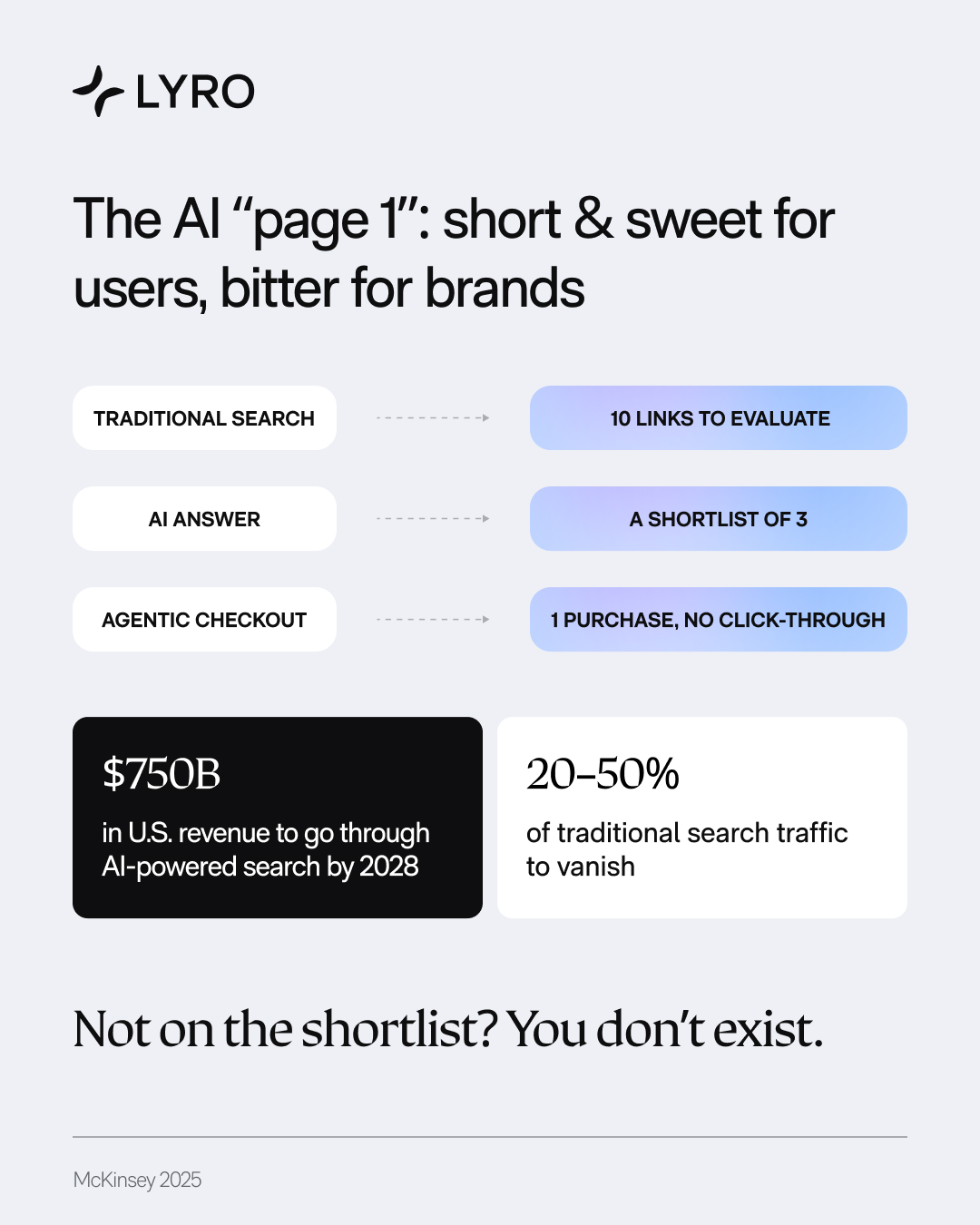
Research from McKinsey estimates that by 2028, $750 billion in U.S. revenue will flow through AI-powered search. Brands that fail to prepare risk losing 20–50% of their traditional search traffic to it. The Eight Oh Two AI & Search Behavior Study finds that 37% of U.S. AI users now start product searches with an AI tool rather than a traditional search engine.
What this means in practice: if your product is not on the AI's shortlist, it effectively does not exist for that consumer in that moment. The stakes of being recommended have been compressed from ranking on page one of ten pages to making a list of three.
The question I kept coming back to is: how does the AI decide who makes the shortlist?
What the AI Doesn't Know It Doesn't Know
Here's the part the industry would prefer you not dwell on too long: the AI is often wrong about products, and it frequently doesn't know it's wrong.
OpenAI's own benchmarks for ChatGPT's Shopping Research feature show 64% overall accuracy. That means more than one in three product recommendations contains an error, a broken link, a discontinued model, an incorrect price, an attribute that doesn't match the actual product. The AI is not lying to you. It simply doesn't have the real-time inventory and pricing data to know that the jacket it just recommended confidently has been out of stock for three months.
McKinsey's analysis adds context: a brand's own website accounts for only 5–10% of the sources AI search references when generating its answers. Over 65% of sources, in categories like consumer goods and financial products, are publishers, user-generated content, and affiliate sites. The AI is synthesizing a picture of the product world from sources that are often stale, financially incentivized, or simply wrong. Then it delivers that synthesis in a confident, short-form, buyer's guide format that does not communicate uncertainty.
The accuracy ceiling matters because it shapes what happens after the recommendation. Research finds that only 30% of consumers trust AI search results "a lot" or "completely." Eighty-five percent of AI users always or often double-check AI answers against other sources before buying. This means most of us are actually running a two-step process: let the AI narrow the field, then go verify. We're using AI as a consideration filter, not a final authority.
That's actually a pretty healthy behavior. The problem is that it's invisible in how the industry talks about these tools, and most consumers haven't consciously articulated it to themselves. They're doing it intuitively, but the AI's confident tone is pushing in the opposite direction toward trust, not verification.
The Recommendation You Didn't Know Was Paid For
This is where things get genuinely murky.
Both Google and OpenAI are now running ads inside AI-generated answers. Google expanded AI Overview ads to desktop in the U.S. and twelve other countries in 2025. OpenAI began testing ads in ChatGPT in January 2026 for logged-in users, positioned at the bottom of answers when "relevant," labeled and separated from the organic response.
OpenAI has been explicit that the ads will not influence the AI's actual answer — the core response is generated independently. The ad is a separate unit. But the user experience puts a paid placement directly below an authoritative-feeling organic recommendation, in an environment where the interface itself trains users to trust the whole answer as a unified output.
The distinction between "organic recommendation" and "sponsored placement appearing directly below it" is subtle in a conversation interface in a way it wasn't in a list of clearly labeled sponsored links at the top of a search results page. Early experiments with ads in AI feeds are not encouraging from a publisher revenue perspective: Perplexity's initial trial generated $20,000 in ad revenue out of $34 million in total revenue. But the format is early, and the incentive to blend the two more seamlessly will grow as the economics are refined.
The question for consumers is not whether ads are present (they have been in search forever) but whether the new format makes the distinction between recommendation and advertisement harder or easier to perceive.
Amazon Knows Something the Others Don't
The most striking data point I came across in a month of following this story closely came from Amazon's Black Friday results.
Sessions on Amazon's site that involved Rufus — Amazon's own conversational AI shopping assistant — resulted in purchases growing at five times the rate of sessions without Rufus. Not five percentage points higher. Five times. The differential represents the strongest conversion signal from any AI shopping assistant yet measured with real first-party data.
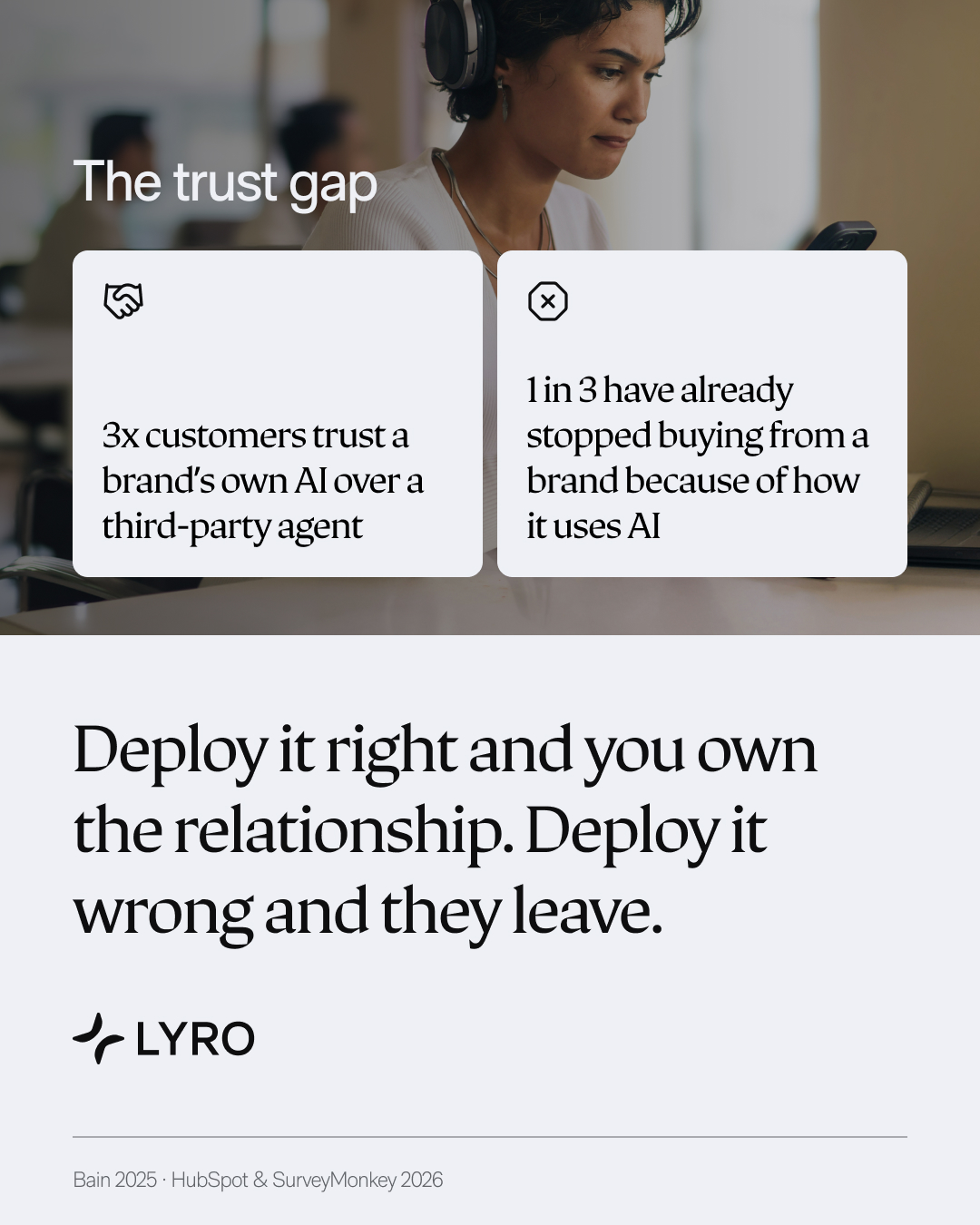
The reason, the research suggests, is trust. Bain's data finds that consumers trust retailer-owned AI approximately three times more than third-party AI assistants. The accountability structure is different: Amazon's AI is making recommendations on behalf of Amazon, which has a return policy, a customer relationship, and a reputation to protect. ChatGPT's shopping recommendations exist in a different accountability context entirely.
When I thought back over my own month of AI-assisted shopping, this resonated. The recommendations I acted on most confidently were from AI tools connected to stores I already bought from embedded assistants that had access to actual inventory, actual pricing, and actual information about my purchase history. The third-party AI recommendations I received I acted on least: I used them to build a shortlist, then went to the actual retailer's site to verify before buying. I was doing the Bain trust hierarchy in practice without having read the study.
What the Industry Calls "Dark Referrals"
There is a statistical phenomenon buried in the e-commerce data that reframes how significant AI's influence already is and how badly we're currently measuring it.
AI-referred traffic to websites sessions that can be directly attributed to an AI tool sending a user to a site grew 632% year-over-year. That sounds enormous. The context: it still represents only 0.2% of total measured sessions. The raw AI-referral number is tiny relative to organic search and direct traffic.
But there's a parallel finding: 37–50% of consumers say they use AI to research products before buying — far higher than the 0.2% of sessions that show an AI referral in analytics. The gap is explained by what researchers are calling "dark AI referrals." A consumer asks ChatGPT about running shoes, gets a recommendation, closes the chat, and then either types the retailer's name directly into their browser or does a branded Google search. The purchase journey started with AI. The conversion credit goes to direct or organic search.
The implication is that AI is influencing far more commerce than attribution models capture and that influence is growing invisibly inside existing channel metrics. Lyro's research estimates there's been a 50% drop in the attributable traffic that AI sends to websites from the chat window, meaning less and less of the AI influence is showing up as a trackable referral. AI is shaping consideration sets and purchase intent at a scale that last-click analytics are simply not designed to see.
The Trust Trap
Twenty-eight percent of consumers have already stopped purchasing from a brand because of its AI use. Not AI in general — a specific brand's specific AI deployment. That figure comes from HubSpot and SurveyMonkey's study of over 15,000 consumers across seven markets, and it captures something the industry's executive layer has consistently underestimated: the downside risk of deploying AI carelessly is measurable, specific, and already happening.
Business leaders, according to the same research, rank loss of customer trust as their lowest AI-related concern at 54%, behind biased outputs (61%) and data security (62%). They have it backwards. The consumer willingness data is accelerating — reluctance to let AI handle transactions has dropped from 66% to 32% in five months. But the 28% who have already walked away from a brand over AI use are a constituency that will only grow as more AI is deployed in more visible customer-facing contexts.
The broader lesson is that trust is not only about recommendation quality. It is also about recovery. When AI gets something wrong, the experience only remains trustworthy if the user can escalate quickly, keep context, and reach a human without friction.
That is why the strongest AI customer experiences are usually hybrid by design. In e-commerce support, the systems that perform best are not the ones trying to automate everything, but the ones built around confident resolution, clear limits, and seamless handoffs. Platforms like Tidio's Lyro follow that model: the AI resolves what it can, then routes the rest to a human with context intact.
"The hybrid model performs best — AI and humans working together with clear handoffs," says Tytus Gołas, founder and CEO of Tidio. The handoff is a feature, not a fallback. The 82% of consumers who still prefer human support even when AI performs equivalently are not a problem to be engineered around. They are a design constraint that the best AI implementations have accepted and built for.
What I Actually Learned From a Month of AI Shopping
I ended the month still using AI to research purchases. The efficiency gain is real. The shortlist function is genuinely useful when I'm in an exploratory phase and want to understand a product category I don't know well. For that job, the AI's synthesis of reviews, attributes, and tradeoffs is better than ten browser tabs.
But I also came away with a habit I didn't have before: I now check the date on AI recommendations for anything where stock and pricing actually matter. I verify the specific model number against the retailer's current inventory before I trust the AI's description of it. I notice when the AI's confidence is not calibrated to the accuracy of the information it has access to.
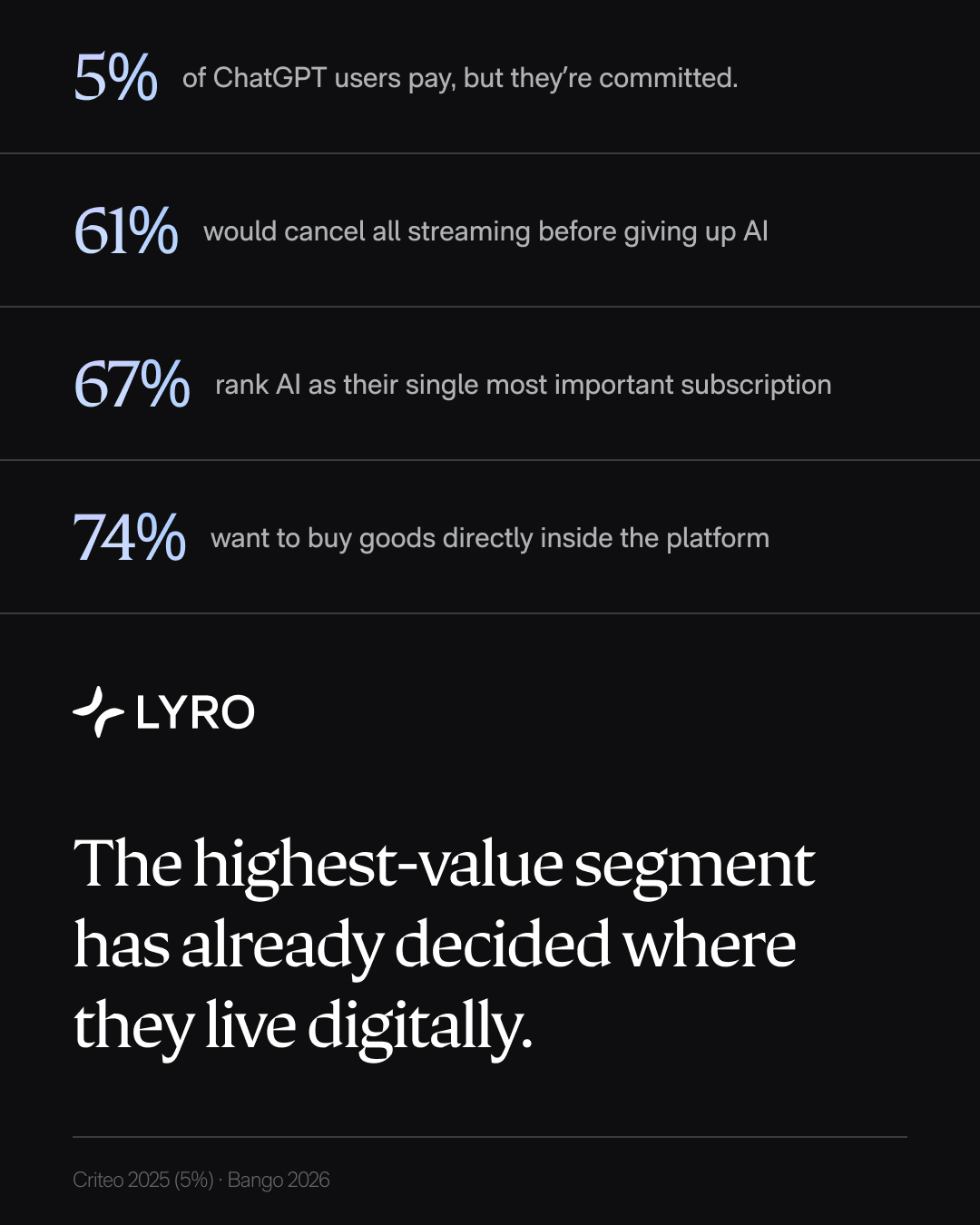
Mostly, I came away thinking about the 61% who would cancel their streaming services before losing their AI tool. These are people who have made a real judgment about where value lies, and they're not wrong: these tools are genuinely useful. But the value they're getting is not neutral. It is being shaped, at the recommendation layer, by a system whose data quality is imperfect, whose commercial relationships are opaque, and whose accuracy the platform itself benchmarks at 64%.
That's not a reason to stop using them. It is a reason to use them the way 85% of AI users apparently already are, as a starting point, not a final word.
This article draws on data presented "AI in E-Commerce in 2026: The New Shopping Funnel," a research report by Tidio, the AI help desk powered by Lyro AI.
About the Creator
Oliver Jones Jr.
Oliver Jones Jr. is a journalist with a keen interest in the dynamic worlds of technology, business, and entrepreneurship.
Enjoyed the story? Support the Creator.
Subscribe for free to receive all their stories in your feed.
Comments
There are no comments for this story
Be the first to respond and start the conversation.