
Chasing a Moving Target
The Hidden Risk of Misreading the Signal that Keeps on Changing

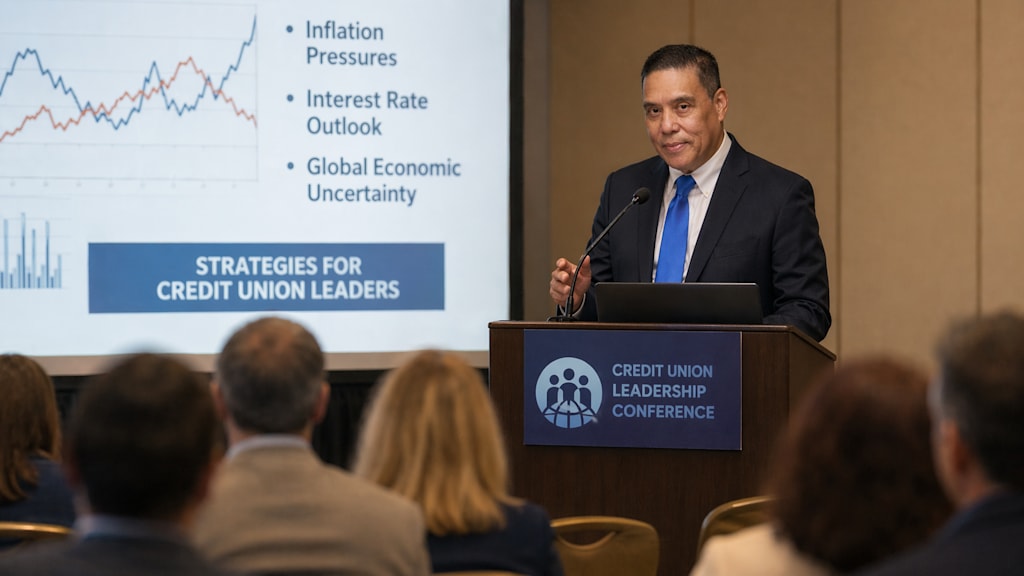
The email always arrived the same way—polite, upbeat, and maddeningly vague.
“We’re looking for an Economist keynote speaker who can truly connect with our audience.”
That was the brief. No data on audience sentiment, no clear objective function, no defined constraints. Just a mandate to “connect,” which, in the professional speaking world, is roughly equivalent to being asked to forecast inflation without knowing whether you’re modeling supply shocks, demand shocks, or political interference.
I had built a reputation as an economist who could translate complex macroeconomic dynamics into plain English. Credit unions, regional banks, and trade associations—they liked that I could stand on stage and explain why credit spreads were widening or why the yield curve was doing something counterintuitive without losing the room. But increasingly, hosts wanted more. Not just analysis, but narrative. Not just data, but relevance to whatever headline was dominating the news cycle that week.
That’s where the guessing game started.
Every engagement felt like pricing an option without knowing the underlying asset. You gathered clues: the industry, recent conferences, and the organizer’s tone. Then you made an educated bet on what would resonate. Sometimes you were right. Sometimes you twisted yourself into something unrecognizable, trying to be right.
This opportunity—a keynote at a large credit union conference—looked promising from the outset. I had just come off a speaking engagement with a group of credit union CEOs and CFOs, and the response, by all accounts, was exceptional. There was strong engagement, follow-up questions, and even a few invitations to future events. In this business, momentum matters, and I had it.
When I spoke with the organizer, the feedback was encouraging but included a caveat.
“We don’t just want an economist,” she said. “We want someone who can address the biggest political challenges of the day.”
That was the signal. The objective function had shifted.
Fine, I thought. Economics doesn’t exist in a vacuum. Political risk is just another input—albeit a volatile one. If they wanted geopolitical depth, I could provide it. The ongoing U.S.–Iran conflict dominated headlines and cleanly intersected with energy markets, inflation expectations, and global risk sentiment.
I committed.
What followed was a 20- to 25-hour research sprint that felt more like preparing a policy briefing than a keynote. I examined Iran's internal power structure, mapping the hierarchy not as it appeared on paper but as it functioned in practice. The formal institutions were one thing; real authority was another.
At the top of that real hierarchy sat the Islamic Revolutionary Guard Corps—the IRGC—a hybrid military, political, and economic force that had steadily consolidated power. By contrast, bodies such as the Supreme National Security Council, once central to strategic decision-making, had seen their influence erode. Leadership changes—violent ones—had only accelerated that shift.
I built a framework around this: who actually governs, how decisions are made under pressure, and what that implies for regime stability amid sustained military and economic strain. Then I layered in scenario analysis—probabilities, not certainties—on whether the current pressure could fracture the system or, paradoxically, strengthen the more hardline elements.
It was dense but relevant. Or so I believed.
I wrote the article under pressure, refining it late into the night to ensure every argument held up and every transition made sense. This wasn’t just about landing the gig—it was about proving I could stretch beyond my perceived lane.
When I submitted it, I felt confident, not complacent. I had done the work. I had responded directly to what I thought they wanted.
Then the response came.
I didn’t get the gig.
The explanation, when it came, was almost clinical. Their focus had shifted. The conference theme had pivoted toward domestic political dynamics—specifically, how upcoming midterm elections might reshape the economic landscape. They were seeking insights into how changes in the composition of the House and Senate could affect inflation trajectories, fiscal policy, and interest rate paths.
In other words, they were looking for the exact analysis I had already begun developing—though I hadn’t submitted it.
While I was immersed in the geopolitics of Iran, I had also been quietly and methodically working on a separate article examining U.S. domestic political scenarios. If one political party gained control of the House, what would that imply for fiscal expansion or contraction? If the Senate flipped, how would that alter the probability distribution of future Federal Reserve rate decisions? It was precisely the kind of framework they now wanted.
But they never saw it.
From their perspective, I had demonstrated depth in international political economy, but not the breadth they now required. The conclusion they drew was simple: I was strong in one domain, but limited in scope.
It was a misread—but an understandable one.
And that’s the part that stays with you. In this business, effort is necessary, but it’s not sufficient. You can do everything right within the parameters you think you’ve been given and still miss the mark if those parameters shift without your knowledge.
I didn’t lose the opportunity because I wasn’t capable. I lost it because I optimized for a moving target.
The lesson isn’t to work less. If anything, it’s the opposite. Preparation, rigor, and discipline are non-negotiable. But they have to be paired with optionality.
If you’re competing for something that depends on someone else’s evolving preferences, you can’t present yourself as a single-threaded solution. You have to hedge. Show range. Signal that you can pivot without sacrificing quality.
In practical terms, that means not just doing the work but also framing it. When I sent that article, I could have included a brief note: “In addition to this geopolitical analysis, I’m also developing a framework on U.S. domestic political scenarios and their economic implications—happy to share if that aligns with your current focus.” That single sentence might have changed the outcome.
Maybe it wouldn’t have. There are no guarantees in this market.
But it would have expanded the perceived solution set.
That’s the real moral of the story. Give every opportunity your best effort—but don’t assume effort alone will carry the day. Anticipate that the goalposts can move. Build flexibility into how you present your value. Make it easy for decision-makers to see not just what you’ve done, but what else you can do.
Because sometimes, the difference between winning and losing isn’t capability—it’s timing, signaling, and the ability to pivot before anyone asks you to.
About the Creator
Anthony Chan
Chan Economics LLC, Public Speaker
Chief Global Economist & Public Speaker JPM Chase ('94-'19).
Senior Economist Barclays ('91-'94)
Economist, NY Federal Reserve ('89-'91)
Econ. Prof. (Univ. of Dayton, '86-'89)
Ph.D. Economics
Enjoyed the story? Support the Creator.
Subscribe for free to receive all their stories in your feed. You could also become a paid subscriber, letting them know you appreciate their work.
Comments
There are no comments for this story
Be the first to respond and start the conversation.