
Thomas Müller Won Everything Except the Award That Defines a Superstar
His career shows why the highlight reel and the Ballon d’Or keep missing the same kind of player.
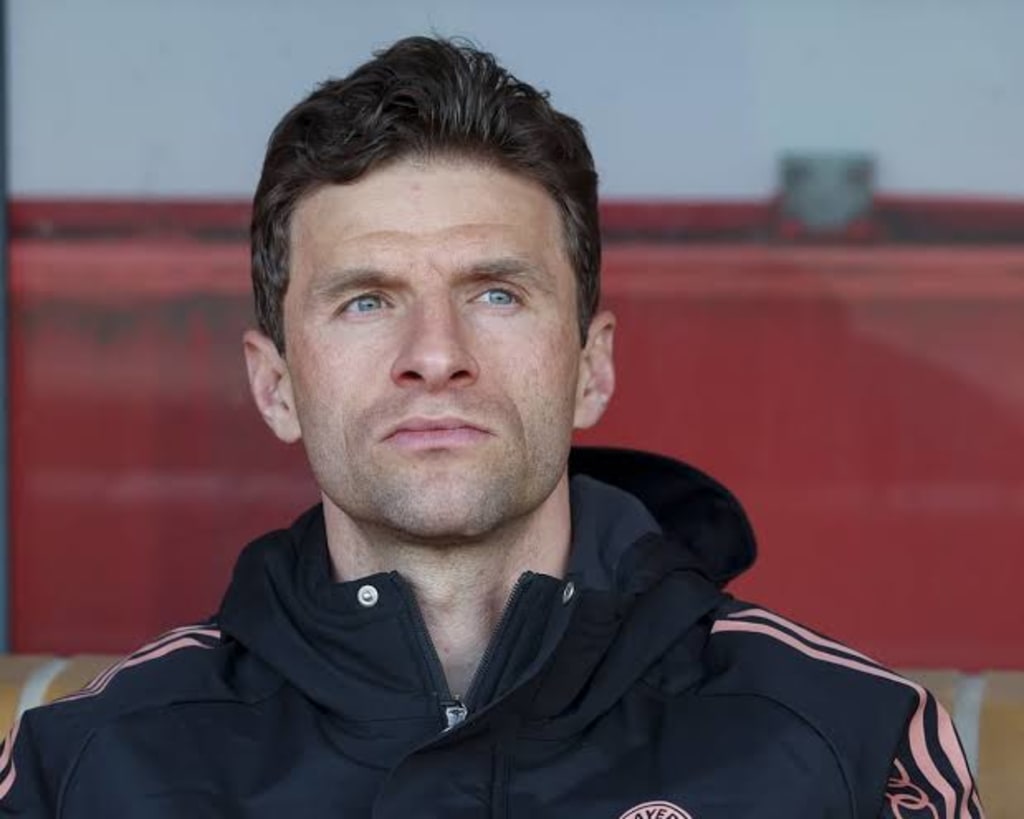
1. 756 appearances, 250 goals, 276 assists
Those are Thomas Müller’s numbers at Bayern Munich. The assist total sits 26 above the goals total. For a player first sold as a scorer, that gap did not appear early. It opened after his late twenties. In 2015-16 he scored 20 Bundesliga goals. In 2016-17 he scored five. From then on, his assists usually ran ahead of his goals.
That pattern does not look like a striker aging normally. It looks like a player being moved into a different job.
Karl-Heinz Rummenigge once said Müller was not especially fast, had average technique, and did not dribble well. Put that on almost any superstar and it sounds like a rejection. Müller played at Bayern for more than a decade. He won 13 Bundesliga titles, two Champions Leagues, and a World Cup. A player whose own executive described his technique that way should not have lasted. He lasted because he did not need the ball to matter.
2. The off-ball problem in a highlight economy
Müller’s game needs full matches. His best work comes before the ball arrives. He finds the gap when a defender looks away. He reaches the passing lane before a teammate lifts his head. He turns a messy box into a simple finish. These moments repeat across 90 minutes. They rarely survive a 30-second clip.
Watch a Müller highlight reel and you see lay-offs, tap-ins, and the occasional awkward miss. You do not see long dribbles, violent shots, or runs from midfield. Huang Jianxiang called him the superstar who least looks like a superstar. That line works because Müller’s value does not produce visual shock. The word superstar, at least in modern football media, depends on visual shock.
His weaknesses matter too. Müller’s on-ball game has long been average for his position. He cannot take a defender out of the game the way Arjen Robben or Franck Ribéry could. When Bayern’s system worked, Müller was the best connector on the pitch. When the system broke and someone had to win a game alone, he was not the first option. Superstar stories favor the first option. Müller’s talent made the first option better.
3. Ancelotti’s change and the resource logic behind it
Carlo Ancelotti replaced Pep Guardiola in 2016. Müller moved from second striker toward wide midfield and attacking midfield. His starting position drifted away from the box. He scored five league goals in 2016-17, his worst league return to that point.
A coach’s choice caused the drop. Bayern’s squad caused the choice. Robben and Ribéry could create something from nothing on the wing. Attacks naturally started and ended with them. Robert Lewandowski was the most reliable finisher in the box. Müller could not match Robben or Ribéry as a one-on-one threat. He could not match Lewandowski as a scorer. Building the team around Müller would have changed the possession map and the running patterns. Asking him to serve the stars would cost him goals.
Müller served. He dropped deeper, linked play, ran into gaps, and laid the ball off. In 2019-20 he recorded 21 assists, tying the Bundesliga single-season record. He scored eight league goals. A player who once scored 20 league goals had become a player with more assists than goals.
Wayne Rooney’s later years at Manchester United followed a similar path. Sir Alex Ferguson moved Rooney deeper to free Cristiano Ronaldo. Rooney stayed great, but the spotlight moved. Müller faced the same trade at Bayern. Robben and Ribéry gave way to Lewandowski. Lewandowski gave way to Jamal Musiala. Müller’s role stayed fixed. He became a permanent service provider.
4. A player who lived on ghosting, then lost half a step
Müller’s game depends on fine physical timing. He wins with acceleration, repeated runs, and anticipation. Those tools do not look as loud as a winger’s sprint. They still demand a healthy body. Around 2016, Müller entered his late twenties. Injuries increased. A half-second lost on a run turns a chance into a lost chance.
He could not remake himself as a physical player. His dribbling and hold-up play were never strengths. When his off-ball threat dropped, his individual attacking weight dropped with it. In 2017-18 he made 29 Bundesliga appearances, with more substitute cameos. Jupp Heynckes briefly revived him. After that season, Müller never consistently returned to 15 or more league goals.
Time pressed on his reputation too. A young Müller made news with goals. An older Müller made news with assists. Assist totals flatter a team player. They carry less weight in Ballon d’Or voting and in public memory.
5. The Ballon d’Or measures a different job
Bayern won the treble in 2013. Müller was a key member. He finished 17th in the Ballon d’Or. Germany won the World Cup in 2014. Müller was a central figure. His best Ballon d’Or finish was fifth. The 2014 World Cup Golden Ball went to Lionel Messi after Argentina lost the final. Diego Maradona complained. The complaint missed the point. Voters saw Müller as a player whose excellence depended on the team. They did not see him as the most individually decisive player in the world.
The Ballon d’Or rewards the player who can decide a match alone and tell a clean story. Müller did not play that way. In key moments he ran into space, received the ball, and found a teammate. In the 2014 semifinal against Brazil, he assisted. In the final against Argentina, he created chances and did not score. His World Cup Golden Boot came in 2010 with five goals and three assists. The Golden Ball went to Diego Forlán. Müller finished fifth.
Two rating systems were looking at the same player. One measured team contribution and tactical value. The other measured individual control and visual impact. Müller was elite in the first. He could not reach the top three in the second.
6. German football taught him to choose the team
Müller once said German football teaches teamwork over individual shine. His career follows that line. He never chased the hero role. He took the team role and pushed it as far as it could go.
That choice brought every team trophy available. It also kept him away from awards built for the most visible individual. His career is the cleanest example of German football’s team-first idea. When he retired after Euro 2024, he left no Ballon d’Or. He left 756 appearances, 250 goals, 276 assists, and a repeated image. He runs into space, takes the pass, moves the ball to the right place, then jogs back with little expression.
7. Another kind of greatness
Müller did not fall short of superstardom. He worked outside its definition. His greatness came from making teammates better, making the system run, and making wins happen in the least dramatic way.
He has no Ballon d’Or. The numbers hold something harder to award. For more than a decade, he changed games without dominating the ball. More assists than goals looks like a compromise for a former scorer. For a player who understood the game, it was a choice.
He made that choice.
About the Creator
Jin
Writer of reamstories
https://reamstories.com/jin
Enjoyed the story? Support the Creator.
Subscribe for free to receive all their stories in your feed. You could also become a paid subscriber, letting them know you appreciate their work.
Comments
There are no comments for this story
Be the first to respond and start the conversation.