
They Promised a Frugal Asian Games. Athletes Got a Survival Challenge.
From tiny meals and flooded container rooms to buses that never arrive, Nagoya 2026 is falling apart before the opening ceremony.
When “frugality” becomes “stinginess”: the organizing predicament of the Nagoya Asian Games
A “survival challenge” triggered by a bowl of noodles
The coach of the Thai takraw team held up a bowl and gave a bitter smile at the camera. Inside were thin noodles, three small pieces of chicken, and rice stuffed into a slender disposable drink cup. He wanted one more spoonful of broccoli. The staff shook their heads. There were only two vegetables, broccoli and cabbage, and you had to choose one.
The video spread among athletes. Someone captioned it: “Is this a weight-loss meal?”
At that point, the opening ceremony was still a few days away. The 21-member Chinese gymnastics team arrived at Nagoya Airport. The registration system crashed, and only two people’s information could be displayed properly. They waited at the airport for nearly six hours. Only water was provided, no food. One athlete said they were “tired, sleepy, and hungry, and still had to train tomorrow.” Another smiled bitterly: “These things are harder than the competition.”
The bus driver for the South Korean men’s football team took the team to a baseball stadium. Not a football stadium. Pre-match warm-up time was cut by more than half an hour. After the South Korean men’s basketball team moved into container housing, players over two meters tall could not stretch their legs in bed. The vice president of the Korea Basketball Association said: “This is the worst ever.”
Before the competition had even begun, a “survival challenge” over basic provisions had already started.
The more money is spent, the worse the experience gets
When bidding in 2016, the organizing committee promised a budget of 85 billion yen. According to the Mainichi Shimbun, total costs including the Asian Para Games have ballooned to about 370 billion yen. More than triple.
Hideaki Omura, chairman of the organizing committee, explained that additional requirements from the Olympic Council of Asia added about 60 billion yen, while rising prices and labor costs added another 55 billion yen.
To control costs, the organizing committee made a rare decision in Asian Games history: cancel the construction of a centralized Athletes’ Village. They argued that the construction cost of an Athletes’ Village capable of housing 15,000 athletes and officials had doubled from an initial estimate of 30 billion yen to about 60 billion yen. So about 4,000 to 5,000 athletes were placed on the Costa Serena cruise ship at the Port of Nagoya, and about 2,000 were housed in container-style accommodations in the port area.
The distance between the cruise ship and venues became a new burden. For athletes staying on the cruise ship, a one-way trip to the table tennis hall took an hour and a half. Venues were spread across Tokyo, Shizuoka, Gifu, Osaka, and other cities, with swimming and diving events scheduled at the Tokyo Aquatics Centre about 350 kilometers from Nagoya. South Korean media outlet JoongAng Ilbo described this decentralized hosting model as more like holding a “national games.”
The construction costs saved were eaten up by the transportation, coordination, and emergency costs brought by the dispersed layout. Without a centralized Athletes’ Village, there was no unified dispatch system. Registration, accommodation, catering, and transportation each operated on their own; when one link failed, the whole chain collapsed.
The ignored “athlete logic”
The catering issue best illustrates the deviation at the execution level.
According to OCA standards, the main dining hall in the Athletes’ Village is a free buffet, operating 20 hours a day, covering Chinese, Muslim, Continental, vegetarian, and other options, with calories and allergens labeled. The problem was venue catering. It used a fixed-portion meal system, with one set portion per person, meat by a fixed number of pieces, and a choice of one of two vegetables.
This catering logic bore the imprint of Japanese food culture. Ichiju sansai emphasizes small portions and variety; hara hachi bu treats eating until 80 percent full as a health principle; and Japan’s Basic Act on Food Education has had nutritionists precisely portioning meals since elementary school. For an office worker’s business lunch, it makes sense. For athletes burning thousands of calories in training every day, it does not hold up.
For athletes in heavier weight categories, such a portion might not even be half a meal. Athletes need sufficient calorie intake and protein replenishment. Refined small portions do not meet that need. One comment hit the mark: “Hosting frugally is not a sin, but athletes are a high-consumption group, and an energy deficit will show up directly in the results.”
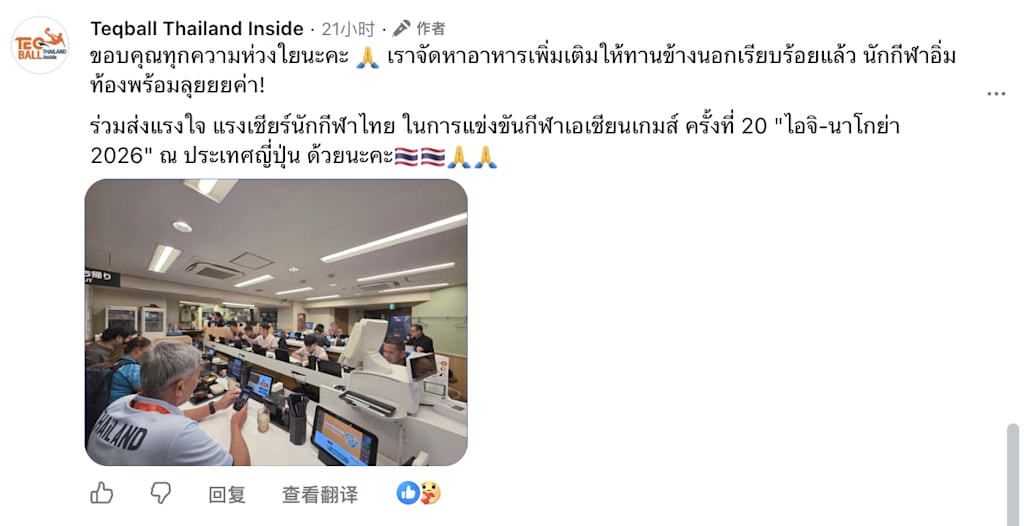
The Thai takraw team later updated on social media: “Thank you for your concern. We have gone out to find extra food.” Many delegations had to arrange extra meals outside on their own. For athletes who need to maintain competitive form, this itself was an extra drain.
Systemic gaps in preparation
The registration system crash and transportation chaos exposed deeper preparation failures.
On September 16, after many delegations arrived at Nagoya Airport, the organizing committee’s information verification system failed, the back end could not query athletes’ registration information, and vehicle dispatch was paralyzed. The Indian rowing team waited more than four hours and still did not get a shuttle bus. An Indian athlete said, “I am completely a ghost in their system.”
Problems in transportation were equally frequent. The buses for the South Korean men’s football team and the Qatari team were taken by drivers to a baseball stadium before their matches. The Vietnamese women’s volleyball team was dropped off in the wrong place by the driver, and the players dragged their luggage and walked back to the hotel under the sun. A South Korean athlete filmed the driver stopping to check a paper map for directions.
The number of participants exceeding expectations was another underestimated variable. The actual number of registered athletes and officials at this edition exceeded 17,000, two thousand more than the initial estimate of 15,000, a participation scale even larger than the Olympics. Planning for food supplies, service staff, and accommodation rooms did not keep up with this change. The only option was to further shrink categories and rigidly control portions, prioritizing “everyone getting one portion.”
The OCA’s defense and the gap with reality
Facing strong dissatisfaction from many delegations, OCA Director General Hussein Al-Musallam responded on September 18. He said that not having an Athletes’ Village was out of consideration for “flexible, pragmatic hosting,” and stressed that “all registered athletes, officials, and coaches at this Asian Games have been arranged accommodation.” Coordination Commission Chairman Ikram said the container dormitories were “of good quality and can meet athletes’ housing needs.”
Because of missing accommodation records, several Thai athletes at one point slept on the floor of the cruise ship lobby. Complaints about insufficient toilets on the cruise ship continued. The container housing faced flooding risks during heavy rain, and South Korean men’s basketball players had to evacuate overnight. Player Byeon Jun-hyung posted a video on social media of a leaking sink and water spreading across the floor, with only one caption: “Please help us.”
Costs tripled even though the OCA called the approach flexible. Organizing committee chairman Hideaki Omura attributed part of this to additional OCA requirements, but the OCA did not provide a detailed explanation.
The paradox of “the more you save, the more you spend”
Almost every decision made with the original intention of saving money produced the opposite effect.
Canceling the Athletes’ Village saved construction costs but brought higher transportation and coordination costs. Reducing the number of volunteers lowered labor expenses but led to insufficient service capacity, forcing extra development of automated systems to compensate. Simplifying the opening ceremony’s visual presentation saved stage design budget, but then additional investment was made to purchase AR/VR equipment. Cutting venue catering categories controlled immediate catering spending but forced delegations to arrange extra meals outside.
Some analysts noted that by the end of 2024, the organizing committee had already admitted that “the original cost estimates and overall expectations were too optimistic.” But even after recognizing the problem, it continued cutting costs in every execution link instead of increasing investment and improving provisions.
The budget tripled, while the athletes’ experience fell to the lowest point of a major event in recent years.
The gap in comparison
The Hangzhou Asian Games three years earlier provided another reference. The athletes’ restaurant in the Hangzhou Asian Games Village offered more than 400 dishes, had windows with different flavors, and implemented a 20-hour meal service system. Catering support covered 56 Asian Games venues, Asian Games sub-villages in six cities, and more than 100 reception hotels. The dishes met food safety and foodborne doping testing requirements while accommodating the dining habits of different participating countries and regions as much as possible.
The Hangzhou Asian Games also emphasized frugality, but while controlling costs in ceremony procedures and consumables, the guarantee of athletes’ food, accommodation, and competition was never compromised. Hosting frugally and guaranteeing athletes’ basic conditions for competition do not contradict each other. The decisive question is where cost control is applied.
The Nagoya Asian Games failed because it treated frugality as squeezing every visible expense and ignored hidden costs. When athletes cannot eat enough, sleep well, or find their way, the damage to the event’s competitive quality and international reputation is far more costly than the small budget savings.
Any multi-sport event must guarantee athletes’ basic conditions for competition. If athletes cannot eat or sleep properly, the competition becomes a test of wilderness survival. Future organizers can learn one thing from Nagoya: saving money is not the goal; doing the job well is.
About the Creator
Jin
Writer of reamstories
https://reamstories.com/jin
Enjoyed the story? Support the Creator.
Subscribe for free to receive all their stories in your feed. You could also become a paid subscriber, letting them know you appreciate their work.
Comments
There are no comments for this story
Be the first to respond and start the conversation.