
The Vinícius Dilemma: Real Madrid’s Left Flank No Longer Belongs to One Man
Vinícius Júnior remains a valuable asset. He is no longer untouchable. Real Madrid’s decision should depend on formation, defensive work, and price.
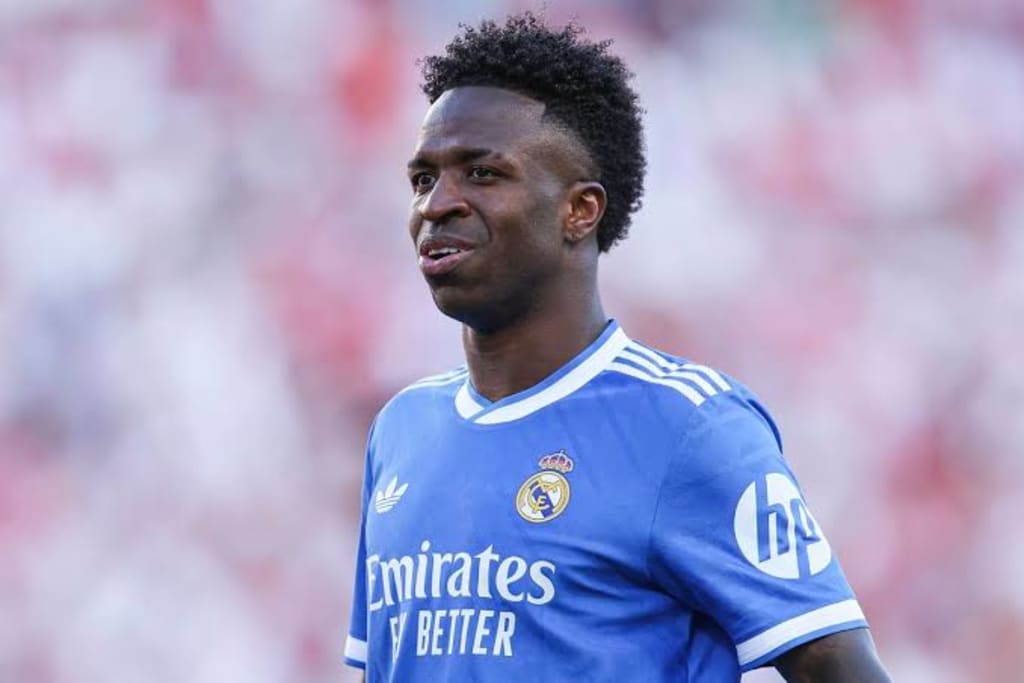
1. Comparing Vinícius and Mbappé by goals misses the point
Vinícius Júnior has never been a pure finisher. In the second leg of the 2022 Champions League tie against Manchester City, he carried the ball forward on the left, drew fouls, and dragged the match into the messy rhythm Real Madrid wanted. He did not score that night. Real Madrid turned the tie around because he could take the ball under pressure and solve the next problem. The 2024 semi-final against Bayern followed a similar pattern: a one-on-one burst on the left, two or three defenders pulled toward him, space opening in the middle.
Mbappé is the stronger finisher. That is clear. Vinícius’s value lies elsewhere: carrying the ball forward, beating a defender one on one, starting transitions, drawing fouls, and pinning back a defensive line. The two players have different skill sets. Comparing them by goals alone measures Vinícius against Mbappé’s best attribute.
The problem started when Mbappé arrived. Vinícius no longer has the left flank to himself. Mbappé needs to start from the left, attack the channel near the box, and receive the team’s finishing resources. They can coexist, but coexistence requires a concession. Someone has to run without the ball. Someone has to track back. Someone has to accept fewer goals. Someone has to accept a smaller tactical role.
If Vinícius accepts that concession, he remains one of Real Madrid’s most important players. If he does not, the issue moves from tactical fit to squad structure.
2. One forward can skip defensive work. Two cannot.
Mbappé has never been a sustained high-intensity presser. He can press in certain matches, but he is not a forward who tracks back for ninety minutes. Vinícius is similar. In good form, he chases back and counter-presses. When his emotions rise, his defensive involvement falls.
That combination creates a clear problem. If Mbappé does not defend and Vinícius does not defend, Real Madrid’s front line becomes two players waiting for the ball, waiting for the counter, and waiting for space. The midfield and full-backs have to cover more ground. The pressing line breaks. The picture is easy to find: both forwards wait upfield, the opponent plays one direct pass through midfield, Real Madrid’s holding midfielder and full-backs chase back, and the two forwards are still walking in the opponent’s half. Two or three of those sequences in a match can loosen the whole defensive structure.
The emotional side matters too. Vinícius is an emotional player. That is not an insult. Emotion can put him in the state where he beats defenders at will. It can also make him boil over when decisions go against him, when his space is squeezed, or when his share of the ball drops. Once he boils over, his running choices, his tracking back, and his combination play all decline. For a Mourinho-style manager, defensive discipline and tactical execution are the baseline. One forward can skip defensive work. Two cannot. One star can be emotional. That emotion cannot break the team’s shape.
Vinícius’s problem is not that he cannot defend. His tactical privilege is shrinking, and his game has not adapted.
3. Formation decides who gets sacrificed
In a 4-4-2, Mbappé could partner a centre-forward such as Espí or Endrick. The theoretical fit is simple: one drops to link play, one runs in behind. Mbappé likes playing with a centre-forward who can combine. That part works. The problem is Vinícius. A 4-4-2 compresses his position. He is not a traditional centre-forward, and the wide role in a 4-4-2 gives him different space and different ball distribution from a 4-3-3 or 4-2-3-1. In that setup, Vinícius is no longer a player who must start every match.
In a 4-2-3-1, Vinícius can return to the left wing, his best position. But Mbappé in the middle runs into the old problem. He needs left-side space to start, and Vinícius occupies that space. They can swap positions, but swapping requires discipline and defensive cover. Without that, the left flank gets crowded, the middle opens, and the right side lacks a winger who can beat a defender one on one.
A cleaner option is Espí at centre-forward, Mbappé on the left, and Güler or Diomande on the right. Mbappé returns to the left. Espí holds the middle. The right side provides width and running. Vinícius becomes a rotation option or a player competing for a place. The structure is clear. The cost is that Real Madrid lose Vinícius’s one-on-one threat on the left, and that threat still matters in tight matches.
The central question is not “4-4-2 or 4-2-3-1?” The central question is whether Real Madrid will sacrifice Vinícius’s tactical privilege to make Mbappé the core. If yes, Vinícius moves from automatic starter to important rotation player. If no, Real Madrid must build a system where both play, and someone accepts the defensive sacrifice.
4. Diomande’s three goals in thirteen days are not enough evidence
Diomande has played well: three goals and five goal involvements in thirteen days, solid work in attack and defence, strong forward thrust. Those are real positives. The sample is still small. A young player’s short burst does not prove he can replace Vinícius over a season. Güler can play wide, but stronger opponents will target his defending and physical duels. In a match against a top side, the opposing winger can attack his side repeatedly, and Real Madrid’s holding midfielder has to cover the right flank more often. That is the cost. Espí and Endrick need more minutes, but needing minutes means they are not fully ready. Rodrygo’s return from injury adds depth, but he is not the same kind of left-sided one-on-one winger as Vinícius.
Real Madrid’s reality is simple. Vinícius is still one of the few wingers in the squad who can change a Champions League match on his own. He is no longer the only player Real Madrid rely on. He can still be replaced only with difficulty. The better judgment is that Vinícius has moved from “absolutely not for sale” to “sellable under the right conditions.” He has not become a player who must be cleared out.
5. Wages, commercial value, and the dressing room create concrete risks
Vinícius earns a high salary. If he demands parity with Mbappé, he will hit Real Madrid’s wage structure directly. His commercial value is lower than Mbappé’s. There can be only one core in the dressing room, and Real Madrid have made Mbappé that core. Those are concrete risks.
Commercial value and sporting value are different things. Vinícius still has a market, still has brand influence, and can still be the leading player at another club. Any buyer must absorb his wages and his emotional risk. Arsenal’s interest is one thing. Whether Arsenal can absorb the wages and meet Real Madrid’s price is another. A fee of €130 million to €150 million is reasonable. Not every club will pay that for a high-wage winger.
In the dressing room, Vinícius can accept a secondary role and compete for his place. Then the balance holds. If he rejects that role, the conflict becomes public. Florentino Pérez has a record of cold realism. From Raúl to Cristiano Ronaldo, he has made hard decisions when a star’s value declines. He will not rush a sale before a replacement is ready. He likes superstars. He trusts timing and price more.
6. Conclusion: sell only under the right conditions
Vinícius’s situation at Real Madrid comes down to three points.
First, he is no longer the left-sided star Real Madrid must rely on every week. He is still an important asset.
Second, his fit with Mbappé is a real tactical problem. It is solvable if someone accepts the defensive work and the smaller role.
Third, Florentino will treat him as a negotiable asset, not an untouchable star. He will not force a sale before a replacement is ready and the price is right.
The sensible path is not “sell Vinícius this summer.” The sensible path is this: make Mbappé the tactical core, ask Vinícius to compete and defend, then judge the fit at the end of the season. If a €130 million to €150 million offer arrives and Diomande, Endrick, or another young player looks ready to take over, a sale makes sense. If the offer is low or the replacements are not ready, keeping him and reshaping his role makes more sense.
Vinícius’s problem is not that he lacks quality. Real Madrid’s front line can no longer hold two stars who both need the left, both need the ball, and neither wants to make a long-term defensive sacrifice. Real Madrid should not clear him out in anger. The club should answer one question: will Vinícius change, and if he changes, is he still worth the salary and the core role?
That is what “conditional asset” means here.
About the Creator
Jin
Writer of reamstories
https://reamstories.com/jin
Enjoyed the story? Support the Creator.
Subscribe for free to receive all their stories in your feed. You could also become a paid subscriber, letting them know you appreciate their work.
Comments
There are no comments for this story
Be the first to respond and start the conversation.