
The Blue-and-White Ribbon
A World Cup final, a whispered score at a wedding, and the lemon tree in San Isidro that still waits for her.
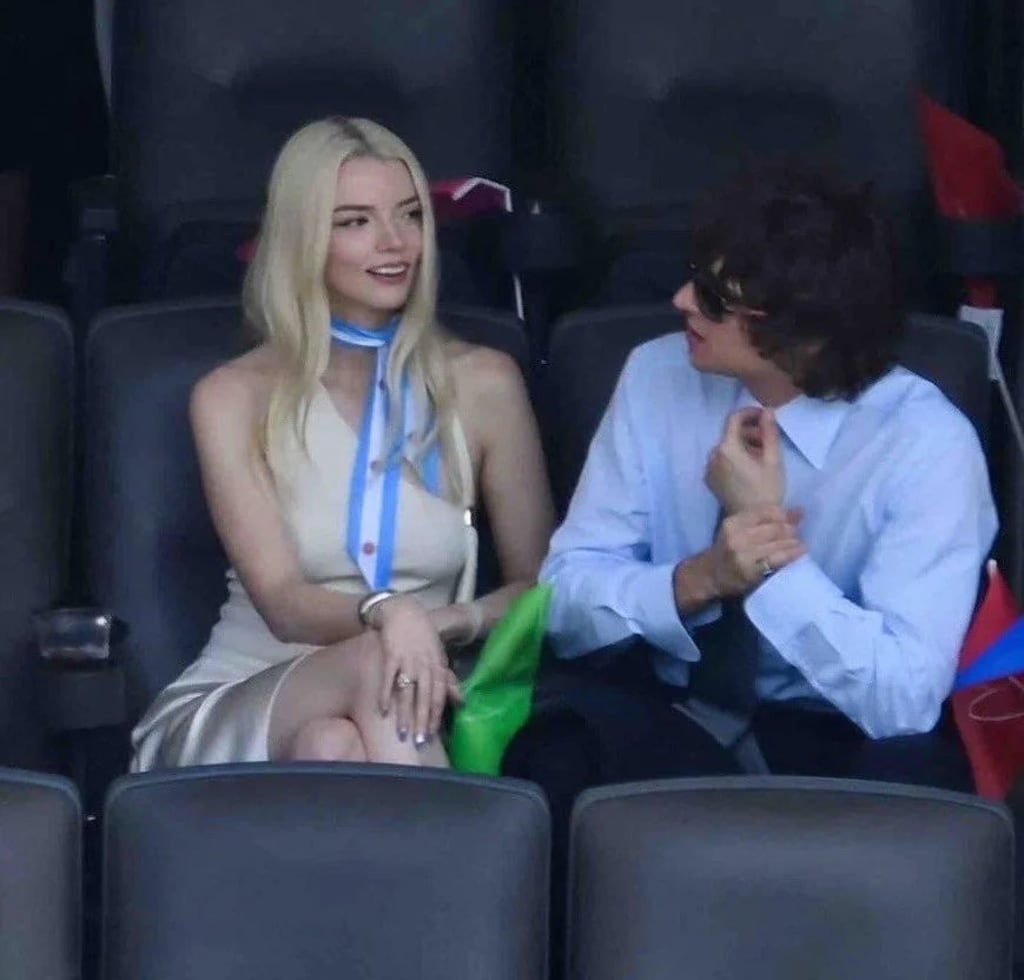
The night wind off the Hudson River swept across the stadium, rustling the flags on the suite’s balcony. Anya Taylor-Joy sat in the third row, a jacket draped over her knees, a blue-and-white ribbon tied at her neck. One end of the ribbon lifted in the breeze, brushing against her collarbone; she didn’t bother with it. Beside her sat Shakira; a few seats over, Matt Damon was leaning sideways, saying something to the person next to him. Far below on the pitch, Argentina and Spain were burning the last of their energy in extra time. The scoreboard read 1–1, but everyone knew that could change at any moment.
Anya’s hands rested on her knees, her fingertips absently tracing the edge of the ribbon. She had seen that fabric countless times on the streets of Buenos Aires—street vendors braiding it into bracelets, tying it to car rearview mirrors, stitching it onto the shoulders of jerseys. She had lived in that city until she was six, in an apartment in Palermo with a wrought-iron balcony. Every morning, the old lady from the grocery store downstairs would hand her mother a paper bag of warm milk, the bag marked with a smiley face drawn in ballpoint pen. Anya couldn’t remember that lady’s name, but she remembered the smiley face, remembered the soft, limp feel of the paper bag dampened by steam.
Later she moved with her family to London. London’s winters had none of that humid heat, none of the smoke drifting from corner grills, none of the neighbors shouting about football from their balconies. She picked up a British accent, performed in school plays, got discovered by a talent scout, and made her first film. But every Christmas she flew back—December in Buenos Aires was summer, hot enough to make you sweat, the jacaranda trees along the streets having shed their petals, replaced by the smell of grilled meat and sweet bread in the air. Her family was still there. Uncles, cousins, her grandmother. Her grandmother lived in San Isidro, with a lemon tree behind the house. Every time Anya visited, her grandmother made the same dish—empanadas, filled with beef, cumin, and onions, baked until the edges were crispy. The grandmother never asked what movies Anya was making in Hollywood; she only asked: “Did you watch the match?”
During the 2024 Copa América, Anya was photographed in the stands in Miami wearing an Argentina jersey. That photo circulated widely on Argentine social media for a while, and people commented, “She’s one of us.” She didn’t respond, but her mother mentioned in an interview once: “Anya grew up in Argentina—that’s the warmest, most passionate part of her character.”
On the day of the semifinal, Argentina against England, Anya was asked on the set of Good Morning America whom she supported. The camera was on her; the makeup artist had just touched up her lipstick, and she was still holding a coffee cup. She looked down, smiled, and said: “Personally, I’m for Argentina, but we have different family members supporting different countries.” She paused, turning the coffee cup half a turn in her hand. “If we have to lose, I can accept losing to England.”
That clip was later screenshotted by English fans and posted on Twitter with the caption: “She left herself a back door.” But Argentine fans read it differently—she said “I support Argentina” first, and only then “losing to England is okay.” Order is priority. She never once said in any interview, “I’m British,” even though she holds a British passport.
The night before the final, she said something even shorter in front of another camera. It was on the red carpet for the premiere of Lucky; a reporter asked in Spanish how she felt about the final. She answered in English first, then repeated it herself in Spanish—her pace unhurried, some words carrying a slight, hesitant pronunciation, as if she were translating in her head before speaking. She said: “Lionel Messi and football mean everything to Argentine people.” Then she looked into the lens, no preamble, no “I’d like to say”—just: “Thank you, Messi. Thank you for making our country proud.”
That line looped all day on Argentine television news. Commentators said, “She’s a true Argentine,” not because of her accent, but because she used the words “our country.”
On the night of the final, MetLife Stadium was packed with more than 80,000 people. Argentine fans occupied the northern stands, blue and white confetti drifting down like snow in the lights. Spanish fans were in the south, their red-and-yellow banners flapping in the night wind. When Anya entered, some Argentine fans recognized her and called her name from behind the barriers. She turned her head and raised a hand in that direction—not a wave, just a lift and drop, as if acknowledging them but not wanting to linger too long.
The suite slowly filled with familiar faces. Tom Cruise wore a dark blue suit and shook hands with someone beside him as he arrived. Dua Lipa sat in the back row, her long hair over her shoulders, glancing down at her phone now and then. Timothée Chalamet and Kylie Jenner came in together, exchanged a few low words, then sat two seats apart. Mick Jagger wore a hat pulled low. The halftime show was the first ever to be staged at a Super Bowl level—Madonna in a silver bodysuit performed a mashup of Like a Prayer with Justin Bieber. Shakira followed, singing her 2010 World Cup theme, the sound from the suite’s speakers vibrating the water in the glasses, creating tiny ripples.
Anya didn’t watch the performance. She kept her eyes on the pitch. Argentina conceded first in the first half, but Messi equalized in stoppage time. At the moment Messi scored, Anya rose to her feet—both hands gripping the railing in front of her, leaning forward as if her own weight could push the ball in. Then she sat back down, her fingers still locked on the railing, knuckles white.
Extra time began, and both teams showed signs of exhaustion. An Argentine defender went down after a tackle, and the medical team ran onto the pitch. Anya turned her head and said something to her husband, Malcolm McRae, who leaned in to listen, nodded, and said nothing. He never touched her, but his body angled slightly toward her, as if shielding her from something.
In the 105th minute, Spain’s Ferran Torres received a pass at the edge of the box, turned, and drove a low shot. The ball slipped between the Argentine goalkeeper’s fingertips and the post.
The big screen in the suite flashed the new score. Anya’s hands went up first, then clamped onto her hair. Two fingers stayed there, her forehead pressed against the back of her hand, as if reading a sentence that should not exist. Then she looked up and waved her hand toward the pitch below—not toward anyone in particular, but a reflexive gesture of denial. As a child, her grandmother had told her that if you said something unlucky, you had to knock on wood three times. She was denying something now, but in the wrong direction—she waved at the air, as if trying to erase what had just happened from time.
Shakira sat beside her, expression unchanged. When the camera panned over, Shakira’s lips parted slightly, then closed. The two women’s faces in the same frame—one in denial, one in waiting.
That footage was cut into a short clip three hours later, with the title “Anya’s Crushing Moment.” It racked up 50,000 shares within two hours. Someone commented: “She looks devastated, while Shakira seems to have foreseen it all.” Another user posted a still of Anya with her hands over her head, paired with a photo of an Argentine fan in the stands striking the same pose, captioned: “We are all the same.”
No one was debating her nationality. Everyone was looking at that gesture—hands up, gripping her hair, waving it away. An expression that needed no translation.
There was a small moment before all this that not many people noticed. Argentina’s knockout match against Cape Verde happened to fall on the same day as Taylor Swift and Travis Kelce’s wedding. The wedding was held at a Rhode Island estate, and Anya attended as a guest. Upon arrival, everyone’s phone was collected into a velvet pouch, sealed, and placed in a wooden box at the door. No photos leaked from the entire ceremony; no one checked the score.
Anya sat midway down the long table, next to a few people she didn’t know. The candelabras on the table were silver, the tablecloth ivory, and five sets of cutlery were arranged in proper order. As the third course was being cleared, a waiter passed behind her, bending to refill the water glass in front of her. He looked to be in his early twenties, his tray holding another bottle of wine; he didn’t slow down. But as he leaned past her ear, he said softly: “Just so you know—Argentina won.”
Anya looked up, but the waiter was already gone, his figure disappearing toward the kitchen. She looked down at the newly poured water in her glass, the surface still trembling slightly. She didn’t tell anyone at the table what had happened; she just picked up the glass and took a sip.
Later, she posted nothing on social media. Her Instagram feed remained as it had been three days earlier—a movie poster for Lucky, captioned with a string of star emojis. After the final, paparazzi caught her getting into a car in the parking lot. In the photos, the blue-and-white ribbon was still tied, now loosened, hanging below her collarbone, one end lifted by the night breeze like a miniature flag.
She paused for a second before getting into the car, turning to glance back toward the stadium. The lights were still on; Spanish fans’ cheers seeped out from within, muffled by the parking lot and the fences, now reduced to a low background hum. She turned, slid into the car, and the door closed.
A week earlier, she had said something in front of a camera. Someone had asked, “Who do you really support in your heart?”—a question she’d been asked dozens of times in different settings. Most times she gave a diplomatic answer, pleasing both sides. But that time she didn’t.
She said: “In my heart of hearts, I’m for Argentina.”
Now she didn’t need to repeat it. The loosened ribbon, that last look back before getting into the car, and even further back, the waiter bending down to whisper those few words, had already written her answer for her.
Someone posted the side-by-side photo of her and Shakira in the suite on Twitter, with only two words as the caption: Blue-and-white ribbon. Argentina’s flag is blue and white; Argentine fans stick blue-and-white decals on their jerseys; Argentine children, when first learning to draw, color in blue and white on paper. That day Anya said nothing, except she tied that knot with a ribbon.
Back in San Isidro, her grandmother was probably gathered around the television with the whole family, watching the replay. Her grandmother wouldn’t see that video clip—she doesn’t use social media. But early tomorrow morning, Anya would call, and her grandmother would pick up and ask: “Have you eaten?” And Anya would answer: “Yes, but I want the empanadas you make.” Her grandmother would pause, then say: “Then come back.”
She didn’t say when she’d return, but they both knew. Every Christmas, December, summer, the jacaranda petals fallen, the smoke rising from grill stands, the neighbors on balconies shouting a score. She would go back, sit beneath the lemon tree, and her grandmother would bring out the beef empanadas with the crisp, browned edges. They wouldn’t talk about football—her grandmother never talked about football. They would just sit, break apart the warm pastries, wait for the steam to escape, and take a bite.
That, too, was Argentina. Not on the scoreboard, not in the commentators’ recaps of the final, not in the camera sweeps across the VIP suite. Somewhere else. In her grandmother’s kitchen, in that loosened ribbon, in the words the waiter leaned in to whisper.
The night wind over New Jersey kept blowing, and the stadium lights went out one by one. The cars in the parking lot drove off one after another. If that blue-and-white ribbon fell into the crevice of some seat, the cleaners would probably pick it up the next day. But that didn’t matter anymore. It was already in the photos, in the freeze-frames of the video clips, in the comments of those who said, “We are all the same.”
Anya Taylor-Joy didn’t post anything. She didn’t need to.
About the Creator
Jin
Writer of reamstories
https://reamstories.com/jin
Enjoyed the story? Support the Creator.
Subscribe for free to receive all their stories in your feed. You could also become a paid subscriber, letting them know you appreciate their work.
Comments
There are no comments for this story
Be the first to respond and start the conversation.