
The $6.33 Billion Bet That United 55 Nations Against FIFA
How one email, one in‑law, and one 247‑word resolution pushed world football to the edge of collapse — and why a silent scoreboard vote may have just saved the World Cup
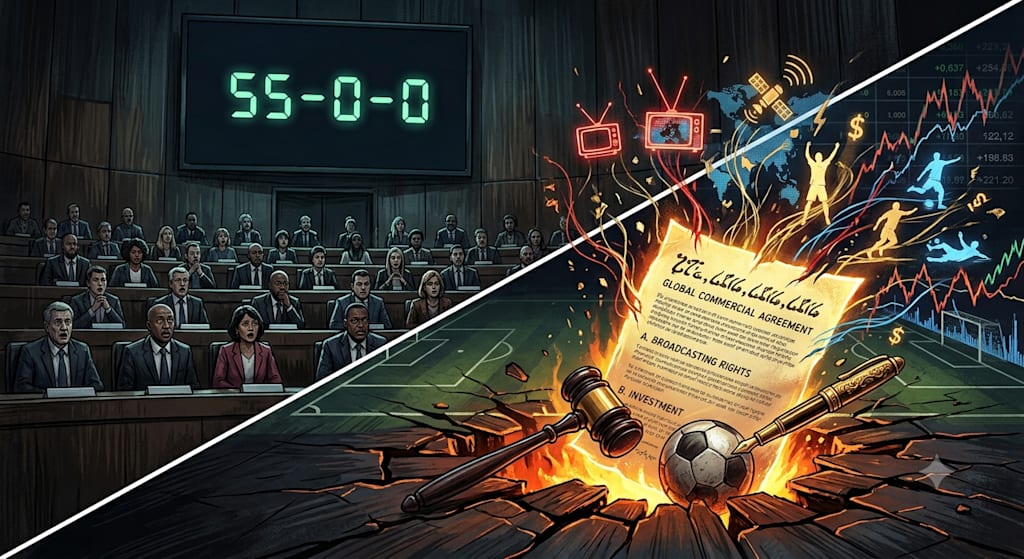
July 30, 2026, Zurich, FIFA Headquarters, Assembly Hall.
The result flashed onto the big screen: 55 votes in favour of boycott, 0 against, 0 abstentions. No applause. Half an hour later, at the coffee machine on the third floor of FIFA’s headquarters, a mid‑level staffer murmured to a colleague in German: “Now no one can pretend this isn’t happening.”
Twenty‑four hours earlier, FIFA president Gianni Infantino had sent an “urgent” attachment to the inboxes of all 211 member associations. The core of the proposal was a new subsidiary called FIFA Forward Enterprise (FFE)—a vehicle that would bundle the commercial rights (broadcast, sponsorship, licensing) to the men’s World Cup, the Women’s World Cup, and the Club World Cup for the next 25 years. The bundle was valued at $20 billion, and up to 21% of its equity would be sold to qualified private investors, targeting $4.2 billion in fresh capital.
Attached to the email was a simple comparison table:
Yes (sign before January 1, 2027): Each association receives an immediate solidarity package of $40 million—a total of $10 billion distributed globally.
No: The package shrinks to $2.7 billion, or roughly $10 million per association.
The difference: $30 million per federation. Multiply that by 211, and you get $6.33 billion. That is the net present value of human nature, priced and itemised.
Infantino called the plan a “democratic financing feat for football.” But the cc line of the email revealed its other face: the lead financial advisor for the transaction was Joshua Kushner, younger brother of Jared Kushner, son‑in‑law of former (and possibly current, depending on your political calendar) U.S. President Donald Trump, and founder of Thrive Capital. The photograph of Infantino toasting Trump in the VIP box at the 2026 World Cup final in the United States had not yet faded from social media timelines. By the time the email landed, the Kushner family’s investment banking team had already checked into the Baur au Lac hotel in Zurich, taking over three top‑floor suites for their due diligence war room.
UEFA’s response took twelve hours.
At dawn on July 30, UEFA convened an emergency meeting of its 55 member associations. There was no lengthy debate. The English FA delegate spoke for barely three sentences: “If FFE goes through, private investors won’t care about France playing Argentina. They’ll only care whether Argentina plays Saudi Arabia at 2 p.m. Asian time—because that’s prime time in Shanghai and Tokyo.” That line was written into the footnotes of the final resolution.
The resolution itself ran to 247 words. Its operative language locked onto two phrases: “binding guarantee” and “permanent rejection.” The core demand was one sentence: as long as the proposal stands, no UEFA‑affiliated team—men’s, women’s, or youth—will participate in any FIFA competition. No exemptions. No transition period.
Infantino’s trump card was divide and rule. Over the previous five years, his “FIFA Forward” programme had funnelled more than $1.7 billion in development aid to associations worldwide, building a reservoir of goodwill in Africa, Asia, and Oceania. His original calculus was simple: use a $40 million cheque to sway the small federations; for many island nations, that sum equals three decades of their annual operating budget.
But UEFA’s pre‑emptive strike set off a cascade of dominoes:
July 29 (one day before UEFA’s vote): CONCACAF, 41 members, the backyard of U.S. finance, publicly rejected the proposal, citing “lack of due process.” A no‑vote from Wall Street’s own neighbourhood carried more weight than any diplomatic phrasing.
July 30 (three hours after UEFA’s vote): The Asian Football Confederation sent a circular to its 47 member associations, warning that the proposal “has no chance of success.”
The Confederation of African Football postponed its closed‑door meeting, originally scheduled for August 1, switching the agenda to “assessing risk exposure after UEFA’s boycott.”
CONMEBOL remained publicly silent, but a board member of the Brazilian Football Confederation left a message in a WhatsApp group that later leaked to Folha de S.Paulo: “If European players don’t play, a World Cup for South Americans is just a warm‑up tournament.”
Arithmetic does not lie.
UEFA’s 55 + CONCACAF’s 41 + AFC’s 47 = 143 votes. The threshold for a veto at the FIFA Congress is a simple majority of 211, that is, 106 votes. Even if Infantino swept all 54 African votes and all 11 from Oceania, his total would reach only 109, barely over the line, but only if none of the 143 European, North American, and Asian votes defected.
Mathematically, Infantino had already lost the ballot box. That is why UEFA’s statement dared to use the phrase “abandonment in full”; they were not negotiating, they were issuing an ultimatum.
But what if Infantino refuses to concede?
UEFA’s Plan B was activated during the Zurich emergency meeting. If the FFE proposal is not withdrawn by the September 19 deadline, UEFA will formally notify FIFA that it is withdrawing from the qualifying process for the 2027 Women’s World Cup and the 2030 men’s World Cup.
That move would trigger a chain reaction, each link measured in concrete numbers:
First link: broadcast collapse.
Current global rights agreements covering the 2027‑2030 cycle are valued at roughly $12 billion. Most contracts contain force‑majeure clauses triggered by “material absence of major participating parties.” Without France, Germany, Spain, Italy, and England in the draw, the legal departments of ESPN and the BBC would issue claims within 30 minutes. FFE’s valuation model was built on the assumption of a full‑strength tournament; if Europe walks, the $20 billion valuation would zero out in pre‑market trading. Buried in the private investors’ due diligence report is an overlooked footnote: “Material tournament‑integrity risk—investors reserve the right to withdraw.”
Second link: player rupture.
FIFA has the authority under Article 22 of its Regulations on the Status and Transfer of Players to impose global bans on any player taking part in unauthorised tournaments. But FIFPRO, the global players’ union, issued a counter‑statement on the evening of July 30: “Any sanction that deprives players of the right to represent their national team will be met with class‑action lawsuits and strike ballots worldwide.” Meanwhile, the medical directors of Europe’s top five leagues have run their own numbers: a World Cup‑free summer would give players an extra four to six weeks of recovery time. Club owners would quietly celebrate; national coaches would have no one to train.
Third link: parallel competition.
An unconfirmed “Plan C” has circulated inside UEFA’s corridors: if FIFA insists on a diluted World Cup, UEFA would stage a “Global Elite Invitational” of the UEFA Nations League in the same 2030 window, inviting the top four ranked teams from South America, Africa, and Asia. This is a rival centre of gravity, not mere fragmentation.
Away from the conference tables, the conflict is sliding into Swiss jurisprudence.
FIFA is headquartered in Zurich and falls under the Swiss Civil Code. Article 80 of that code states explicitly that an association “may not engage in commercial activities contrary to its statutory purpose.” UEFA has already retained a Zurich‑based law firm to prepare an injunction application, asking the local court to freeze FFE’s incorporation on the grounds that “transferring non‑profit sports governance to for‑profit private capital constitutes a fundamental ultra‑vires act.”
At the same time, a senior official from the European Commission’s Directorate‑General for Competition, speaking anonymously to the Financial Times, indicated that if FIFA proceeds with FFE, UEFA could invoke Article 6 of the Digital Markets Act, arguing that FIFA is abusing its dominant position in global football to restrict the trade freedom of European national teams. That would be an untested antitrust path in the sports domain.
A more symbolic move took place on the morning of July 31: a UEFA delegation met the Deputy Director of UNESCO’s Division for Cultural Affairs at the UN’s European headquarters in Geneva, handing over a memorandum titled “The Public Nature of Football as Intangible Cultural Heritage.” The memo’s concluding line was a single sentence: “The World Cup cannot be sold, because it does not belong to FIFA—it belongs to every generation that kicked a ball on the street.”
All of this echoes the spring of 2021 and the “European Super League” fiasco.
Back then, twelve of Europe’s richest clubs tried to create a closed‑shop league, and it collapsed within 24 hours. The UEFA president of that time, Aleksander Čeferin, stood in a Brussels press hall and denounced the plotters as “greedy and shameless.” Four years later, the same man stood in Zurich and delivered almost identical lines, only this time he was defending not his own tournament’s cake, but the common ground of the entire football world.
Only three endgames remain:
Best case (50% probability): On the eve of the September 19 Congress, Infantino withdraws the proposal in exchange for a “permanent prohibition” resolution. FFE dies stillborn, though the Kushner team’s $42 million due‑diligence bill is written off. Infantino stays in office until 2027, but from then on, his public duties are confined to ribbon‑cutting and trophy‑holding.
Mid‑case (30%): The Congress formally votes down the proposal, but Infantino refuses to resign. Swiss prosecutors open an investigation into potential conflicts of interest during FFE’s preparation, specifically whether the Kushner team offered Infantino any side‑deal beyond advisory fees. The probe drags on for 18 months, paralysing FIFA’s day‑to‑day governance.
Breakdown (20%): Infantino uses his executive authority to bypass the Congress and register FFE unilaterally. On September 1, 2026, UEFA formally withdraws from the entire FIFA competition calendar. Global football enters a four‑year “cold war,” until the 2030 World Cup bidding process, abandoned by every serious host, forces both sides back to a Brussels negotiating table.
UEFA’s 247‑word statement contained one line that was quoted in full by every major wire service:
“The World Cup is not a commodity and cannot be treated as an investment product.”
In an age where everything can be securitised, that sentence carried no adjectives, no exclamation mark. It sat quietly in the seventh paragraph.
And precisely because it offered no explication, it punctured Infantino’s entire rhetoric of “democratic financing.” A World Cup broadcast deal can be priced. Turf maintenance can be outsourced. VAR equipment can be leased. But the opening whistle does not belong to any prospectus.
When 55 European nations, divided by wealth, language, and league rivalries, set aside their differences within 24 hours and raised the same hand in the same room, Infantino should have understood one thing: there are lines that, once crossed, buy you a few hundred million in extra cash flow, but cost you a century of accumulated trust.
Where the 2030 World Cup will be played, no one can answer today. But one thing became clear in Zurich at the end of July:
When that opening whistle blows, if the stands are empty of England’s fans, of France’s tricolours, of Germany’s drumbeats, then it is not the World Cup.
It is just 22 men chasing a ball in a commercial show. And football has never been just business.
About the Creator
Jin
Writer of reamstories
https://reamstories.com/jin
Enjoyed the story? Support the Creator.
Subscribe for free to receive all their stories in your feed. You could also become a paid subscriber, letting them know you appreciate their work.
Comments
There are no comments for this story
Be the first to respond and start the conversation.