

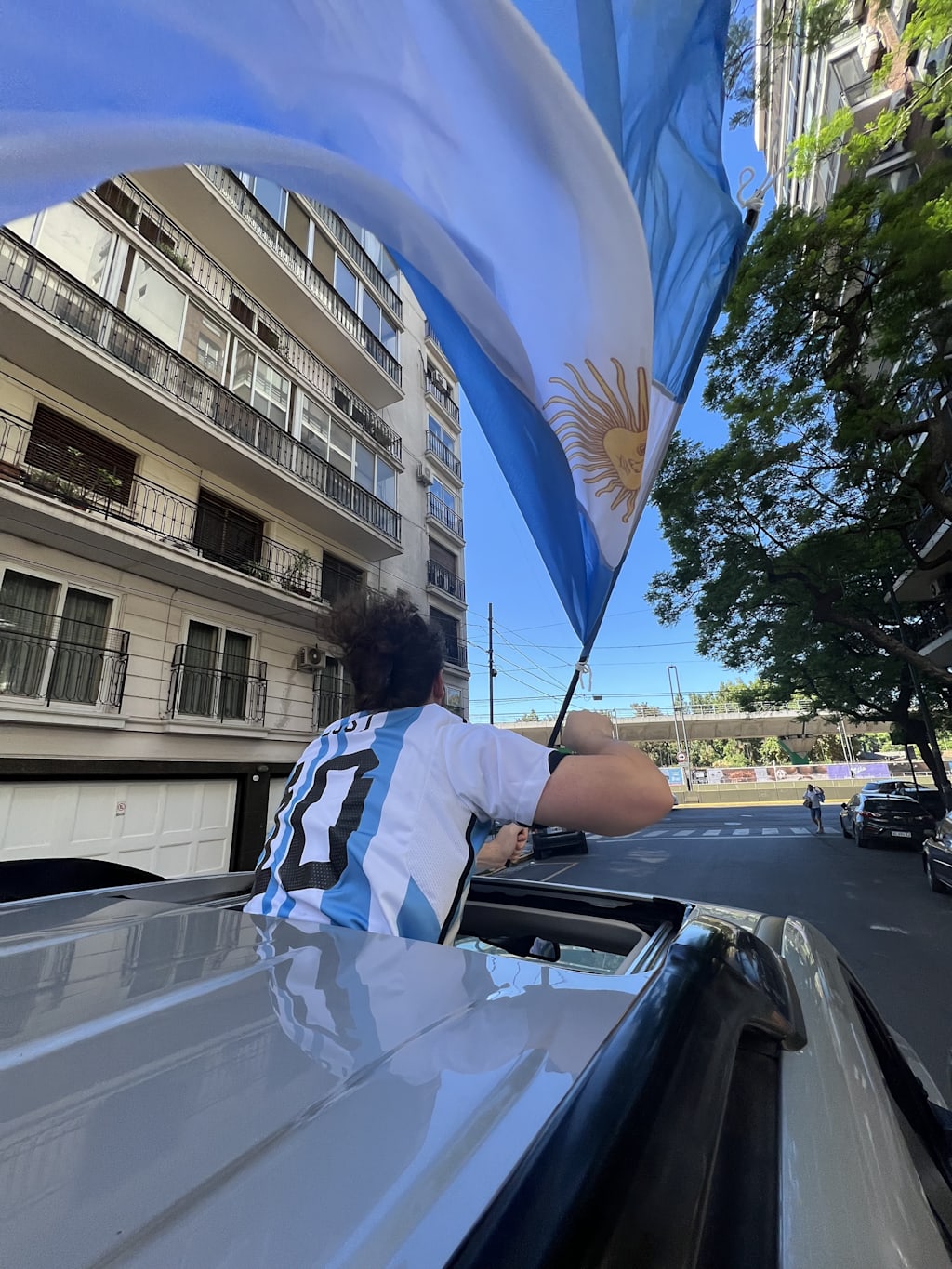
“You’re from Argentina? Like Messi?”
Those five words saved my life. It sounds insane and kinda dramatic, I know, but it’s true. A person I have never met influenced my life and health in an incredible way.
I’m from Argentina, raised there for most of my life, which, although now it’s a staple of my identity and very much part of who I am, I wasn’t so thrilled to be from when I was a kid. I wasn’t born in Argentina; I was born in the US, and that was used against me by people and even some extended family members as not “truly being from Argentina”. My parents moved back to Argentina before I was even 2 years old, so I never felt like I was from the US, either, since I didn’t grow up there. I did visit the US often since we had family there, and I eventually moved there for my studies after high school, but it never felt like I was from there since my experiences growing up had been very different from those of the kids my age. So I wasn’t “truly” from Argentina, and I wasn’t “truly” from the US. This identity crisis is one I’ve had my entire life. On top of that, I was very sensitive as a kid with unpopular tastes. I watched cartoons and anime like Pokemon and Digimon. And, because of (and now thanks to) being in between two sisters, they usually chose what to watch, so I was well-versed in very “girly” shows, which didn’t help with my already shunned tastes. I loved fantasy and would tend to space out into my own stories, and eventually got into video games. Not cool video games with guns and sports; I was obviously more into The Legend of Zelda and Mario Party. You know, baby games (we were around 10-year-old kids, by the way). This all gave way to relentless, merciless bullying from my classmates. Add the fact that I wasn’t good at football (soccer) and preferred pretending that I was a Power Ranger to playing sports, and I was basically a child pariah. Back then, not being good at football was bad, but not even choosing to play practically branded you as a leper, never accepted by anyone, constantly used as an example of what a loser was like, harassed at every given opportunity, and essentially deemed less than the rest. I liked football, always have. I even followed my favorite team, Boca Juniors. But my knowledge at the time was not sufficient, and I didn’t follow enough of the sport to even participate in conversations at school about it. This all probably sounds insane to someone who hasn’t lived in Argentina, but here, football is practically a religion. It causes arguments and instant friendships. It divides families and unites people. It is bleeding for your colors and crying with joy. It is a culture carried in the fabric of faded, sweat-soaked jerseys worn like armor, bridging generations between grandfathers who saw the golden eras and kids juggling a deflated ball in dusty streets. People would spend Sunday mornings absolving their sins in church, only to head straight to their true cathedral by the afternoon—the concrete bowl of the stadium, where the only scripture was written across the green grass in flares and sweat. You’d confess your sins on Sunday morning, just to commit a few new ones screaming at the referee by three in the afternoon. To say football is a way of life doesn’t even properly describe what the sport means to some of us. Maybe it’s because life here demands so much endurance that we need a sanctuary where we are allowed to care about something this intensely—looking to a team to hand us a victory, just to prove that triumph is still within reach, even during our darkest hardships.
Yet, as fractured as the country could be on any given Sunday by club rivalries, there was a singular magic when the national team played: twenty-four million people—different provinces, opposing neighborhoods, conflicting lives—instantly dissolving into a single, breathing organism under one banner. It was the ultimate belonging, a shared heartbeat where everyone had a rightful place at the table. This meant that a kid who wasn't a practiced scholar in the religion was prone to cruel persecution. For a kid already struggling to figure out where he fit on a map, watching an entire nation effortlessly lock arms behind a single jersey only made my own lack of a clear identity feel that much more isolating—leaving me wide open to the relentless oppression of classmates who could smell an outsider from a mile away. This painful part of my youth carried on until about 8th grade, when my parents dropped a piece of news that made my stomach drop: my dad's job was going to have us relocate to what was then called the Czech Republic. The thought of leaving filled me with absolute dread. I wasn’t just staring down a brand-new cycle of bullying in a completely foreign country—I was looking at an even wider identity gap, and worst of all, the heartbreaking loss of the only two friends who had ever made me feel safe. Facebook wasn’t a thing yet back then, kids didn’t have emails, and it wasn’t like we could make long-distance calls—they were astronomically expensive (this makes me sound ancient). Once I left, that meant that those connections were just... gone. But staying wasn’t an option, so away we went to a land where the language was stranger than anything I had ever imagined. And then came the feared first day at the new school. My potential new battlefield, where I would once again be burned at the stake for being me. In my first homeroom class came the crucible. I was asked to get up in front of everyone and introduce myself to my new potential aggressors. And so I started like I had practiced the night before about a million times to make sure I didn't mess it up.
"My name is Matias Costa, and I come from Argentina. I like a lot of things, but I'm really looking forward to learning new things and finding new activities to like." A quick, calculated speech to hide my shameful tastes and open the door to being influenced by whatever was popular with them, hiding anything that could potentially be used as a weapon against me. Immediately after I said these words, a boy in the back raised his hand (the idea behind the introduction was to open the floor for questions to better get to know the new kid. Absolutely terrifying). My palms began to sweat. This was the moment they would ask, “Well, what do you like?” And I would have to confess the reality of it all—that I was a loser kid with childish tastes and no real identity that would warrant isolation yet again. It was an isolation I wasn’t confident I could endure one more time, and a pain I had hidden from my family so as not to worry them, because the prospect of enduring that physical and psychological abuse all over again gave me constant nightmares. I looked at the boy with his raised hand and, in the most casual way my 13-year-old self could fake, I let him know I was ready for his question. He stood up and delivered the 5 words that changed me: “You’re from Argentina? Like Messi?”
At the time, Lionel Messi was a 19-year-old rising star from Argentina who was relatively new to the professional scene. But anyone who had even the smallest sliver of football knowledge had heard of him. He was the little boy from Rosario who had moved to Barcelona, Spain, to play football at the age of 13, and had just debuted for Argentina and made an impact in the 2006 World Cup. Because he had lived in Spain for a few years and was so young, he was offered the opportunity to play for the Spanish national team, but he chose to play for Argentina, a country he left as a child. He didn’t say a lot; he seemed quiet and shy in his interviews. But his Spanish was so unapologetically Argentine, it almost seemed silly to think he was anything but Argentine. The older “adult” critics and “sports experts” had already begun calling him out, looking to find mannerisms or ticks that would show him to be more Spanish than Argentine, but to many of my generation, he was an inspiration, and we could find no fault in him. I was one of those whom he inspired and was in awe every time I watched him play.
“You’re from Argentina? Like Messi?”
“Yes…” I replied wearily. I wasn’t sure about being connected to football, the source of so much of my pain back home.
“Sick!! You should come play football with us during the lunch break then!” the boy replied excitedly. I froze. One of my worst fears was materializing. I had been hurt so much by the sport during recess that I had practically come to give it up completely, making up excuses and blaming my asthma as to why I couldn’t play when that was the only option.
Not wanting to expose all this on my first introduction, I simply replied with: “Thanks, but I’m not very good. I don’t think you would want me on the team.” I just wanted to set clear expectations. I mean, being put in the same sentence as Messi already made me feel guilty.
“That’s ok; we’re not that great either,” another boy jumped in. “But I call dibs on having you on my team because, just by being from Argentina, I know you’ll summon Messi’s power and make us all play better!” My heart fluttered a bit. Something that seemed very similar to hope lit up my soul. Just because I shared my country with Lionel Messi, these two kids were willing to take me under their wing?
“I mean, if you don’t mind me being literally the worst player ever, um, sure, I’d love to play.” I genuinely wanted to play. I had feared football for so long; I missed it. But this seemed too good to be true.
“Awesome, come sit back here with us, Messi. We have to introduce you to some of the guys who will play with us. Some of the other guys are in the other class, so you won’t meet them until the actual break time, but don’t worry, as soon as we tell them you’re from Argentina, they’ll be just as excited to play with you.” Were they calling me Messi? As a nickname just for being from the same country? And other people were going to be excited to meet me just because Messi and I were from the same country? That didn’t make sense. Football had been the origin of a lot of my exclusion from school; how could this be so different here? I don’t remember much of my introduction or the classes after that. I was so preoccupied with disappointing Jeremy, the kid who asked me if I was from Argentina like Messi, during the lunch break, that I could barely concentrate during class. Until the dreaded lunch break came up. Jeremy and Joon, the guys from my homeroom class, dragged me outside excitedly, where they usually played football with even some of the high schoolers (so cool!), and they introduced me to the group as “This is Matias, from Argentina, like Messi!” That seemed like a magic word. People wanted me on their teams just because I was from the same place as Messi. It seemed surreal. I was constantly reminding people that I was terrible at the sport, but they didn’t seem to care. To them, Messi and I were practically brothers, and that was exciting for everyone.
I’d love to say that I suddenly discovered my natural raw talent and athleticism, which eventually led to a pro career as a footballer, but that is not what happened. I played terribly, as expected. But they didn’t care. To them, it was an honor to have someone from the same country as Messi. So when they asked me to pass the ball to them, they would say, “Messi, pass!” Or when they wanted me to shoot, they would say, “Shoot, Messi!” Whenever the ball got to me, I was representing Messi from Argentina. Something I learned later on is that, in International School, where you are from is a literal part of who you are because, in a foreign land, that is what gives a base to your identity. So to them, being from the same country as Messi was literally the coolest possible thing you could be.
While I obviously didn’t become a pro athlete, I did get better. And my love for the sport grew each day. I’ve coached teams, completed some academy courses, and even hosted and have been invited to a couple of podcasts. My confidence grew, my love for my country increased, and the idea of being an Argentine abroad became a blessing. As Messi’s career grew, Argentina was more and more recognized. I kept traveling, moving around, but the “Argentina? Like Messi?” comments never stopped. Messi showed humility in a sport previously considered incredibly egotistical. He built an openness in the sport that hadn’t been experienced before. He wasn’t afraid to cry in what he felt were his failures, take time away when he needed to take care of his personal health, and never gave up. Lionel Messi became a captain not just to the Argentine squad, but of the entire country. When I say Messi saved my life, it sounds dramatic. How could someone I’ve never actually met save my life? But as a young boy, being close to Messi just by being from the same country gave me courage, confidence, and self-appreciation that had previously been nothing but pain, abuse, and darkness. He gave me and many others a light to look up to. It seems exaggerated to cry because he played his final game wearing the Argentine colors, but to me, it’s seeing a hero who unknowingly protected my youth, recovered my mental health, and helped mold my identity into who I am today.
“You’re from Argentina? Like Messi?” Yes, I am. And I am so proud of it.
Thank you, Lionel Andrés Messi Cuccittini
About the Creator
Matias Costa
Always loved making up stories and adventures in my mind. Thought I'd start putting some of them on paper! (or website haha). Lived all over the world!
Enjoyed the story? Support the Creator.
Subscribe for free to receive all their stories in your feed.
Comments
There are no comments for this story
Be the first to respond and start the conversation.