
One Like, Infinite Mirrors: Ronaldo, FIFA, and the Myth of the Final Chapter
A single Instagram click—no timestamp, no caption—split into a global debate about corruption, rivalry, and the stories we need to believe.
I. The Factual Prism: A Clip from Four Days Earlier, Ripples After the Final
On July 22, 2026, the World Cup final in the United States, Mexico, and Canada came to an end, with Spain defeating Argentina 2–1. But a second wave of public debate erupted hours after the final whistle, when netizens noticed that Cristiano Ronaldo’s Instagram account had liked a clip from a Spanish television program, Espejo Público, that had been posted four days earlier.
The clip, roughly three minutes long, contained the following remarks from the host and a guest:
"Argentina is a team that should have been eliminated about five games ago. Thanks to FIFA—one of the most corrupt institutions on earth—Argentina doesn't scare me at all. What scares me is Infantino. That's how we start this morning's discussion with real energy. I don't think we're playing against Argentina; we're playing against the entire institution of FIFA. They want to give the World Cup to Messi, just like they did four years ago in Qatar. Ticket prices have turned a mass experience into a privilege for a select elite. Mass tickets? Not at all. Football is a mass sport, but it no longer is. I think FIFA is a vile, mafia-like, shameful organization. This sport survives precisely because it resists the actions of this disruptive institution. Still, we will enjoy the game—but not because FIFA provided favorable conditions."
The like was confirmed to have come from Ronaldo’s personal account, but the exact timing remains unknown. It could have occurred before the final, or after. That temporal ambiguity leaves room for every subsequent interpretation.
II. Three Forks in Motivational Logic: Every Hypothesis Has Its Shadow
Without an official statement from Ronaldo, any single attribution is speculation. But we can examine the three most common hypotheses under the light of available facts.
Hypothesis A: A Public Critique of the FIFA System
Ronaldo has repeatedly complained in interviews about congested European fixture schedules and inconsistent VAR standards. After his move to Saudi Arabia in 2023, he also spoke openly about the need for reform in European football. The program’s core criticism—corruption and ticket pricing—overlaps with Ronaldo’s long-standing grievances against governing bodies. If the like occurred before the final, it reads more like an anti-establishment gesture than a swipe at Argentina.
Hypothesis B: Unconscious Projection of Competitive Rivalry
The clip explicitly uses “FIFA favouring Messi” as its central argument. Ronaldo and Messi have competed for fifteen years, from Ballon d’Ors to Champions League titles, and any claim that Messi received extra advantage would inevitably amplify within Ronaldo’s information sphere. But this hypothesis demands evidence: has Ronaldo ever liked similar content disparaging Messi in the past? Public records show no such instance. Thus, “projection” remains an inference, not a fact.
Hypothesis C: A Common Social Media Management Error
Celebrity accounts are typically managed by teams, and accidental likes, either through mis-taps or skimming without full attention, are not uncommon in the industry. Given the heightened sensitivity during a World Cup, one would expect greater caution from a major athlete’s team, yet “slipped finger” still carries the lowest explanatory cost.
All three hypotheses coexist, and none can be definitively proven or disproven. This is the hallmark of every social media “like incident”—it provides only the action, never the context.
III. Secondary Fermentation of Opinion: Why Chinese-Language Internet Favors the “Murong Fu” Narrative
As the event rippled through Chinese social media, a highly shareable interpretation emerged: comparing Ronaldo to Murong Fu, a fictional character from Jin Yong’s martial arts novels who spends his life obsessed with restoring a fallen kingdom, while portraying Messi as the “serene one who has long reconciled with football.”
The popularity of this metaphor reveals something. It does not stem from any direct quote from Ronaldo, but rather from fans’ dramatic expectations for the “final chapter of the two superstars”: one still raging in defiance, the other already transcendent and at peace. This narrative pattern recurs frequently in sports commentary because it satisfies people’s aesthetic preference for “rivalry closure,” yet it often overlooks the complex reality of athletes as individuals.
During the 2026 World Cup qualifiers, Ronaldo averaged 1.2 goals per game; in the current Saudi league season, he has scored 28 goals. Messi leads Major League Soccer in assists. Both continue to define themselves through on‑pitch performance, not through likes.
IV. FIFA’s Shadow and the Game’s Underlying Reality
The sharpest accusation in the clip is that “FIFA wanted to hand the World Cup to Messi.” To test this charge, we need to look at the tournament data itself:
In Argentina’s seven matches at this World Cup, they averaged 61% possession and 14.2 shots per game, both ranking in the top three.
They had previously won the 2024 Copa América and the 2025 Finalissima, and their FIFA ranking remained among the top two.
In the final, Spain’s victory came from two open-play goals, and no major refereeing controversy arose.
These facts do not definitively rule out “FIFA favouritism,” but they do show that Argentina’s progression was not without competitive merit. FIFA’s corruption issues, with several senior executives convicted in recent years, belong to the institutional governance level; they do not automatically equate to match‑fixing or rigged outcomes. Conflating the two is an emotional simplification of factual reality.
V. One Gesture, Two Players, Three Mirrors
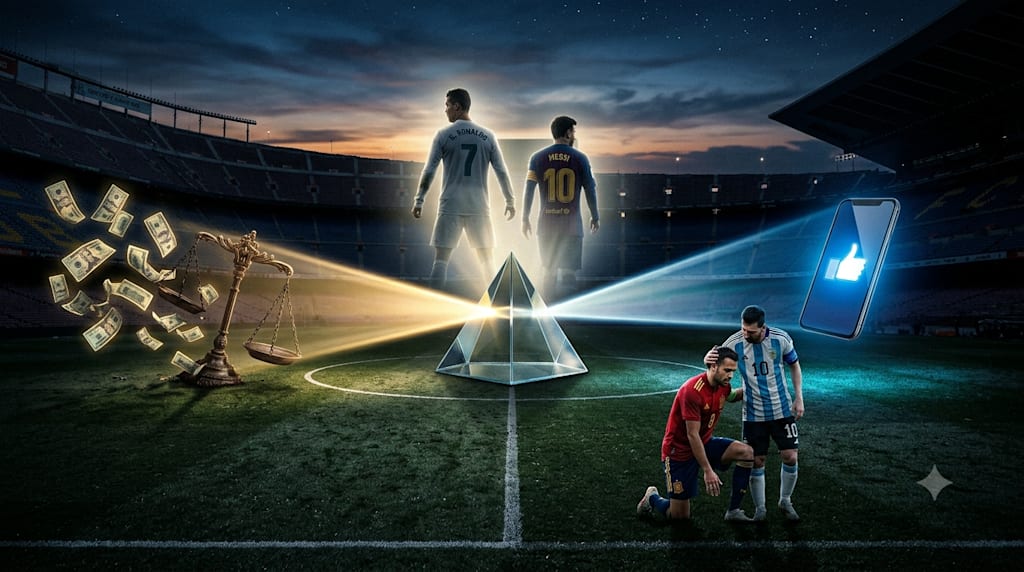
The like incident acts as a triangular prism, refracting three distinct beams of light:
The first reflects public distrust in governing institutions;
The second reflects fans’ fixation on a dramatic conclusion to the “two‑superstar” saga;
The third reflects how, in the age of social media, a timestamp‑less click can be layered with endless meaning.
But at the end of those light beams lies the pitch itself.
After the final whistle, Spain’s captain, Álvaro Morata, walked to the centre circle, knelt down, and touched the turf with his hand. Then he rose and embraced Argentina’s Lionel Messi. The gesture lasted less than two seconds. No words. No explanation.
Those two seconds were closer to football than any like could ever be.
About the Creator
Jin
Writer of reamstories
https://reamstories.com/jin
Enjoyed the story? Support the Creator.
Subscribe for free to receive all their stories in your feed. You could also become a paid subscriber, letting them know you appreciate their work.
Comments
There are no comments for this story
Be the first to respond and start the conversation.