
Messi at 38: I Have No Idea What´s Going to Happen. Neither
And honestly? that migtht be the best thing about this World Cup

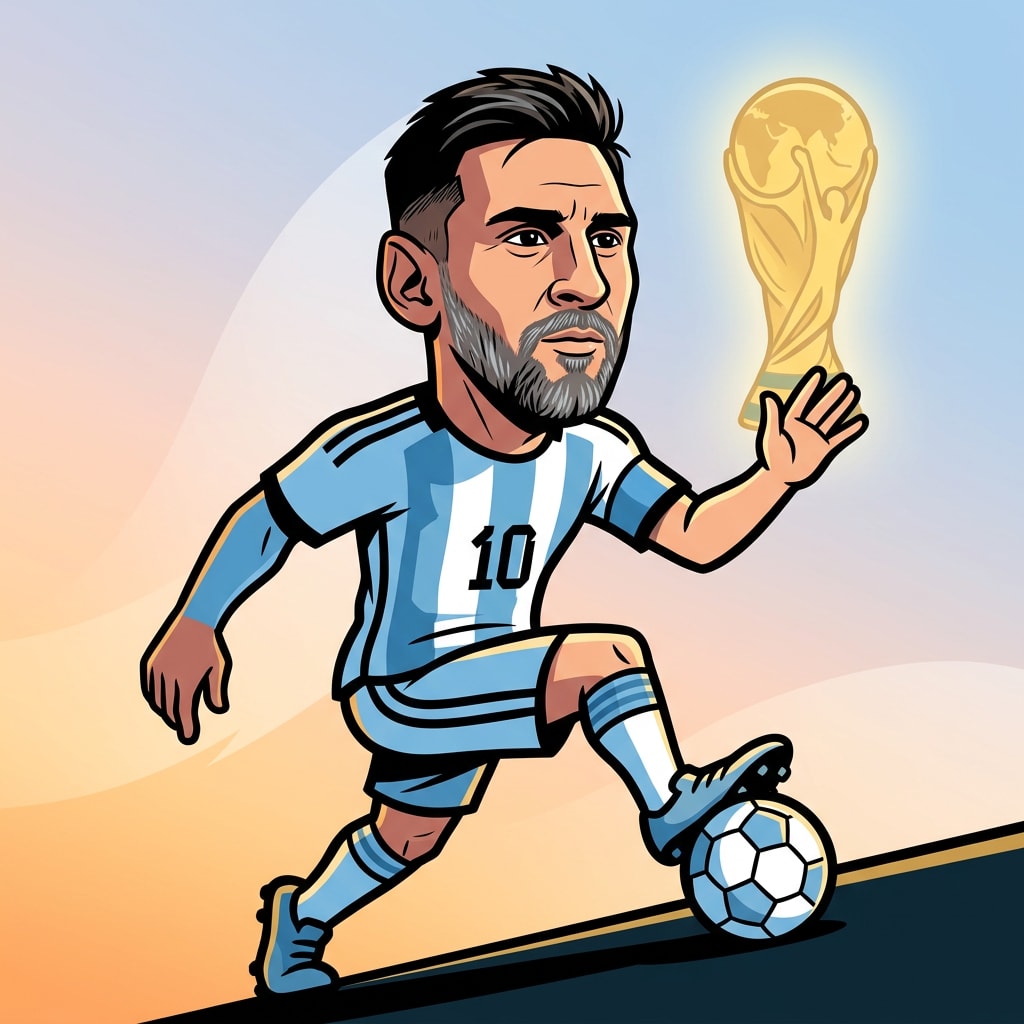
My neighbor growing up — this was in the late nineties, I'm dating myself here — had a poster of Ronaldo on his wall. The Brazilian one. R9. And I remember thinking even then, as a kid who barely understood the offside rule, that there was something almost unfair about watching him play. Like the sport had been calibrated for everyone else and then this one guy showed up and broke all the math.
I thought about that poster a few weeks ago, sitting in a bar watching Inter Miami highlights on a screen above the beer taps. Messi picked up the ball near midfield, took two touches, looked up, and played a pass that didn't make sense until the striker was already through on goal. The bar wasn't even watching. Sports bar, Friday night, nobody looked up.
I don't know why that bothered me so much. But it did.
What Argentina Actually Won in 2022
Here's something I think gets lost in all the coverage of Qatar: Argentina didn't just win a World Cup. They ended something.
Thirty-six years of a specific kind of suffering that doesn't really translate well if you haven't grown up inside it. It's not like losing a championship and waiting for next year. It's more like — okay, I'll try. It's like your whole national identity being tied to a promise that keeps almost coming true. 1990 final, lost to Germany. 2014 final, lost to Germany again. Messi on the field both times, brilliant both times, not enough both times.
By the time Qatar came around there were people in Argentina who genuinely believed the tournament was cursed for them specifically. I'm not being dramatic. I talked to an Argentine journalist in 2021 who told me, dead serious, that she'd stopped watching penalty shootouts because she couldn't take it anymore. She watched the 2022 final from her kitchen, listening, not looking at the screen.
When it ended she cried for an hour. That's what winning meant.
So when people ask what Messi goes into 2026 trying to prove — the honest answer is nothing. He doesn't owe anyone anything. The debt, if there ever was one, got paid in full in Lusail.
The Weirdest Part of Defending a World Cup
Okay so I looked this up because I kept hearing about the "defending champions curse" and wanted to know if it was actually real or just the kind of thing people say.
It's kind of real? France won in 1998, went out in the group stage in 2002 without scoring a goal. Brazil won in 2002, lost to France in the quarterfinals in 2006. Italy won in 2006, group stage exit in 2010. Spain won in 2010, group stage exit in 2014. Germany won in 2014 — group stage exit in 2018.
That's five consecutive defending champions failing to make the knockout round. Five.
The reasons are different every time. Complacency, fatigue, age catching up with key players, the opposition having four years to study your system. But the pattern is there and it's uncomfortable to look at if you're an Argentina fan heading into this summer.
What's different about this Argentina squad — and I genuinely believe this, it's not just optimism — is that Scaloni built something more resilient than a team built around one player's brilliance. The 2014 Argentina, the one that reached the final in Brazil, basically ran on Messi carrying them through games they had no business winning. That's an exhausting way to exist in a tournament. You're always one bad Messi day from going home.
This group has De Paul running box to box like he's personally offended by the other team. Mac Allister doing things in midfield that made Liverpool pay serious money for him. Emiliano Martínez, who is genuinely one of the best goalkeepers in the world right now and who has a psychological relationship with penalty shootouts that I find slightly terrifying. This is a squad, not a one-man show with backup dancers.
That matters. A lot.
On the Subject of Being 38
I turned 38 last year. I'm not going to pretend I can relate to Lionel Messi's physical condition in any meaningful way — I pulled my hamstring playing five-a-side with people who are mostly accountants — but I do have a new appreciation for what it means to ask your body to keep doing something it's been doing for two decades.
Messi at 38 is not Messi at 27. That's not a criticism, it's physics. The guy who used to take on four defenders in a straight line doesn't do that anymore. He doesn't need to. He's figured out how to get to the same result using about sixty percent less effort, which is either the sign of a declining player or the sign of someone who's become so intelligent about the game that the physical diminishment barely registers.
I lean toward the second one. Watching him at Inter Miami — and I've watched a lot of Inter Miami games at this point, which tells you something about either my dedication to research or my personal life — he plays in these small pockets of stillness that suddenly become catastrophic for the other team. He's never where the pressure is. He's always where the ball needs to go next.
The genuine concern is injury. Not performance — injury. A hamstring, a knock, a knockout stage game that goes to extra time when he's already been playing through fatigue. At 38 the margin for that kind of thing is smaller. That's the real variable nobody can calculate.
A Thing About Rosario
Leo Messi grew up in Rosario, which is Argentina's third largest city and which, depending on who you ask, also produced Che Guevara. Make of that what you will.
I bring this up because there's a version of the Messi story that I think gets told wrong a lot in English-language coverage. The version where he's this almost alien talent who showed up fully formed and glided through a career without friction. That's not really accurate.
He left Rosario at thirteen. His growth hormone deficiency — the condition that Barcelona famously agreed to treat in exchange for him joining their academy — meant that without intervention he would have been too small to play professional football. His entire career almost didn't happen. He moved to Spain as a kid, essentially alone, in a country where he didn't have family around him, playing in a system that was explicitly grooming him to represent Spain internationally if Argentina didn't claim him first.
The fact that he ended up lifting the World Cup for Argentina in 2022 has a kind of narrative completeness to it that I don't think we fully appreciate. The kid who had to leave to get the treatment that let him play came back, eventually, and won the thing. That arc is real. It wasn't inevitable. It almost went sideways a dozen different times.
I think about that when people ask whether 2026 matters in terms of legacy. His legacy isn't a trophy count. It's that whole story. The trophies are just the evidence.
What I'm Actually Watching For
I'm going to be honest about what I want from this tournament, personally, as someone who has watched more football than is probably healthy.
I want a moment. Not necessarily a goal — though obviously a goal would be great — but a moment where Messi does something that makes the broadcast team go quiet for a second because there's nothing to say. Those moments are rarer now than they used to be, but they still happen. They happened in Qatar. That chip over Lloris in the final. The way he moved in the semifinal against Croatia, when he just looked like the best player who had ever lived, at thirty-five, in the most pressurized environment in football.
If this is the last World Cup, I want one of those. Something to remember him by that isn't just a highlight reel or a Wikipedia entry.
But I also want — and this is maybe a stranger thing to want — to watch him play badly in at least one game. A game where the legs aren't there, where he's getting closed down and can't shake it, where Argentina has to win without him. Because that would be honest. That would be the real picture of what this tournament is, a man at the very edge of what his body can still do, trying one more time, not guaranteed anything.
That's more interesting to me than a coronation.
Nobody Knows
There's a particular kind of Argentine football fan — I've met a few — who approaches the question of Messi with something that's almost closer to love than to sports fandom. Not admiration. Love. The kind that makes you nervous on his behalf.
They're the ones who've been watching since Messi was nineteen and running at defenders for Barcelona like the laws of motion didn't apply to him. They've watched thirty seasons of league football, four World Cups, the Copa América wins, the losses, the near misses, the years when it seemed like he was carrying the weight of an entire national self-image on a set of shoulders that were, by any objective measure, not particularly large.
Those fans are the ones who will watch every minute of every Argentina game this summer. Not because they need Messi to win something. Because they want to see him one more time, at this level, in this competition, playing the game he's been playing since he was a kid in Rosario who was too small for anyone to take seriously.
I get that. I understand it completely.
The ball will be at the center of the pitch. The whistle will blow. And Lionel Messi — at 38, as the defending champion, in the last World Cup he will almost certainly ever play — will do what he has always done.
He'll find the space nobody else sees. And then we'll find out what happens next.
Neither of us knows yet. That's the whole point.
About the Creator
ELIAS PULIDO
Storyteller by necessity. The best stories don't live in headlines — they live in the details nobody notices. I write about people, ideas, and the moments when the world shifts direction. Sometimes without anyone realizing it.
Enjoyed the story? Support the Creator.
Subscribe for free to receive all their stories in your feed.
Comments
There are no comments for this story
Be the first to respond and start the conversation.