
He Barely Touched the Ball, Yet Won the Golden Glove — The Unai Simón Paradox
A journalist called him a “curiosity.” But the stats only tell half the story. Here’s why Spain’s goalkeeper did nothing, and everything, at the same time.
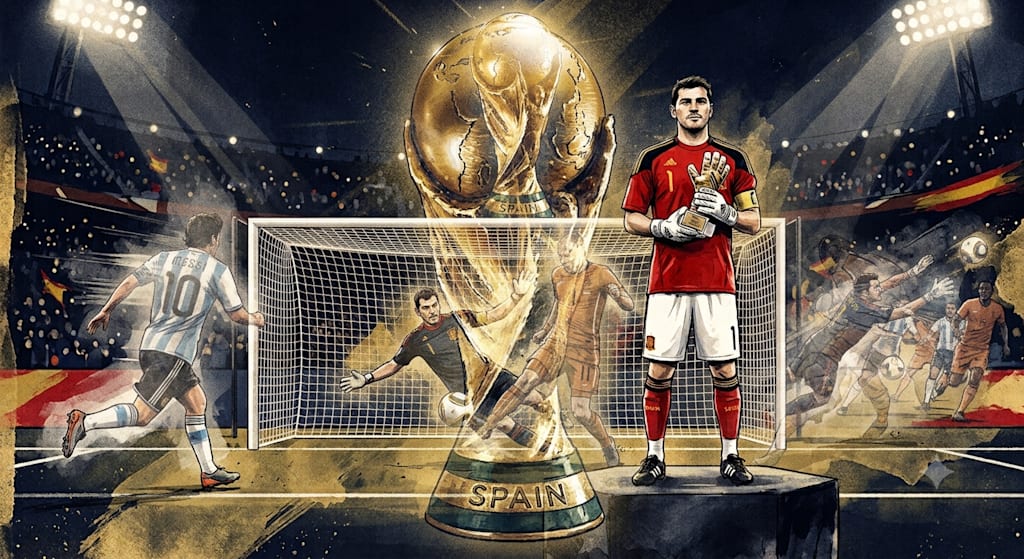
A “Lazy Man” Took the Golden Glove
Spanish journalist Javi Miguel typed a line on social media.
“Unai Simón wins the World Cup’s Best Goalkeeper award, but throughout the entire tournament he made no more than four saves, and in the final there wasn’t even a single shot on target. A curiosity from FIFA.”
When he typed the word “curiosity,” he probably thought he had just exposed a joke.
Looking at the stat sheet, Simón indeed didn’t look like a “best goalkeeper.” Throughout the World Cup, Spain conceded only one goal in eight matches, but Simón’s official save count stood at just ten, ranking 20th among all participating goalkeepers. In the final against Argentina, over 90 minutes, the Argentine side didn’t even manage a single shot on target. Simón stood between the posts, his gloves barely touching the ball.
Next door, Emiliano Martínez was saving penalties; Simón was taking a stroll.
If “best goalkeeper” equals “most saves,” then the award was indeed given to the wrong person.
Three actions that weren’t counted as “saves”
Fifth minute of the final.
Argentina threaded a through ball through Spain’s defense, and Messi ran clear of the offside trap. The ball rolled in his path, about 40 meters from goal. Messi was already accelerating. With his feet, he could do many things: chip the keeper, round him and push into an empty net, or simply drill it into the far corner. Give him half a second of adjustment time, and the scoreboard could have changed.
Simón had already moved before Messi even received the ball. He charged out of his goal, lowered his body, and lunged toward Messi’s feet. He didn’t stretch out his hands, didn’t make a diving save—he simply used his body to seal off the angles. Messi was forced toward the touchline, and the ball was cleared out of play.
When the overhead replay came on, the picture was clearer: behind Simón lay a wide‑open goal. If he had started just 0.5 seconds later, Messi would only have needed a gentle nudge to slot into an empty net. But Simón didn’t give Messi those 0.5 seconds.
In the 27th minute, Álvarez broke the offside trap for a one‑on‑one. Same scenario, same solution. Simón reached the ball’s landing spot half a second earlier than Álvarez and slid to poke it out for a throw‑in.
During first‑half stoppage time, Martínez launched a long ball from the back to find Álvarez. If the “Spider” controlled it, it would be another one‑on‑one. Simón burst out of his area for the third time, and for the third time he neutralized the threat before the opponent could get a shot off.
Three charges, three one‑on‑ones snuffed out.
Not one counted as a “save.”
The stat sheet stayed clean. Argentina’s attacking stats read: zero clear‑cut chances.
When you have work to do, that’s the disaster
The Spanish journalist complained that Simón “had nothing to do.”
Turn that around and it makes perfect sense: Simón had nothing to do because Spain’s defense was doing its job. If he had been making save after save, it would have meant Rodri was being overrun and Spain’s possession system had collapsed.
Simón’s most striking statistic from this tournament wasn’t his save count—it was another number: 22 sweeper‑keeper interceptions, the highest among all goalkeepers. He frequently stormed out of his box, defending with his feet. His range covered both flanks outside the penalty area, and every opponent’s attempt to break the offside trap was stifled at the very moment it began.
The price of a high defensive line is space left behind. Spain’s midfield trio pinned Argentina deep, leaving acres of open ground behind them. Simón was the man patrolling that open ground. His workplace wasn’t the goal line—it was the grey zone just behind his defenders.
His only mishap came against France. He rushed out to challenge Mbappé, won the first ball, but the second fell to Désiré Doué. Facing an empty net, Doué hesitated and didn’t shoot. That moment of hesitation preserved Simón’s clean‑sheet record.
Someone joked: “Doué’s hesitation hesitated Simón’s Golden Glove into existence.”
The flip side of that joke is this: a sweeper‑keeper walks a tightrope by nature. Simón walked the full length and never fell off.
How the Golden Glove is decided
This award isn’t calculated by Excel.
FIFA’s Technical Study Group—a panel of former coaches and players—sit together, watch matches, and vote. They don’t judge solely on “saves,” but on “overall contribution to the team.” Goals conceded, clean sheets, success rate of interventions, distribution, match impact—all count. But how these are weighted has no fixed formula.
So the selection always carries a subjective tint.
If we looked only at save numbers, the tournament’s busiest keeper was Cape Verde’s Vozinha, who averaged over four saves per game. His team went out in the group stage. Giving him the Golden Glove with the reasoning “he saved a lot of balls” would sound odd, to say the least.
What Simón had on his résumé: seven clean sheets, 650 minutes without conceding—a World Cup record—and a World Cup trophy on top.
Historical experience tells everyone: the Golden Glove almost always goes to the champion team’s goalkeeper. It’s not a written rule, but a voting inertia. When a keeper sets a historic shutout record and lifts the trophy at the same time, it’s hard for the panel to vote for anyone else.
Simón’s award is not a failure of the selection system. It’s the normal extension of that inertial logic.
Two kinds of goalkeepers
This controversy boils down to one question: how should a goalkeeper be measured?
One view: a keeper’s job is to make saves. Diving, fingertip stops, penalty heroics—these are the essence of the position. Martínez’s penalty‑saving performances are the textbook example of this aesthetic. By that standard, Simón hardly ever appears in highlight reels. His footage is mostly “charge out, clear, get up, walk back.” Not flashy enough.
Another view: a goalkeeper’s highest form is to prevent the opponent from even shooting. Killing the threat before it becomes a shot is cleaner than having to save it. Simón’s style is the ultimate expression of that logic. He does his job so thoroughly that the untrained eye can’t see what he’s done.
Both views have merit. But on the World Cup final pitch, the latter one won.
When Simón went up to receive his award, the entire Spanish defense stood behind him. Rodri patted him on the back. Luis Enrique nodded from the technical area.
The Basque man stepped onto the podium, the Golden Glove in his hands, a slightly shy look on his face. He probably knew people would gossip about him winning it. But he also knew something else: that Spanish journalist who kept complaining he “had nothing to do”—when the final whistle blew, what came out of his mouth was “We are champions.”
As for “glorious deeds” versus “doing nothing”: on the base of the World Cup trophy is engraved Spain’s name, not a save‑stat sheet.
About the Creator
Jin
Writer of reamstories
https://reamstories.com/jin
Enjoyed the story? Support the Creator.
Subscribe for free to receive all their stories in your feed. You could also become a paid subscriber, letting them know you appreciate their work.
Comments
There are no comments for this story
Be the first to respond and start the conversation.